

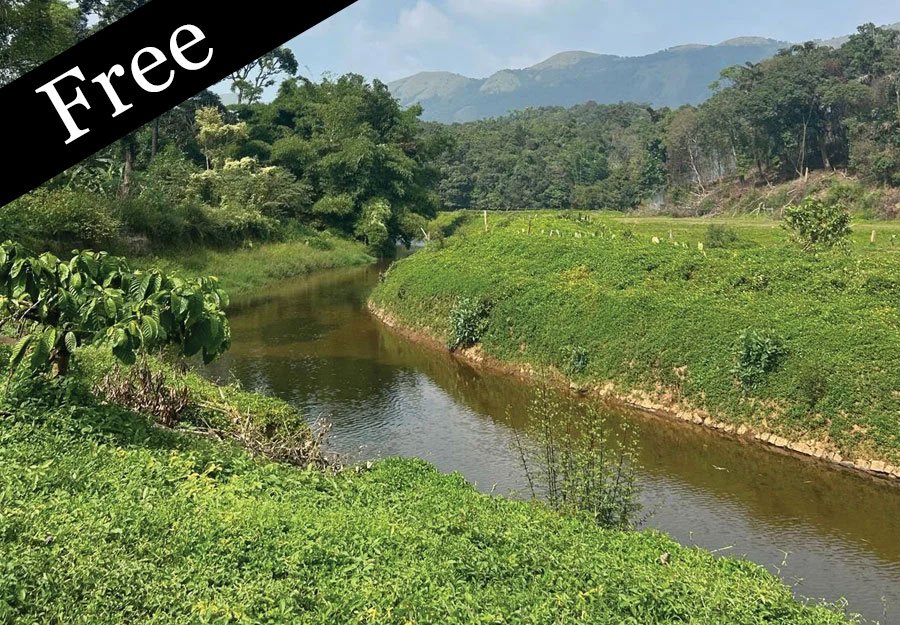
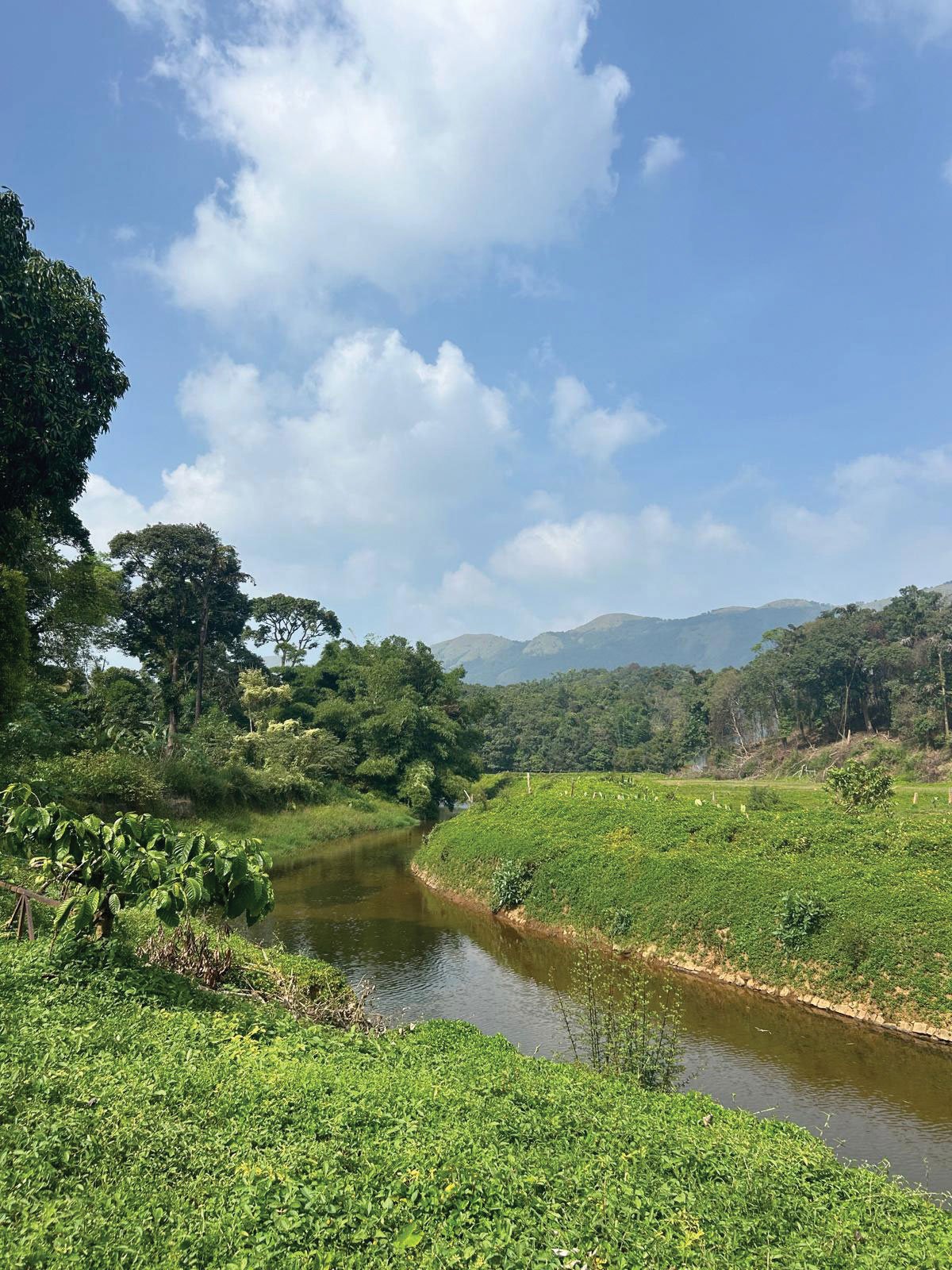
I first met the Kaveri in story.
She is the river, the Goddess, that my paternal grandmother was named after and lived alongside. I have never seen the river the way she has, but there is an intimacy (or perhaps a deluded intimacy) in imagining the river through her eyes. Places and entities are turned both real and ethereal through family narration. We grasp at it, because in unknowing—and destruction—that’s all we have.
How many places exist only in narration because today they are lost, or they are not as they were?
Jayasri Sridhar coins an apt neologism for this sentiment in Science Gallery Bengaluru’s trilingual glossary on the Kaveri—River Landscapes: Reimagining the Kaveri:
Ajnabaqt—noun
The way development creeps up around you in that inevitable yet saddening way, observed especially when visiting a hometown or ancestral village you live away from; a sense of time having passed in a way you cannot retrieve.
—The sheer ajnabaqt of the phut-phut-phuting auto-rickshaws and the vanished parijat tree choked her.
I have never met the Kaveri waters that cradled Srirangam, the island home of my grandmother, but if I visit, I am almost certain that a sense of ajnabaqt will weigh heavy on me. The horror of ajnabaqt hangs over me in thinking about the river, in writing about the river. But it does not crush me; I am also buoyed by memories and stories of the rivers’ beauty.
When my dad speaks of Tirichippalli, or specifically, the island neighbourhood Srirangam where his mother grew up, it’s the Kaveri and the Ranganathaswamy Temple he describes. Places he himself has not seen, but entities relayed to him through his mother’s stories. Sites of constant return around which daily life centred. After getting married and moving to Mumbai, she never returned—but she longed to. That longing transferred on to her children, and now I, too, hold that yearning in my bones, aching to see the waters as she did.
Her daily morning routine was to bathe in the joyous flow of the holy river, then offer prayers at Sri Ranganathaswamy temple—the largest functioning temple complex in the world at 156 acres. The river was the basis of life, a home of sorts. It cleansed her, provided drinking water, fed the lush surrounding forests, and, together with the Kollidam river on the other side, enveloped her island home.
From the Kaveri glossary, I show my dad Sridhar’s poem titled ‘Aadi Perukku’. He is pulled back into memories of his mother repeating this phrase and speaking of this festival that ushers in the monsoon. In great excitement, people would rush down to the river to see it swell and replenish the lands, and seek blessings from the gods.
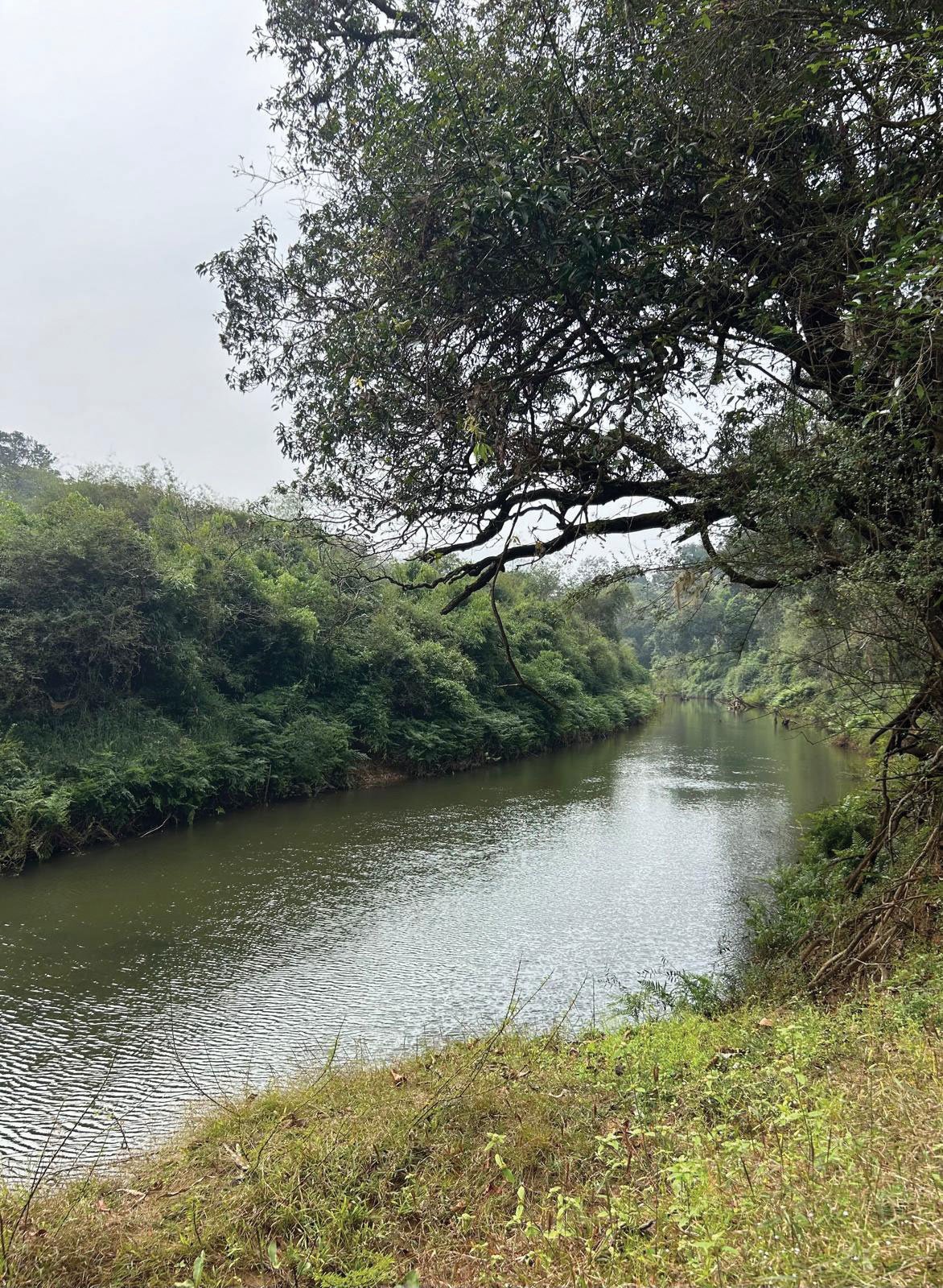
In 2024, I went on a family trip from Melbourne to Mumbai, where most of my paternal family live. While we originally planned to visit Tirichippalli, we swapped our Tamil Nadu itinerary for Karnataka at the last minute due to weather issues and road-tripped from Mangalore to Humpi, meeting the Kaveri along the way in Coorg and through its tributary, Kabini.
I followed the path of Kaveri through serene forests and coffee plantations in Coorg, watching tadpoles swish collectively. At the river’s origin, Talakaveri, I was overtaken by the awe of the mountaintop overlooking a lush sprawling forest shrouded in distant hazy fog. I have seen the sun rise over a mist-covered Kabini, birds perched atop protruding trees, spotted deer rambling along the shore. I have dipped my legs into Kaveri’s clear and gently swirling currents at Sri Bhagandeshwara Temple, a confluence of three rivers: Kaveri, Kanika, and Sujyoti. Resplendent in the sun, the river’s company exuded a deep calm and care. I felt my feet swelling, the river seeping under my skin, nurtured by Kaveri.
Kaveri is long washed away from me but I am grateful to have an embodied knowing of her now. It is easy to slip into idealising the river, to speak of her myths, beauty, and wonder. Kaveri is majestic, there’s no denying that. But I have only met Kaveri in nostalgic stories and had the freedom to bask in her beauty as a visitor, then disappear back to the comforts of my Melbourne life. I have not tended to this river, witnessed her ghosts, or the brutality that those living intimately with the river know. That is a different knowing.
Beneath the beauty of the river that I was privileged to encounter, something darker was lurking out of sight.
In early 2026, three of my aunties—three sisters (my dad’s cousins, my grandmother’s nieces)—make an ancestral trip to Srirangam. They seek out the revered temple, distant relatives, and, of course, the river. They lament that it’s not what it once was. It has dried up. Ajnabaqt.
The grand temple-town of Srirangam was once believed to be a utopian island mirroring the cosmos, filled with vibrant forests and a way of life deeply in tune with the water’s patterns. A key site during the Chola era, it was a hub of spiritual, social, and cultural flourishing. The Chola Empire was built around the Kaveri delta which stretches out across current day Tamil Nadu. Dubbed the “Ganges of the South”, and “Ponni (the golden one)” in Tamil literature, the Kaveri is a lifeline for millions, holding deep cultural significance; she is a sustainer of wildlife, livelihoods and agriculture, temple towns and communities.
Kaveri was born deep in the Brahmagiri Hills in Karnataka, overlooking the western ghats. Fed by rainwater, the Kaveri emerges as a spring in monsoon season, at Talakaveri. Flowing from Karnataka to Tamil Nadu with its tributaries running through Kerala and Puducherry, it eventually releases out into the Bay of Bengal. Before reaching Tirichippalli in Tamil Nadu, the river splits into the Kaveri and Kollidam rivers to encircle the island neighbourhood, nurturing its vegetation and providing for all beings.
Today, Srirangam, by definition, is no longer an island. River beds have dried up and the Kaveri has been restricted by dams around the region, while the Kollidam is dry and used as a floodplain in case of an overflow. Water wells within homes have become unusable, sewage encroaches on the temple-town, forests have been replaced by agricultural land and people reliant on the river have been displaced.
Even if I were to visit Srirangam, I will never see the Kaveri the way that my grandmother saw it, in all its radiant abundance.
The Kaveri, along with several other rivers in India, are battling their own scarcity and degradation. They are forced to endure a cruel combination of many forms of extraction: mass urbanisation, industrialisation, pollution, tourism, poor infrastructure, unsustainable water practices, and both illegal and legal dumping of waste and industrial effluents. The climate crisis has brought on severe droughts and changing rainfall patterns, causing significant shortages in reservoirs and other water catchments, affecting access to drinking water and irrigation for many.
Perhaps most eerily and heartbreakingly (although not surprisingly), colonial legacies continue to shape the river’s health. Under British rule in the nineteenth and early twentieth century, the river’s value was reduced to capitalistic output. The British Raj and the East India Company attempted to control, redirect, increase flow, and extract maximum productivity from the Kaveri. By building dams, canals, and other irrigation systems, colonial rule drastically increased agricultural output. While the Chola dynasty had previously built irrigation systems and agriculture was a significant source of wealth, the river remained vibrant and healthy. People lived in relationship with the river, it was not a dynamic of domination and over-extraction. In ‘Indian Rivers, Productive Works, and the Emergence of Large Dams in Nineteenth-Century Madras’, published in 2021 in The Historical Journal, Aditya Ramesh posits that Kaveri became one of highest revenue-generating regions in the Indian subcontinent under the British Raj. Control of the Kaveri was at the centre of controlling the natural landscape of South India and, by extension, warping communities’ relationship with water and the land.
In Benjamin Murphy’s essay for the Kaveri glossary, ‘Let Her Dance: Decoloniality and the Need for a Flowing Kaveri’, he argues that “by regulating the directional flows of the Kaveri, the Raj successfully altered all future generations’ relationship with Kaveri. What was once a relationship of respect, care, and worship became one of extraction, resource management, and attempts to control.” In the colonial hangover, these ways of being and relating are still pervasive, and the river’s degradation is exacerbated by further construction of waterways, excessive bore wells, pollution, and untreated sewage and effluents.
The Kaveri knows deep sorrow. She’s intimately acquainted with droughts, floods, invasions, manipulation, greed, death, excess. She has become a deathbed for fish found rising to the surface. She has watched otters lose their homes as sand continues to be over-extracted. She mourns the loss of over 40 per cent of her native aquatic species (Indian Council of Agricultural Research). In the city of Erode she is forced to consume 35 to 40 million litres of sewage daily—the large majority of it untreated. She watches the illegal sewage dumping go undetected. In an interview with The Hindu, M Thangaraj, president of the Tamil Nadu Iyarkkai Vivasayigal Munnetra Sangam, shared that illegal sewage dumping is denied and hidden with well-timed releases that dilute sewage before it can be detected. She has seen irrigation canals so polluted that they cannot support agriculture. Helpless, she has painfully observed farmers develop skin conditions from working with this contaminated water. She has been a silent witness as crops perpetually fail, farmers struggle to make ends meet, and they take their own lives. Between 2023 and 2025, 2,809 farmer suicide cases were reported in Karnataka.
Lives are lost as parts of Kaveri herself disappear. The river experienced a 28 per cent decline in streamflow between 1951 and 2012, according to a study published in Earth’s Future by Dipesh Singh Chuphal and Vimal Mishra. The study also predicted a 3.5 per cent decline in Kaveri’s waters between 2026 and 2050, whereas floods are expected for rivers in the north. Most likely, this percentage will actually be higher, as the study focused on climate-driven changes and did not account for human interventions such as irrigation and dams, which could worsen the projected shortages.
So, can we hold hope in the Kaveri? In the river’s longevity and abundance?
There is discourse brewing and initiatives in development, stories spreading, contestation, research, activism, calls for policy change and action. Earth5R, a UNESCO endorsed sustainability initiative, outlined key measures to be undertaken to work towards revitalisation of the Kaveri, including installation of sewage treatment plants to reach an ultimate goal of zero untreated sewage, waste-to-recycling circular economy solutions, ecological restoration, pollution control measures, community engagement, and transparent real-time data monitoring. There are structural and organisational obstacles that have prevented initiatives from launching at a broad scale, but there is movement.
In 2017, New Zealand granted legal personhood to one of its most sacred rivers, the Whanganui River. This means that the entire river system—tributaries, forests, the wildlife, and “its physical and metaphysical elements”—has its own rights, duties, and liabilities as a legal person, “reflecting the view of the river as a living and integrated whole”. The core idea is that a river has a right to exist and thrive, unpolluted and undamaged.
Two of India’s most sacred rivers, the Ganges and the Yamuna, were also recognised as living entities with full legal rights three days after New Zealand’s decision. However, this was soon contested and retracted. What chance, then, is there for the Kaveri? And even if it were to be granted legal personhood, would policies and practices actually uphold these principles?
In all the stories about the origin of the river goddess, of Kaveri Mata as she is fondly known, she is selfless and ever-giving. In one version, Kaveri marries a sage under the condition that if he should leave her, she would become a river as she had long yearned to be. The sage tries hard to keep his promise but one day, he gets stuck in philosophical discussion and she makes her escape, fulfilling her desire to serve the world. Kaveri has a single noble aspiration to serve the people and the land. Does that make it easier to extract from her? Are the river’s life-giving powers taken for granted, in the way a mother’s giving is assumed?
Does the mother and goddess archetype also not generate reverence and nurturing in return? This is not to discount the countless people who do revere and care for the river; the problem is larger and systemic. It requires much work to undo the work of those who don’t revere the river.
Your fate is uncertain, but attention and urgency has been increasingly turning towards you. The Kaveri glossary, of which Sridhar’s neologisms and poem are a part, is a collective work of essays, art, poetry, and storytelling that creates a “point of confluence” by providing a multi-faceted encounter with one of India’s most vital rivers, “insist[ing] on thinking with the river rather than about it”. In broadening understandings and histories of the river, it pushes language, “where a dam becomes a wound, a flood an archive, a riverbank a classroom, a dispute a sedimented history”. Projects like this give the river life and character beyond water disputes, ideals of beauty, and declining water levels. Of course, that, too, is part of the river’s story, but there is more and it is ever-changing and contradictory, which the glossary makes space for. While I flail in my unknowing, yet dually reach for connection to this river, it is projects like these that give me hope, that fill the gaps, and help me step into a sense of ‘janupnadi’.
There is a tenderness I feel, a sense that I am informed by the river. ‘Janupnadi’, another neologism defined aptly by Sridhar, conjures a deep aqueous interconnectedness and shared lineage. When I first shared space with the gently flowing Kaveri, I intrinsically felt this notion but fumbled to grasp at words.
Janupnadi—noun
The idea of people as tributaries to rivers, the various ways we end up in them and join something of ourselves in their flow.
—While the janupnadi of this river is particularly noxious, some others in these parts still have reverent, even ancestral janupnadis.
Many indigenous communities centre water in their worldview and have a version of a ‘janupnadi’ or the idea that we are deeply connected to bodies of water. A Māori greeting “Ko wai koe?” asks who you are, or, more literally, who are your waters, reflecting the idea that we are defined by place. If I am claiming ancestral ties with the river, I want to know Kaveri intimately.
If my grandmother’s Kaveri exists as fragments of stories relayed to me, then you, or as you were in Tirichippali, exist as fragments in fragments. A story within a story, further frayed by time and distance and the baton passing down to another pair of hands, further away from the source. But the baton is passing, your stories are alive.
When I meet you again and my yearning finds a landing place and I am held in your currents, I am seeking a deep knowing. It won’t be the same as my grandmother’s but I hold the stories, and I am building my own relationship with the river.
I hope to meet you again in the depths of your glory, in your cascading waterfalls, your abundant flows, the thriving forests you feed, the joy you witness, the lives and communities you sustain. While parts of you appear dire, other parts thrive. You persevere, unrelenting despite brutal extraction. But I sense that you are tired.
I hope, too, that I have the courage to witness your ghosts: your dried riverbeds, the polluted waterways, the trails of destruction. I hold a third hope that you will be revitalised, your ghosts resurrected, your water running clear; people will live with you and care deeply for you. Is it too much to hope that you can live without exploitation and self-serving extraction? Is there hope for that in this lifetime?
For now, though, I am not afraid to know you in your entirety: your suffering, your wonder, who you once were, and the potential of what you could be. I hold your stories, the fragments that they are, and know that they are part of a larger whole. They are a fraction of what you can be and I am privileged to have met at least a fraction.

More from Mekong Review
-

Nothing happens in Salt Lake, and that's all right.
-

Snacking in Calcutta
-
After years of internet disruptions, a generation of Kashmiri cricket commentators is turning village matches into digital broadcasts, and building livelihoods through a connection they once lived without
- Tags: India, Issue 44, Monique Nair
