

Many buffalo killed. It was very nice,” said the slight French man at dinner.
His wife nodded. “Yes, very nice. Lots of blood.”
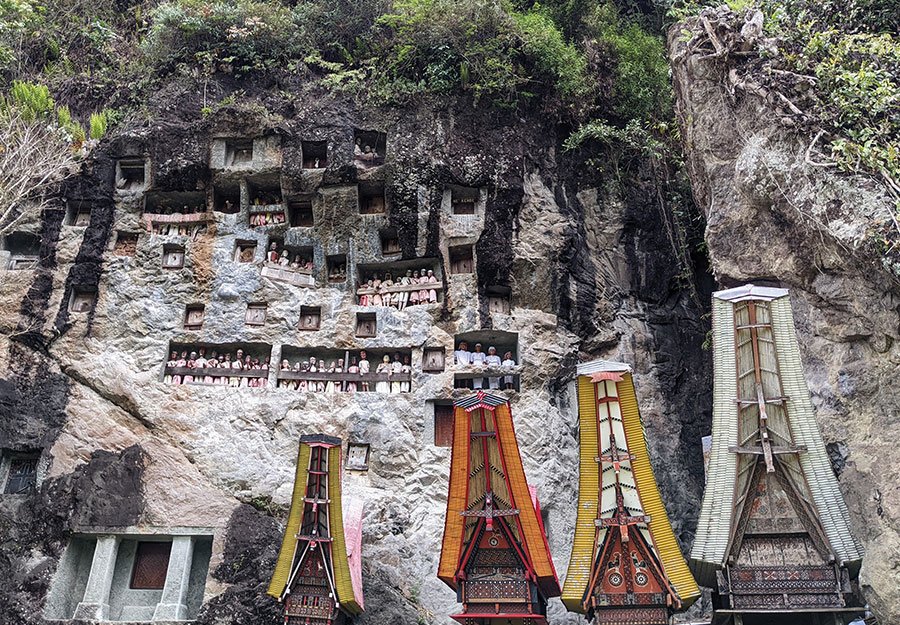
We were sitting at the table at Meyske’s homestay in the Tana Toraja highlands of Sulawesi, Indonesia. Meyske had taken them to a slaughtering ceremony—one stage of a multi-day Toraja funeral. Depending on the wealth and status of the family, anywhere from tens to hundreds of buffalo are killed, on specific days during the funeral period, to guide the dead into the afterlife.
I had opted out. Gore makes me queasy and something about going felt voyeuristic. I wasn’t sure where the line between attending out of a curiosity to learn versus relishing the spectacle might be. Regardless, “nice” didn’t feel like the right word. Then again, the couple’s English was limited, and it’s easy for a native English speaker to judge.
To get here, we’d flown from Bali into a landscape that already felt different. As the plane descended, I could see why the Portuguese first mistook Sulawesi for several islands; each octopus-like arm emerged from a mountainous centre. Makassar, the provincial capital of South Sulawesi, sits at the tip of one of these arms. From this city we took a night bus, through endless hairpin turns, up into the highlands. Dawn found us in Meyske’s village, staring through the morning mist at the tongkonan—an ancestral house of the Toraja people—where we would be staying.
More from Mekong Review
-
Between climate change and a lack of jobs at home, working-class Indonesians are increasingly vulnerable to recruitment by scam syndicates in countries like Cambodia.
-
An interview with the founder and director of the Ubud Writers & Readers Festival
-
Prabowo’s government now calls the “spread of LGBTQ culture” a non-military threat. Rafly Gilang Pratama grew up in Indonesia carrying some of the same prejudice.
- Tags: Indonesia, Issue 45, Lila Roberts