

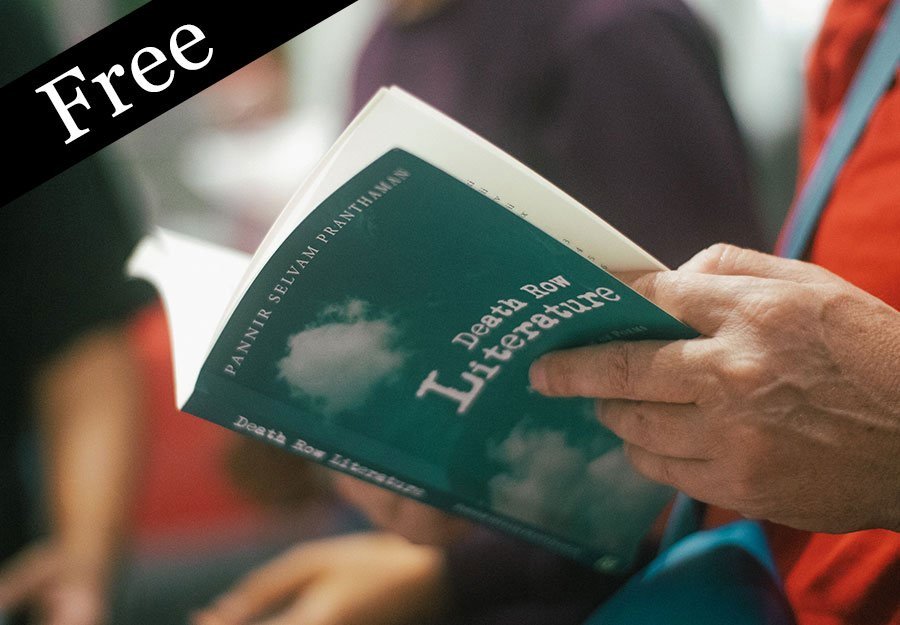
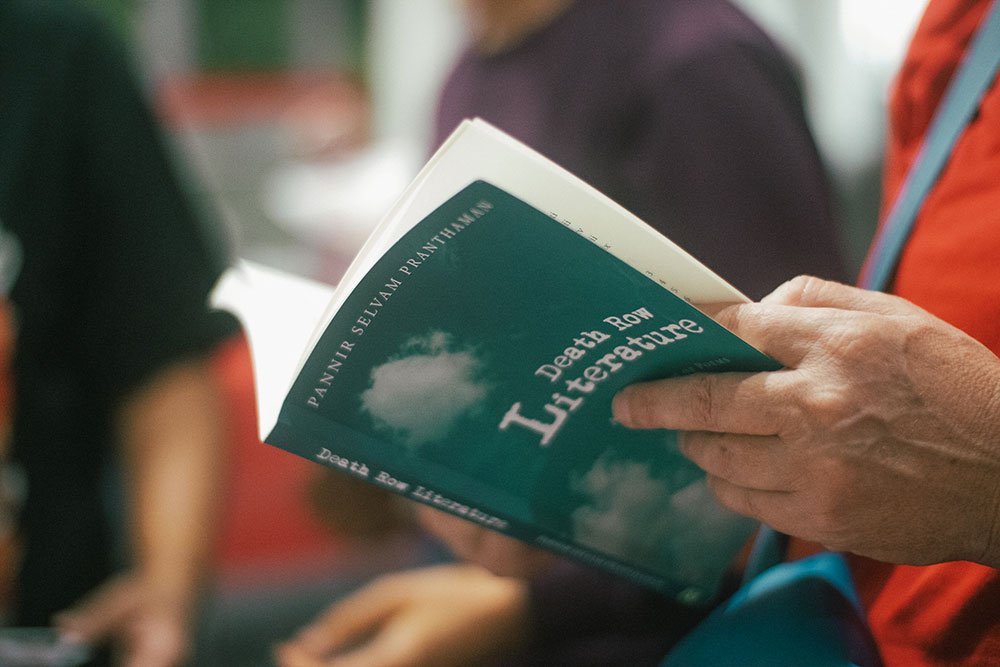
Death Row Literature: A Collection of Poems
Pannir Selvam Pranthaman
Gerakbudaya Enterprise: 2025
.
Prison literature is an acknowledged genre. Oscar Wilde wrote De Profundis to Alfred Bosie, his lover, while incarcerated for “gross indecency”. The Egyptian writer Nawal El Sadaawi wrote Memoirs from the Women’s Prison after being imprisoned for opposing the Anwar Sadat regime. The Indonesian novelist Pramoedya Ananta Toer dreamed up Buru Quartet on the remote island of Buru while serving a fourteen-year sentence during Suharto’s New Order. Said Zahari, detained for seventeen years without trial under Singapore’s Internal Security Act, produced Puisi dari Penjara / Poems from Prison. With Death Row Literature: A Collection of Poems, Pannir Selvam Pranthaman joins their ranks.
Pannir, a Malaysian, was caught carrying drugs into Singapore in 2014. Three years later, he was convicted of trafficking 51.84 grams of heroin under Singapore’s Misuse of Drugs Act, which stipulates the mandatory death penalty for trafficking 15 grams or more of heroin.
Pannir spent eleven years behind bars, eight of those in a solitary cell on death row. He’d merely been a low-level courier, but the prosecution refused to certify that he’d provided “substantive assistance” to anti-drug law enforcement operations. Such certification is necessary before the court can sentence drug mules to life imprisonment and caning instead of the death penalty. Without it, the judges’ hands are tied.
Pannir had two close brushes with the gallows, receiving an execution notice in May 2019 and again in February 2025. Both times, he was granted a stay of execution just one day before the scheduled hanging. Although this review was written while Pannir was still alive, he was hanged on 8 October, shortly before this issue went to print.
There’s a Wikipedia page on Pannir, leading with his criminal conviction. We have to scroll down to discover other aspects of his identity. He was born in Ipoh, Malaysia, and worked various jobs since he was a teenager to help with his family’s finances. After moving to Singapore, he worked as a private security officer.
Even further down the page, he’s described as a songwriter and a writer. Significantly, these latter two ‘occupations’ emerged while he was in prison. Some of his songs have been produced in collaboration with Malaysian artistes as part of a campaign to draw attention to his plight. Other works appear in Death Row Literature.
In reviewing the collection, I’m conscious that Pannir’s writing career did not precede his incarceration. I can only speculate on his creative intentions and urges: as a refuge from prison routine, a mode of introspection, an attempt to stall the relentless march of time. (At the book launch on 27 September, his sister Sangkari said that Pannir wrote because he wanted people to know him as more than just a death row prisoner.) I also have to consider the constricted circumstances in which the writing occurred. Pannir wasn’t granted the privileges of other writers—easy availability of writing materials and resources; access to an editor; or the agency to attend to his muse at any hour of the day.
Pannir also writes of a “censorship process which has been put in place here in order to watch over the security and good order of the prison”. He knew that his letters were vetted—there were even instances in which his private correspondence was unlawfully forwarded by the prison to the Attorney-General’s Chambers—and we don’t know how else he would have penned his poetry if they were not. We assume that the freedom to express themselves might be one of the few freedoms left to someone in jail, but even this is conditional. As Pannir observes: “They said, ‘there’s freedom of expression here’. / But is there freedom after the expression?”
In laying out these caveats, I don’t wish to suggest that I’m adjusting my own aesthetic criteria in reviewing the work. The task of the critic, however, is not only to evaluate, but to contextualise.
Death Row Literature is divided into two sections: ‘Part 1: Poetry at Length’ and ‘Part 2: Poetry in a Flash’. The poems are all written in free verse and cover a range of subjects: dedications to family members and friends, commentary on social issues like poverty and injustice, lyric poems about hope and despair, and political critique (of Malaysian politics, which might be the reason they were passed by Singaporean authorities).
Many of the poems might be described as protest poetry. In ‘Last Breath’, dedicated to the late rapper Tupac Shakur, Pannir writes, “For all the love that you gave / hatred and bullets were how they repaid”. In ‘The Problem to Stay’, he paints his picture of politicians: “promise breakers float in pools at mansions, / plotting how to fool us in the next election”. The diction is streetwise, the sentiment raw.
In another poem, ‘Angel With Invisible Wings’—written for his younger sister, Angelia—Pannir uses blunt rhymes to create unexpected connections between the formal and affective, the technical and liturgical:
On each visit’s departure,
I am hacked and ruptured.
Separated by a plexiglass structure,
where we share God’s scripture.
In ‘Memories’ Cemetery’, written in a more plain-spoken register, he addresses the paradox of painful memories:
I am conflicted;
by the grips of these realities,
that these torments are killing me,
and keeping me alive all at once.
There’s a destructive force to these memories, yet the pain is what affirms his consciousness—like someone who asks to be pinched to assure himself that he’s not dreaming. While the poem’s diction is uncomplicated, there are also unexpected phrases like “rugged past” and similes like “loyal as the dark night”.
The second half of the book is composed of pieces which might be more accurately described as aphorisms. Some of them, consisting of a single line, are striking in their homespun philosophy. Here is ‘Change’:
The climate changes, because humans do not.
And ‘I Write Less’:
I write less so you would read more
The absence of the full-stop at the end suggests a sense of something unfinished, or an involuntary abandonment. The white space on the page becomes crowded with the unwritten.
The bisection of Death Row Literature into the lengthy and the brief is also alluded to, in a metatextual manner, by these lines from ‘Time’:
Time is the only thing
That I have and don’t have
While many of Pannir’s poems are direct and unassuming, there are a handful that luxuriate in more lyrical language. In ‘The Sun in Your Soul’, he undams a cascade of dazzling images, in the vein of Pablo Neruda:
Shadow of a crescent moon,
Light of the southern cross
Soul of the blue sea of the white water,
Heart of a classical dance,
Chandelier of mystique, fire of sapphire,
Lilies of the valley, veins of the maple leaves,
You live. You live in everything that exists.
Among the literary genres, poetry—especially lyric poetry—is most closely aligned with the voice of the author. Punctuation and line breaks mimic speech patterns and breath pauses. Death Row Literature is shadowed by mortality—but that is true of most poetry collections. As Pannir writes in ‘The Grey Sea of Justice’: “written by ink that never dries. / It’s my blood in disguise.”

More from Mekong Review
-

A poem from Eileen Chong
-

A poem from Hon-Wai Wong
-
A poem from Jee Leong Koh
