


Oasis of Now
Chia Chee Sum (director)
theCommonist, Afternoon Pictures, Akanga Film Asia, La Fabrica Nocturna Cinéma: 2023
.
Tomorrow Is a Long Time
Jow Zhi Wei (director)
Akanga Film Asia, Volos Films, La Fabrica Nocturna Cinéma, Potocol, Oublaum Filmes: 2023
.
This brutal year, a pair of debut films gave me passage back to the daydreams of youth. That said, Oasis of Now by Chia Chee Sum and Tomorrow Is a Long Time by Jow Zhi Wei—from Malaysia and Singapore respectively—are no idyllic reveries. The two writer-directors, both born in 1983, revolve their first features around the relationship between a single parent and child, alongside issues of the underprivileged. Both films are meditations on love, time and space. In Oasis of Now, a Vietnamese mother working as an undocumented housekeeper has secret meetings with her daughter, who is fast integrating into Malaysian society. In Tomorrow Is a Long Time, the teenage son of a silent fumigator dad faces school bullying and the looming threat, or release, of conscription.
Made in a similar low-key style, Chia’s and Jow’s non-activist films gracefully sidestep the predictable miseries of social realism. Oasis of Now and Tomorrow Is a Long Time consider being a single child of a single, working-class parent as simply another unquestioned, natural part of coming of age, perhaps even the purest distillation of familial ties. Through humanistic seeing and a metaphysical journey, their movies instead reflect on remembered and invented time as a temporary solace and restorative loop; they evoke the unspoken, undemonstrative love inherited across generations. Chia and Jow grant their characters—and one reviewer—a momentary, much-needed dream of rest.
To be sure, lone parents, especially mothers, face comparable hardships in neighbouring Malaysia and Singapore. In Malaysia, fewer than 8 per cent of the 800,000 single mothers (certainly not undocumented ones) received paltry government aid, The Star reported. Singapore’s Association of Women for Action and Research has campaigned against the public housing, employment and social discrimination single mother households face. Research into one-parent families in Asia has also found that while societal disapproval of these “‘deviant’ family behaviors” exists, extended families often step in to fill in the childrearing gap that divorce or separation, death and labour migration leaves.
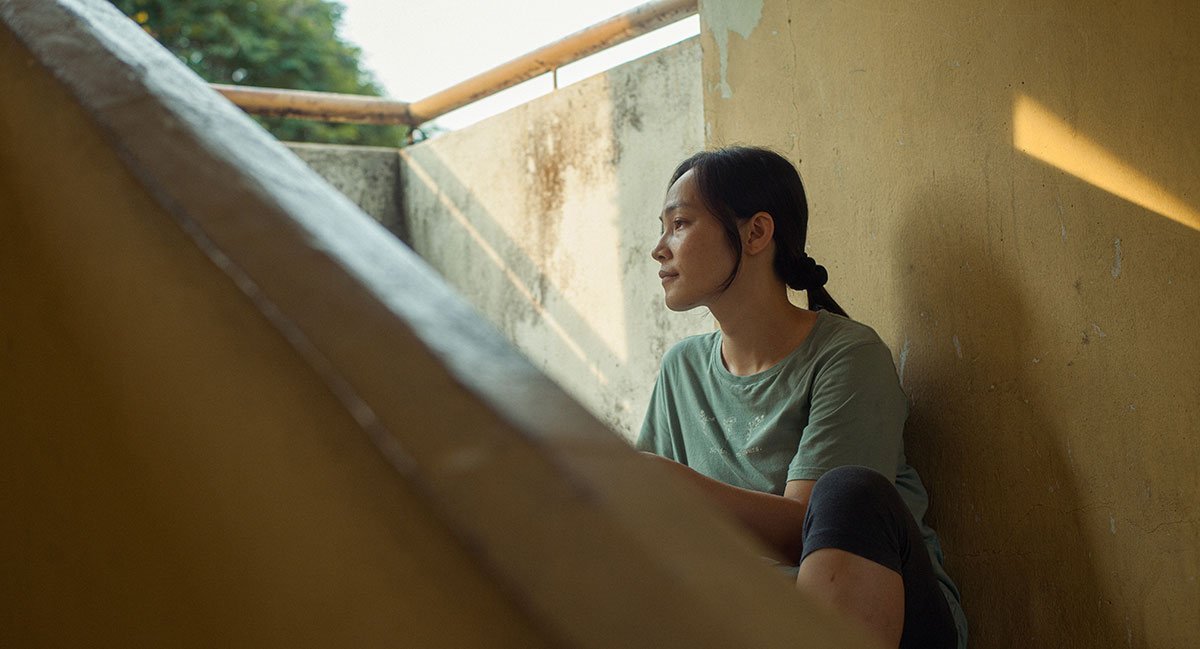
Winner of the Silver Hanoman award at the Jogja-NETPAC Asian Film Festival 2023, Chia Chee Sum’s Oasis of Now presents its protagonist, Hanh, without obvious labels. Over the course of a few days (there are no night scenes), we are elliptically immersed into her routine: cleaning various apartments, recycling household wares and babysitting a girl within a dilapidated housing complex in Petaling Jaya, Malaysia, where the director lived with his stepfamily in real life.
Constantly clad in a baggy T-shirt (the better to hide scars), her hair in a neat ponytail, Hanh sneaks out intermittently to a quiet stairwell to reunite with another girl. Together, they play a childhood game, selambut (five stones/jacks). It takes a while before we realise they are parent and child: the cherubic Ting Ting lives with a Cantonese caregiver who calls herself “mommy” (disclaimer: I helped with the subtitles); Hanh speaks to her daughter in Vietnamese, and initially, Ting Ting angrily replies in Mandarin. Ting Ting wants her real mother to “take me out somewhere to eat”, but the cloak of secrecy—hence the clandestine meeting location—must be maintained. In a blink-and-miss-it moment (I almost did), Hanh flees from an immigration raid, not for the first time, and is helped by an employer’s husband, who appears to work with the authorities. He later extracts from the unauthorised worker a highly personal quid pro quo, but it is Ting Ting’s increasing attachment to her second mother that really strikes at Hanh’s heart.
Through the magic of everyday interactions, Chia’s Oasis of Now evokes the porosity of family structures and national borders. While Hanh is on the run, wandering along a corridor, a pakcik neighbour familiarly nags at her from his flat, then invites her in for a meal. Azmi’s household, comprising him, a Malay mother and daughter and a young Burmese woman and Malay man, has “cooked together just now”; like a makeshift family, these presumable tenants and landlord sit together on the floor to share their food with Hanh. It’s also tantalisingly unclear to what ends Azmi mistakes Hanh as his daughter—from behind thick glasses, he refers to himself as “dad” and references his late wife, to Hanh, as “your mom”, regaling her with their courtship story. What is very clear, however, is the familial love that instantly transpires between Azmi and Hanh. They naturally assume a father-daughter dynamic, and, as if cementing their bond with stones, play selambut together, too.

Lensed by Jimmy Gimferrer (Tiger Stripes), Chia’s movie maintains such visual restraint and naturalistic performances that it sometimes feels like we are a (respectful) fly on the wall. The entirely still and stately framing heightens the playful, interactive game of observation, like noticing the action snuck in at the corners and sides of the screen, or listening in to conversation partners placed entirely outside. Predominantly shot through weathered doorways and down expansive corridors, all the larger from a child’s perspective, Oasis of Now lets us glimpse into the fundamentally unknowable depths of its characters—in profile, their faces half-hidden in the deep shadows of late afternoon, even just Hanh’s graceful nape—especially during its most moving moments.
As a Singaporean watching this Malaysian film, I was additionally struck by its sheer melting pot of languages. Vietnamese, Malay, Cantonese and Mandarin, Tamil and English are casually code-switched, often by non-native speakers, and a beautiful Burmese song of friendship is sung. In contrast to Singapore’s painfully forced demarcations of mother tongues (and banning of Chinese dialects), this easy mélange of cross-cultural communication, where a Vietnamese, Burmese and Malaysian can so easily connect, places personhood firmly ahead of identity markers and points out just how arbitrary a term like “illegal immigrant” is, considering the overlapping histories and economies of Southeast Asia.
Perhaps Chia’s broadening of what a family and nation, or even region, can be is best encapsulated by the Asian use of “auntie” and “uncle”. The terms primarily refer to blood relations, but also to any older stranger you might want to confer respect to. In the final frames of Oasis of Now, it is Hanh’s being called her own daughter’s “auntie” that helps her decide about her family’s future. Intensely subtle, inward decisions such as this may hinder Oasis of Now from fully delivering its emotional payoff, but the film pays dividends in the mind afterwards. It’s worth reflecting on who these tough yet precious moments are an “oasis” for. Aided by sensitive sound design, Chia conjures up a hot, still afternoon—a filmic mirage—in which a mother and daughter can perhaps look back, in the years and houses to come, to realise that they had found homes of refuge in each other.

The actions of [a parent] determines the fate of the [child]”, Jow Zhi Wei writes in his director’s statement for Tomorrow Is a Long Time. “The next life of a parent is their child.” Jow’s film, which competed at Berlinale’s Generation 14plus section (for young adults), plays out these “indelible, almost metaphysical but concrete” intergenerational relations through its two-part structure. In the first, Meng is a dreamy, elfin-like sixteen-year-old whose grandmother lies comatose in a nursing home. Meng tries to squeeze stories of his grandparents out of his stony father, but Chua (played by acclaimed Taiwanese actor Leon Dai) prefers to forgo sleep and take on extra shifts as a pest exterminator. In the latter part, happening in the absence of his dad and Singapore’s concrete jungle, Meng is a soldier on a military exercise that takes an existential turn. In the wilderness, he is seemingly fated to be punished for ancestral sins and forever lead an inherited life.
The Chinese character for filial piety, 孝 (xiào), depicts a younger man below, supporting an older man. Accordingly, this key tenet of Confucianism spells out that parents’ needs and judgements should be above the child’s; beyond showing obedience and respect, descendants have the duty to complete the unfinished work of their forebears. Tomorrow Is a Long Time, which bears an evocative Mandarin title meaning “tomorrow will be longer than yesterday”, injects some hopeful ambiguity—a coming-of-age release from the past—into this lovely but feudal concept.
The limits of language are at the heart of Jow’s single parent-child relationship. Practising filial piety in letter but not in spirit, Chua and Meng’s non-conversations are a masterclass in old-school Asian parenting and indirect messaging. Especially at mealtimes, silence reigns and eyes are locked on food, a symbolic carrier of familial love. Food is also ritualistically offered, at the family altar, to Meng’s late grandfather.
“What was Grandpa like?” Meng mousily asks his dad after every death anniversary. “Hurry up and eat,” Chua retorts.
My favourite lack of an exchange occurs when Meng suggests that his increasingly sicker grandma could move in with them, even offering up his room. Twice in response, Chua, who had nothing to say to Grandma when he paid her an obligatory visit, swiftly changes subjects, shovelling heaps of food into his son’s bowl.
True communication between the generations occurs through brutality, wordless tenderness and music. Like the paternalistic city-state, Chua expresses his love through forcing what’s supposedly best upon his son. He subjects Meng to a punishing exercise regime and, after Meng goes from being bullied in school to a bully, bashes him up for being a “good-for-nothing”. In a moment of mutual crisis, though, Meng goes to his sleeping father and reaches out to him. As opposed to the film’s opening, when father shakes son awake to perform filial duties, they clasp hands here. Meng’s hands also hold his grandmother’s, when she mumbles, and her diary, too, where he uncovers handwritten lyrics to a Taiwanese song,《雨夜风》(“The Torment of a Flower”). Dreaming of becoming a singer, perhaps in a continuation of her aspirations, Meng is later comforted, as a soldier, by this number from Japanese colonial rule.
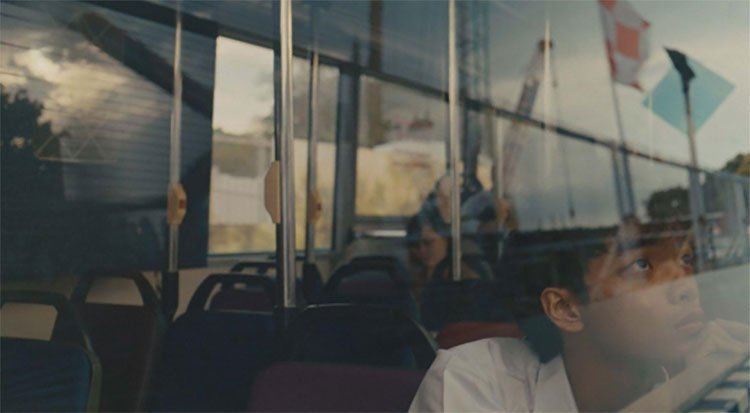
Absent of the extended family, even of Oasis of Now’s neighbour-caregivers, blood ties in Tomorrow Is a Long Time are similar to smoke. The all-enveloping, toxic fog Chua emits as a fumigator (“This job destroys you”), performatively and pointlessly killing insects (and nature at large) in “godforsaken” sites; the wisps of smoke from the cigarette Meng is made to puff before beating up a schoolmate, completing his “manly” transformation; and the mist obscuring the jungle of Meng’s army misadventure, where another type of peer pressure and hazing hovers, but lifts through care. Like a suffusing vapour, the concept of a family and ancestor spirits are portrayed as being all around and even within, inescapable but intangible; suffocating yet seductive. Here, familial love is impossible to speak of directly, particularly between males; one’s duty to an ever-growing family of ghosts goes without saying.
Coming ten years after his latest short film, it’s understandable that Jow’s debut feature suffers from some pacing issues: the first half is slightly overstuffed with plot developments, as if unspooling a decade’s worth of thoughts, while the second meanders for quite a while after its intentions are clear. Commit to the whole journey, though, and its blue-collar characters and mise-en-scène come to light.
Resisting national image-laundering, Tomorrow Is a Long Time invaluably honours Singapore’s “working class lost in the wilderness of survival”, “people working to sustain [modern cities’] ‘images’”, as Jow’s director’s statement goes. Its alternate, non-sensational pictures, crafted by cinematographer Russell Morton (#LookAtMe), may be stalked by slow deaths and strange illnesses, but there is a visual grace in its silent suffering, reprieve after pain, and freaky beauty in the industrial behemoths that surround its people.
Beyond shots of his characters sleeping, or trying to sleep, Jow’s images resonate with the mystery of nature and dreaminess of deep rest, a promise fulfilled by the final virtuoso panning shot. This long, unbroken sequence loops Tomorrow Is a Long Time back to its beginning, but also frees Meng—whose name sounds like the Chinese word for “dream”—to different, independent futures. Up in the air, he finds a balance between forever being his father’s son and becoming a singular man of his own, finally.
This essay was completed under the ArtsEquator Fellowship. Views expressed are solely of the writer/creator.

More from Mekong Review
-

Malaysia's opposition delivered a startling victory in May's elections by going house-to-house.
-

A friendship forged between an essential and non-essential worker.
-

A family scattered by politics
- Tags: Chia Chee Sum, Dan Koh, Free to read, Jow Zhi Wei, Malaysia, Notebook, Singapore
