

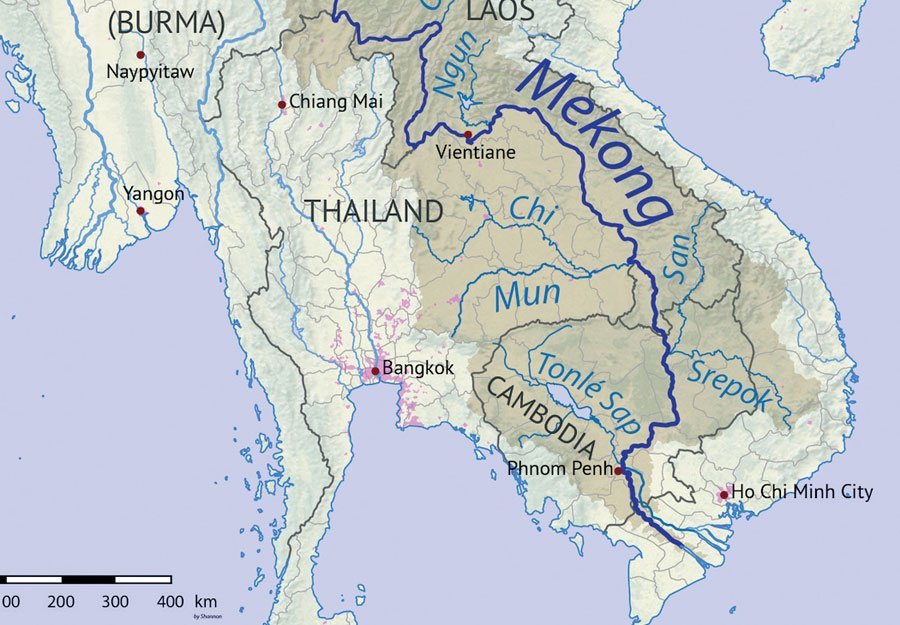

China has tapped heavily into the Mekong River with mega-dams that are slowly strangling this vital lifeline of Southeast Asia. Through the construction of eleven mega-dams on the Mekong main stream in Yunnan, China has generated more than 21 gigawatts of hydropower, equivalent to the output of the Three Gorges Dam, by far the biggest dam on the planet. Not just damming the Mekong but other rivers sourced in Tibet, it is the biggest water heist in recorded history.
China desperately needs both power and water, so these mega-dams have solved that problem. Dams give the potential of diverting water for mining, industrial use and agriculture. There are several engineering plans on the drawing board. But in the process, China has created an even bigger problem: slowly strangling the Mekong as a free-flowing river for everything—and everyone—that depends on the river in the five nations downstream: Myanmar, Laos, Thailand, Cambodia and Vietnam. That amounts to more than 70 million people, including those in Tibet and Yunnan within the borders of China.
More from Mekong Review
-

A poem by Anthony Tao
-

Shanghai has undergone three transformations in three years. First, it turned itself into a bubble, then it clamped down hard, monitoring every resident’s movements. Finally, it bounced back to normalcy, almost as if the previous years had been a fever dream.
-

Since participating in a protest in China puts one’s safety in jeopardy, using a blank sign serves as a form of plausible deniability. It’s also consistent with the complex reality of memory and historical events in China.