

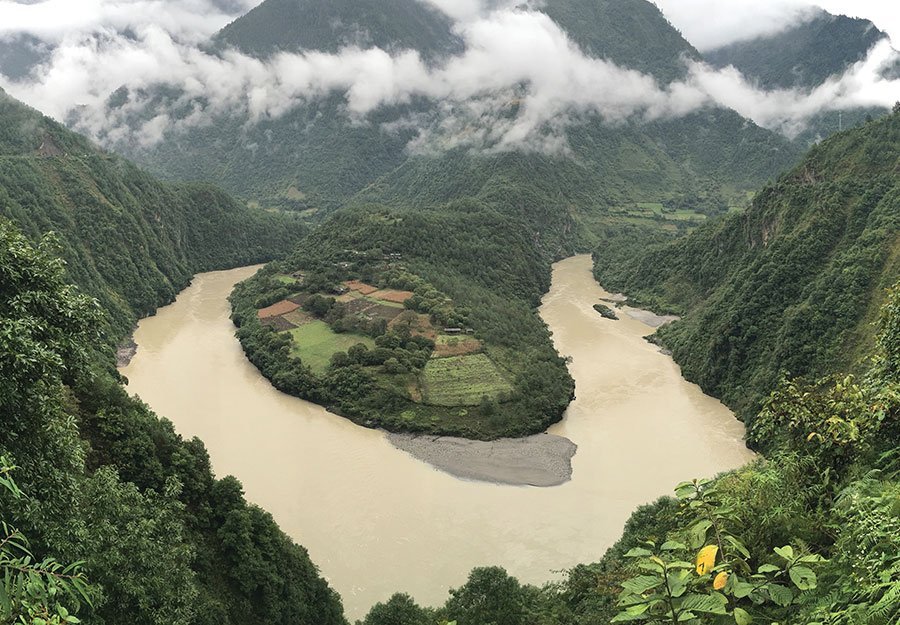

Have you also learned that secret from the river; that there is no such thing as time?
—Hermann Hesse, Siddhartha
The tempest raged within and without. A cold rain beat down on my sunshine-yellow tent, which had leaked through the night—my first on the trail. I lay in my expensive blue sleeping bag, lashed by self-recrimination and fear, curling up as a puddle menacingly inched towards me. I should have returned home to my loving wife and daughters three days ago, when an immigration officer at Kunming airport had politely informed me that Singaporean citizens can enter China without a visa, but only for a period not exceeding fifteen days. Instead, I had boarded a domestic flight to Shangri-La, knowing full well that getting a visa was not possible because of public holidays and the remoteness of my impending trek near the Yunnan-Tibet border. The trip leader, a tall Mandarin-speaking British expatriate, had reassured me that since I would overstay my legal welcome in China by “only” two days, I would “in all likelihood” be let off with a mere verbal warning by the Exit and Entry Administration of the People’s Republic of China. But a corrosive doubt had seeped into my sleepless solitude: I could also be blacklisted, detained or deported.
We were a small group of four trekkers, two men and two women, unknown to one another, and to the high passes and valleys of the mystical land we were passing through, where rocks seemed to chant Om Mani Padme Hum to the accompaniment of fluttering prayer flags. This ubiquitous six-syllable mantra is an invocation of the Buddha (jewel or mani) inside each heart (lotus or padme). The day before, at the ancient Dong Zhu Lin Monastery in the town of Benzilan, one of the few in Tibet never ravaged by the Chinese army, we had beheld chirpy, young maroon-robed monks drying crushed white marble—dyed red, blue, green, yellow and black—in the blinding mid-morning sun. Older Buddhist monks drew intricate geometric patterns on a wooden board, creating spaces that would be gently filled with coloured sands over many days using small, ridged metal funnels called chakpurs, till the Wheel of Time Sand Mandala lay incarnated. Soon after, the beautiful but ephemeral Kalachakra Mandala would be ritually destroyed and scattered in water, in celebration of the ineluctable impermanence of all existence.
More from Mekong Review
-

Poetry from David Chandler
-
A poem by Yago Tse.
-
A poem by Aiden Heung
- Tags: Issue 34, Jinendra Jain, Tibet