
Let the dead speak
Fathima Cader
Shehan Karunatilaka’s Chats with the Dead is a darkly satirical novel with a good dose of the fatalistic humour Sri Lankans will find familiar.


Shehan Karunatilaka’s Chats with the Dead is a darkly satirical novel with a good dose of the fatalistic humour Sri Lankans will find familiar.
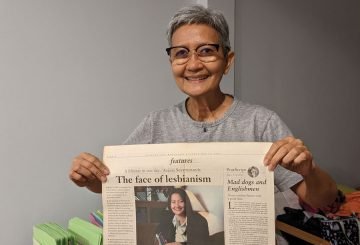
The Anjaree Archive preserves material collected over the decades by one of Thailand’s first advocacy groups for gender and sexual rights. But can an archive also tell the story of its own messy creation?
In Now You See Us, Balli Kaur Jaswal has created a social world that magnifies the indignities and frustrations of everyday life as a migrant domestic worker in Singapore.
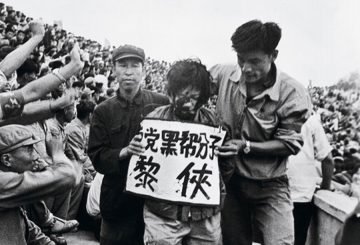
What a country doesn’t collectively talk about can often be more important than what it does. Tania Branigan’s book reveals the complexities of remembering the Cultural Revolution.

Our growing Thai family, now into its fourth generation, has given us plenty of smiles and laughter… and outbursts of anger and stubbornness and exasperation.

For much of her adult life, Bacani has been known for her photojournalism. But she has extended her practice considerably—a constant reinvention.

This could be After The Inquiry’s intention: to rile us up and stir a sense of indignation at a system in which the truth might not win out over politics and power

Janice Pariat chooses to manifest light in her writing across a ricocheting canvas that crisscrosses eras, characters in history, decisive philosophies in botany and momentous voyages.

Since participating in a protest in China puts one’s safety in jeopardy, using a blank sign serves as a form of plausible deniability. It’s also consistent with the complex reality of memory and historical events in China.

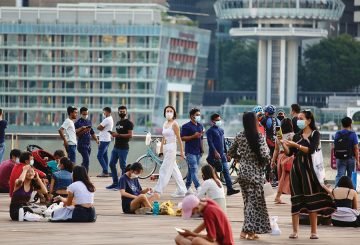
Shanghai has undergone three transformations in three years. First, it turned itself into a bubble, then it clamped down hard, monitoring every resident’s movements. Finally, it bounced back to normalcy, almost as if the previous years had been a fever dream.

A controversy—involving questions of privacy, consent, autonomy and censorship—began to develop around the documentary To My Nineteen-Year-Old Self, one that starkly parallels the Hong Kong government’s relationship with the youth.

Prism of Photography is an attempt to challenge the fixity of historical account, specifically the 6 October 1976 massacre at Thammasat University, through images.

Not only did the promise of “Naya Pakistan” never materialise, the country is actually much worse off today.

A short story by Aditya Narayan Sharma

Could distance runner Soh Rui Yong’s absence from Singapore’s national team point to something bigger about how things work? He thinks this could be a “good opportunity” to ask questions.

In his memoirs, Burgess recalled Graham Greene telling him (not unkindly) that Time for a Tiger was an amusing but essentially frivolous book. Greene’s evaluation hasn’t stood the test of time.

A sordid saga of greed, corruption, desperate despots and out-of-control dam-building corporations—propelling the rapid demise of the Mekong River.

A poem by Anthony Tao

I’ve often come to forks while travelling. Do I stop where I had planned to arrive, or do I keep going? Maybe if I go on a bit further, I might find something I have never quite seen, in quite the same way, before.

Mae Sot, Thailand, provides the anonymity a Burmese peace activist needs, although not without guarded boundaries and precarious undercurrents to navigate
A poem from Jake Dennis
A poem from Maung Day
Poetry from Kulleh Grasi

A short story by Ngan Nguyen
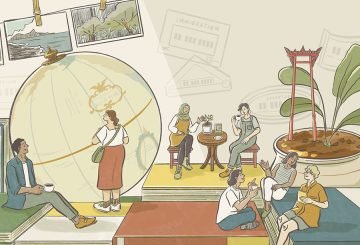
Yo and Noom choose their books, in English and Thai, with care and purpose to ensure that Passport Bookshop has a clear identity and its patrons a quality read.

It is especially important to pay attention to Myanmar right now, but the future of Burmese-language instruction in English is uncertain. Joe Freeman speaks with linguist Justin Watkins about his work.

It was hoped that social media would facilitate democracy. Today, we worry about misinformation polarising society and undermining democracy.

It’s hard to pin down exactly how to describe Đinh Nhung and what she does. Her work has spanned art installations, photography, curation and the compilation of lexicons of queerness in Vietnam.
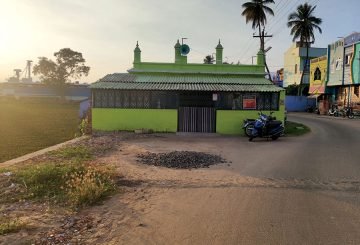
Hindu-Muslim relations are worsening across India. There have been no rumblings of communal strife in Kadayanallur yet, but news from elsewhere creates ripples of anxiety and worry.

Lifting the stone on ‘Big Conservation’, Sarah Milne’s book demonstrates how conservation is inherently political—an effort to impose meaning on to landscape and people.

When Oliver Slow writes that the Myanmar military must return to the barracks, he presumably means they should only be in the barracks. Readers may wonder if they were ever so confined.

Chiang Kai-shek might have put in place measures that eventually led to Taiwan’s economic miracle, but political freedom for the Taiwanese was the last thing on his mind.

What Philip J. Stern offers is a reflection on the nature of power—how organisations created to share risks and raise capital for economic activities ended up becoming a dominant force.

What happens in a border town when the border is closed? Bryony Lau travels to Muse in Myanmar’s northeast and reflects on its history and the effects of the Covid-19 pandemic.

Scot Marciel spent most of his time in service focused on one region. In Imperfect Partners, he brings readers through the evolution of US involvement and interest in Southeast Asia from Reagan through Trump.

Personal testimonies are always more powerful than hypothetical discussions, and Elaine Pearson’s extensive experience in investigating human rights abuses and advocating for positive changes serves as a practitioner’s handbook.

Fiona Sze-Lorrain’s novel Dear Chrysanthemums offers a provocative look at the defining events of the past half-century of Chinese history.

Unable to write openly about repression, Uyghur writer Perhat Tursun resorted to symbolism, invoking visceral descriptions in his novel The Backstreets to convey a sense of disconnect and despair.

Esther Yi’s debut novel grapples with social disconnectivity and fanaticism through an esoteric tale of a woman who falls desperately for a K-pop star and goes on a journey to integrate him into her life.

Queer Southeast Asia provides a multifaceted mosaic of the region, stretching for all to see the complexities that will always simmer beneath the volume’s name.