

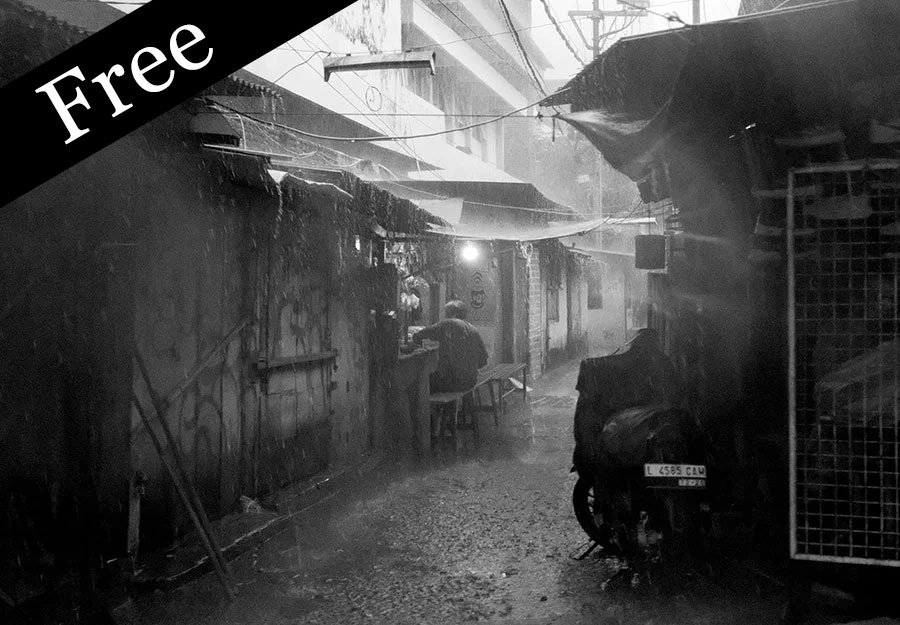
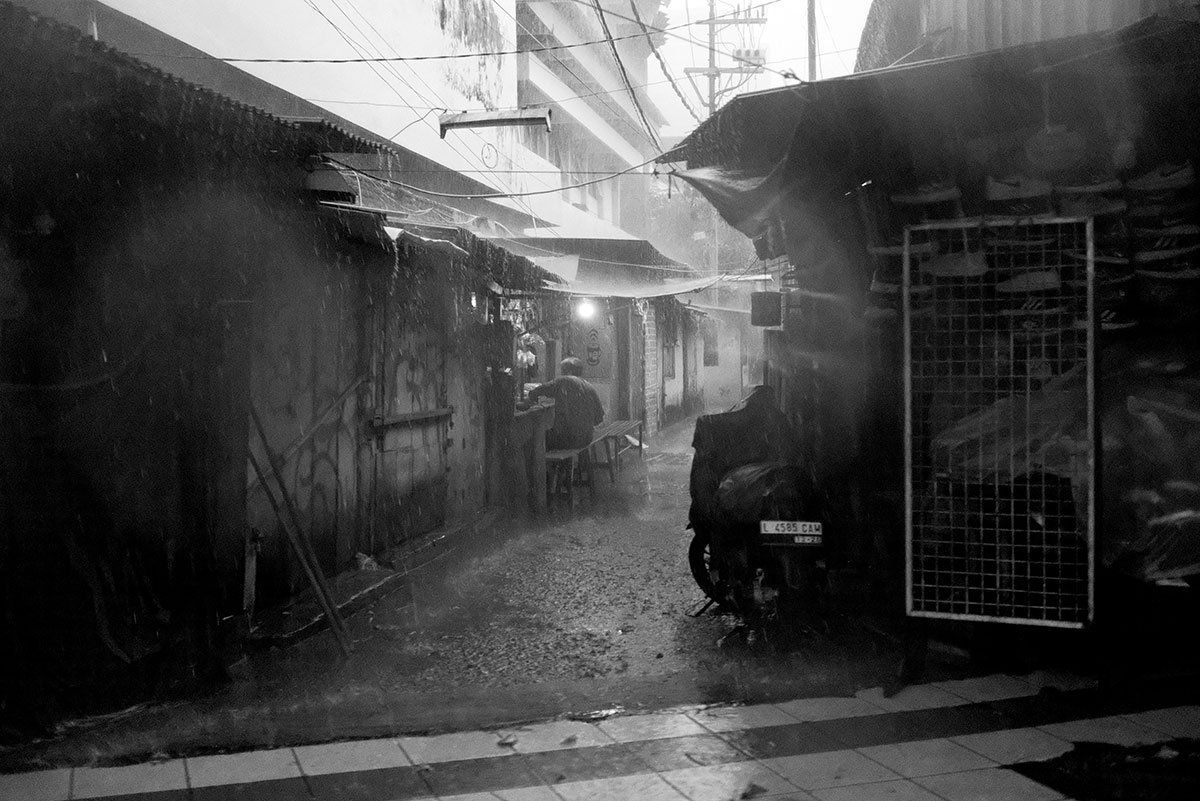
The young men in the videos sounded as though they were having fun.
It was well past midnight in Bogor, Indonesia’s “rain city”. The roads were mostly empty and the boys rode motorcycles, looking for people they perceived to be gay, effeminate, or transgender. They revved their engines as they rode through the streets, shouting: “Bersih-bersih boti!”
“Clean up the boti!”
They proudly called themselves “boti hunters”, turning boti, a slang term derived from ‘bottom’, into the name of their little vigilante enterprise. There’s something accidentally homoerotic about groups of young men spending their midnight hours patrolling pitch-black alleys thinking about nothing but bottoms—but then someone in the frame starts running for their life, and the joke dies.
Accounts carrying variations of the “boti hunter” name soon appeared online. In the videos, the boys laugh and shout while they chase people through the streets, filming everything for a little bit of social media clout.
I’ve heard those laughs before.
I attended an elite, all-boys pesantren, an Islamic boarding school, in West Java. I entered primary school through a scholarship programme for yatim—children who had lost their fathers—and students from low-income families. By junior high, paying students from much wealthier families had joined us, many able to afford fees my family would have considered astronomical.
We joked that the pesantren was a “holy jail”: we were cut off from almost everything beyond the compound, our school surrounded by high walls with barbed wire. Our contact with the outside world was limited to about thirty minutes of restricted internet use at the end of computer class, Sunday family visits, and newspaper clippings pinned to noticeboards around the campus.
I remember how my friends and I were then. My roommates and I would steal (sorry!) the newspapers from the noticeboards and hoard the sports pages inside plastic binders. Our most prized trophy was a grainy image of Cristiano Ronaldo in his gloriously red Manchester United home kit. We loved the swagger, but mostly we loved that he belonged somewhere outside our cloistered world. One of my friends was from England—I called him “Brit Boy”—and some of the other kids would make fun of him for playing with us scholarship kids.
Twelve-year-old boys can be cruel. Hundreds of us living together, without girls or much privacy, meant that we turned our attention towards one another. As a scholarship kid whose father died when I was two, I learnt to harden myself. I had little in the way of a monthly allowance, and I didn’t receive the care packages that arrived for some of the other boys. I couldn’t compare with the rich kids who went on holiday and came back to school wearing the same bright Nike or Adidas shoes that professional footballers wore. I had no interest in becoming easy prey, so I tried my best to keep my head down.
One of the words we threw around was banci, a slur for boys thought to be too ‘feminine’. I had a friend who cared about his skin. We usually went straight to the mosque after our afternoon classes, carrying our bags with us at the end of the school day. One afternoon, he sat among us, putting something on his face. I don’t even remember what it was anymore, but that was enough. Suddenly, he was “banci” and the other boys were making fun of him. I laughed, too. I was scared of becoming the next boy people laughed at. At that age, drawing attention to myself felt like flying too close to the sun. Laughing along felt safer.
During those years in school, we learnt the story of Prophet Lut and the destruction of Sodom. We heard frightening descriptions of stones, each engraved with a sinner’s name, falling from the sky, and the earth being overturned. We were taught that it was an azab, a divine punishment. By the age of nine, I had internalised the message that it was a sin for men to develop romantic relationships with other men, and that tolerating this sin would bring punishment upon everyone. It was only years later that I would encounter other interpretations of the story, including from progressive Muslim scholars, that centred coercion, sexual violence, and abuse of power.
In our school, we were aware of kakak-adek-an—situations in which older boys developed conspicuously close attachments to younger boys, often the fair-skinned, smooth-faced ones. (We had a word for them, too: amrad, the unbearded youth.) Some of the kakak-adek-an relationships may have been exactly what they claimed to be—just an older boy looking out for a younger kid—but others are harder for me to remember so innocently.
From time to time, there were stories of sexual abuse: we once heard that an older boy, who had been given authority over a dormitory room of younger students, had made those who were under his charge touch him after lights-out. His punishment was gruesome: positioned in the centre of the open courtyard, many of us were ordered to watch as he received twenty strokes of a rattan cane on the naked soles of his feet before he was expelled.
A friend also once told me about being cornered by an older boy in an empty classroom after prayers. Most of the other boys were playing outside when this boy led him away. My friend said he was pressured to touch him, but somebody ran past the classroom and that disruption put a stop to everything.
The story stuck in my mind; back then, I had no real way of separating abuse from sexuality. In my young mind, homosexuality and predation blurred together, because so many of the same-sex encounters that I remember being told about involved coercion or abuse. There were no examples of same-sex couples who had simply chosen each other. All I had, in that gated world behind barbed wire, were rattan strikes to the feet and stories of boys being assaulted and then silenced over bowls of bakso and mie ayam. It took me years to understand that abuse was about coercion and power, that it was not the same as homosexual love.
When I was in Grade 10, I moved to another pesantren in Central Java, at the foot of Mount Merbabu. This second school is why my story is not a simple, clear-cut one of internalising hatred in religious establishments and later being liberated from conservatism. I found a tight-knit community in this second pesantren and still treasure much of what boarding-school life gave me. Some of the friendships I made there have lasted into adulthood, and my years in that school also gave me some of the ideas I later used to question my own prejudice.
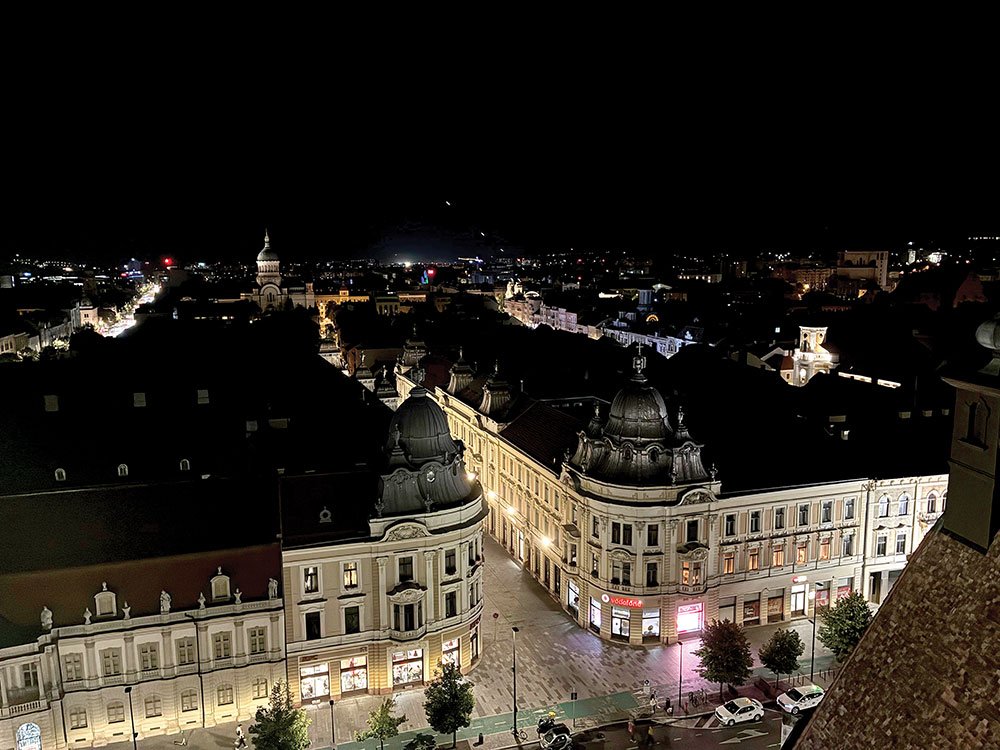
The previous school had shut us in, but I never saw this pesantren as another place to escape. I learnt how to live away from my mother, to live among people I had not chosen and yet still find my footing. I learnt that it was possible to end up anywhere on God’s green earth and still fit right in. So, when I eventually moved to Cluj-Napoca in Romania in my early twenties, the distance barely made me flinch. It was an adaptability that mattered in a predominantly white, Eastern Orthodox country where I was constantly the outsider.
My pesantren years left me with religious concepts I use to this day, although not always in the way I was taught to use them. Two were hablum minallah, one’s relationship with God, and hablum minannas, one’s relationship with other people.
Hablum minallah became increasingly private to me as I got older. Whatever bargain I have with God is difficult enough; it’s no one’s business to weigh in on something that’s only between us. Hablum minannas was trickier because it had to do with my interactions with other people. But by the time I boarded a plane for Europe in the winter of 2020, some of the beliefs I’d grown up with were already loosening their grip on me.
One of the first openly queer people I became close to in Romania was a bisexual German woman. We dated for a month or two; she later married a woman back in her home country. Then there was another woman I dated. One afternoon, while on a bus, I noticed a rainbow pin on her very mainstream JanSport backpack.
“Wait. Are you…?”
“Yeah,” she replied. “Didn’t I tell you?”
“No? But cool.”
The bus kept going. There was nothing more that needed to be said. This was true of most of the queer people I met; unlike the horror stories I’d heard in my childhood, there was nothing frightening or threatening about their sexual orientation. People, whether queer or straight, went to class, partied too hard, missed buses and trams, fell in and out of relationships, and worried about their exams.
Obviously, there was plenty of homophobia in Romania, too. Like in Indonesia, people teased and joked about being gay—as if it was something insulting or strange—and the government still does not recognise same-sex marriages or registered partnerships. In the 2026 Rainbow Map compiled by ILGA-Europe, an umbrella organisation of LGBTQ+ groups in Europe and Central Asia, Romania is the lowest-ranked European Union member state in terms of legal and policy practices relevant to LGBTQ+ people. But the ordinary lives of the queer people around me were a world away from the revulsion for queer people that my first pesantren had drummed into us.
While in Romania, I also got a taste of what it felt like to be reduced to just one aspect of myself.
Almost every Friday in Cluj, I would walk twenty minutes down to Hașdeu, a massive student complex. The mosque was housed in an Islamic community centre tucked just outside Pasteur, barely a three-minute walk from Piezișă, the city’s infamous student party street. Leaving my shoes at the door, I prayed in a carpeted room with other international students and foreigners, many Arab and North African. I kept up this routine for my first two years in Romania, but began to show up less in my third year. I didn’t pretend to be a saint. I checked if the university canteen’s sarmale (cabbage rolls) contained pork, but was never above grabbing a glass of mulled wine at the overpriced Christmas markets when the season rolled around. I wasn’t the most pious of Muslims, but no ustaz hunted me down to tell me that I was damned.
Despite my changing relationship with Islam, Ramadan meant something to me beyond a set of religious rules. As the month approached, I told the woman with the JanSport backpack that I wanted to fast. She did not take it well. During the argument that followed, she eventually told me: “I’m not saying all Muslims are terrorists, but all terrorists are Muslims.” When I told her to get out of my apartment, she cried, as if I had been the one in the wrong. I hated that all the other things she knew about me suddenly mattered less than the fact that I was Muslim. It was a reminder that, just as I didn’t want to be reduced to just my religion, I had no business reducing someone else to just their sexual orientation.
A verse I had recited since childhood began to sound different: “Lakum diinukum wa liya diin (for you your religion, for me mine)”. I could keep my faith without expecting other people to live by it.
My early relationship with Islam had been shaped by a carrot-and-stick system—there was constant judgment about whether I conformed to the rules or not. While Islam has given me things that I value, I don’t want my religion to simply be a box of dos and don’ts. I realised that it was unreasonable to demand that everyone adhere to my beliefs and standards; in any case, I’d stopped caring about policing how other people lived. It was never my place to sit in judgment of others.
Not long after I moved back to Indonesia, I met an old friend from my second pesantren at a coffee shop near the Romanian embassy in central Jakarta. We sat in the open-air smoking area and did what old classmates do: tried to work out who had married, who had had kids, who had disappeared. All the fun, juicy gossip.
Nearly five years abroad had changed how I dressed. In Europe, I got used to walking outside in a sleeveless cotton vest, a necklace, and loose trousers without it even occurring to me that such an outfit might signal anything about my sexuality.
“You look like a boti,” my friend suddenly said.
“What makes me look like one?”
He looked me over again, inspecting the ‘evidence’. I touched my necklace and asked if that was the problem. Then the vest. Or maybe the trousers? He laughed a little and said, “I don’t know. You just do.”
Heh?
Nothing came out of that offhand comment, but it wasn’t the last time someone made assumptions based on how I dressed, reminding me how quickly judgment and prejudice can manifest. Months later, something happened in Indonesia on a much larger scale.
President Prabowo Subianto signed Presidential Regulation (Perpres) No. 111 of 2025. It laid out Indonesia’s general national defence policy for 2025 to 2029, and included a long list of non-military threats to the country. Terrorism and separatism appeared alongside radicalism, prohibited ideologies, narcotics, online gambling, illegal lending, and… “penyebaran budaya Lesbian, Gay, Bisexual, Transgender, and Queer (LGBTQ)”, which roughly translates to “the spread of LGBTQ culture”.
My conservative education had insisted that queer relationships were sinful. But a threat? That word carried a different weight. My mind went to Joshua Oppenheimer’s The Act of Killing and The Look of Silence, films about the anti-communist massacres of 1965 to 1966. Suharto’s New Order regime spent decades framing those killings as a justified defence of Indonesia against a communist threat. Looking at the new presidential regulation, I feared that Indonesians were once again being turned against their fellow citizens.
The government has tried to have its cake and eat it, too, drawing a line between LGBTQ+ people and LGBTQ+ “culture”. In July 2026, Yusril Ihza Mahendra, the coordinating minister for law, human rights, immigration, and corrections, said Perpres 111 could not justify the persecution of queer Indonesians; the threat, he said, was the spread of LGBTQ+ “culture”, not the people themselves. That same month, the religious affairs ministry said it was preparing educational material for students as young as fourth graders to prevent the spread of such “culture”.
I was around that age when homosexuality was presented to me as something frightening and shameful. That was when teachers told us the story of Prophet Lut; when it was heavily implied that same-sex relationships could only be harmful and abusive; when we began to police one another in our boarding school, ready to pounce on anything that seemed to diverge from what was expected of boys. That was when I learnt to laugh at another boy when he was singled out for being “banci”; I’d even thought that he deserved it. My own upbringing is proof that it’s not possible to denounce a “culture” without hurting the people associated with it.
The videos from Bogor went viral on social media in mid-July and are still available online. Amnesty International Indonesia reported that at least ten trans women had been targeted there in a two-month period. In some cases, the attackers forced the victims to strip and tore their clothes. Through it all, the boys who called themselves “boti hunters” laughed. Where did they pick up these attitudes towards queer people?
Whenever I think of this, I remember that a young Rafly would probably have laughed along, too.

More from Mekong Review
-
Between climate change and a lack of jobs at home, working-class Indonesians are increasingly vulnerable to recruitment by scam syndicates in countries like Cambodia.
-
An interview with the founder and director of the Ubud Writers & Readers Festival
-
Magical realism meets gritty realism
- Tags: Indonesia, Issue 45, LGBTQ+, Rafly Gilang Pratama
