

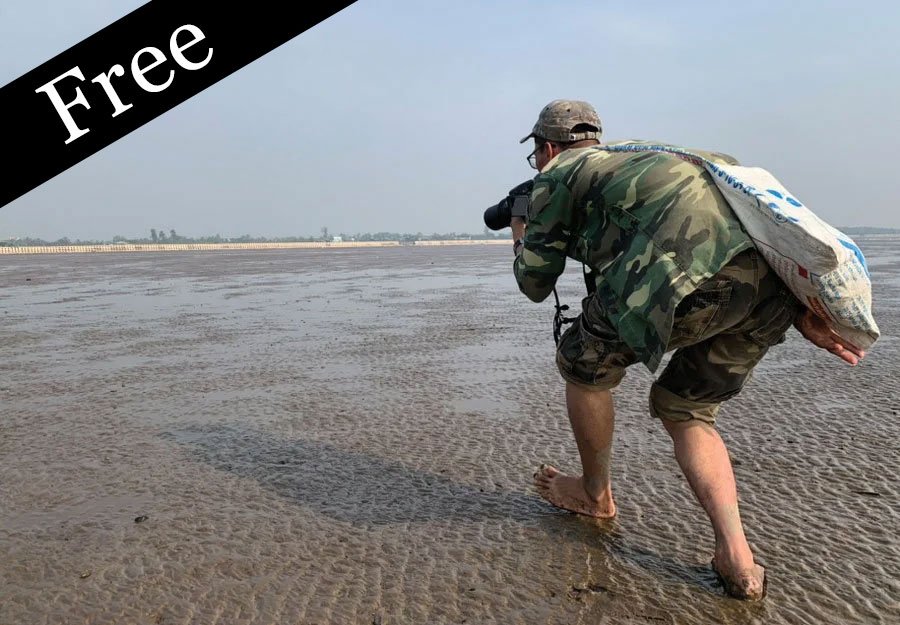
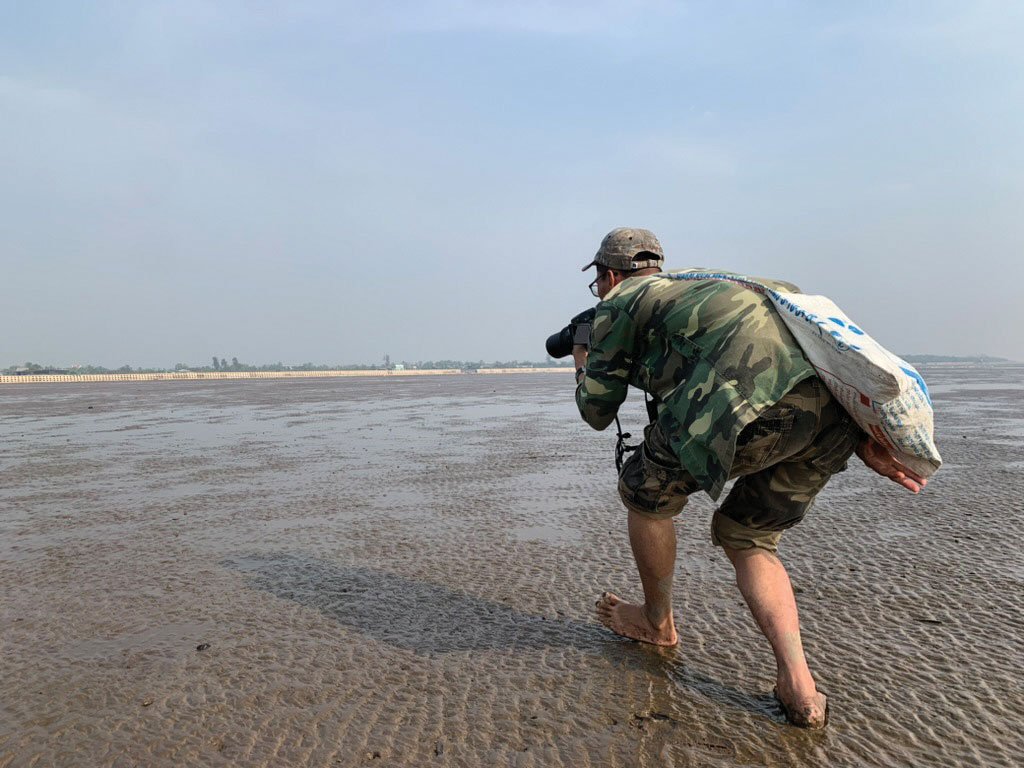
Mud envelopes my feet, dark and cool, slick with sea. It’s low tide, and the sea has receded to reveal a massive mudflat stretching as far as the eye can see. We are at Tân Thành beach, roughly two hours by car from Saigon, on the coast of Vietnam’s Mekong Delta. It is early January—the dry season in the tropical south—when huge numbers of migratory shorebirds can be found on this expanse.
Following the lead of our guide, Ba and I cautiously navigate the ankle-deep water of a tidal channel. From atop the sea wall a storm-grey heron watches our slow progress. To the north and east, fishing huts perch high on bamboo posts. To the south, giant steel transmission towers dominate the horizon as they march offshore towards rows of wind turbines. On the muddy backshore, fishing boats lie stranded with nowhere to go, outsized eyes painted on their fading prows. They are the same kind of boats that my family used when we fled the country over forty years ago.
We are sloshing across the mudflats this morning because somewhere out there might be a spoon-billed sandpiper, one of the world’s rarest shorebirds and a critically endangered species. A few regular, if elusive, birds are recorded every winter here at Tân Thành. Our guide is Bùi Thành Trung—or, as he prefers it, Toby. He’s one the best birders in Vietnam, a shorebird specialist with a knack for finding “spoonies”, as he affectionately calls them.
“Stay inside the channel!” Toby shouts, spotting scope balanced over a shoulder. We have about two hours before the tide makes it too dangerous to be wandering the mudflats. We aren’t the only ones making the most of low tide. Further out, dozens of local women are digging for clams.
The watery path leads to the first set of makeshift bamboo “monkey bridges” we’ll need to cross. My seventy-four-year-old father stops in his tracks, considers the 30-metre obstacle course, his old knees, his bad balance, and tells us “kids” to go ahead without him. But Toby has just the pep talk. “You’re still cứng” he says, clenching his fist and smiling—still hard, still tough. That’s all it takes; Ba comes along.
There is something simultaneously exhilarating and comforting about being at Tân Thành. There’s no point bothering with footwear because they’ll only get stuck in the mud. Earlier, the act of taking off our shoes before setting foot on the mudflat called to mind the familiar Asian custom before entering a home. We are, after all, guests here in what Toby calls “Spoonyland”.
For the past few days, Ba and I have been on a meandering road trip through the Mekong Delta, from Saigon to the river town of Châu Đốc near Cambodia. He wanted to show me some of the places where he was stationed and fought during the war, some fifty years ago, as an officer of a patrol boat unit in the South Vietnamese Navy.
Today, we return to our primary mission: to experience Vietnam through its birds. Whenever we returned to Vietnam in the past, we usually spent all our time visiting family. For once, I wanted to see the country itself. On this matter, Ba and I found common ground. While he’s no avid birdwatcher like me, Ba likes a good challenge and wants to see as much of Vietnam as he still can.
Given the country’s long, distinctive coastline, a trip focused on shorebirds seemed essential, and searching for the spoon-billed sandpiper offered us a chance to do something extraordinary: witness a bird brought back from the brink of extinction. The guide I initially contacted was unavailable, but put me in touch with his friend, Toby. I knew about Toby from eBird, an online platform that birdwatchers the world over use to record and share sightings. Toby was the top “lister” in Vietnam, with 750 species observed—a distinction that filled me with unexpected pride when I first saw his Vietnamese name on top of a leaderboard stacked with Anglo-sounding names.
Toby studied business administration and held a decent desk job for an industrial sales company. Then, one day, a brief encounter with a sunbird ignited his passion for birds. More than ten years later, Toby has explored nearly every province in Vietnam on a quest to photograph every bird species in the country.
Reaching the sandbar peninsula, we catch our first glimpse of the shorebirds. I can’t make most of them out; they are only shapes flying back and forth. The birds are everywhere, in disorienting abundance, in wondrous array. How the hell are we going to find a tiny “spoonie”—a bird the weight of a lightbulb and the length of a compact smartphone—amid these thronging masses?
Toby quickly sets up the tripod and scope, and begins scanning through the active groups of small sandpipers. He makes it look easy, but I know Toby has logged countless observation hours in the field. It was here at Tân Thành, he tells me, where he developed a passion for shorebirds. He owes much to his birding mentor, Nguyễn Hoài Bảo, an ornithology instructor at Vietnam National University and a renowned bird ecologist in Southeast Asia.
Working methodically, Toby shares some tips. Forget about looking for the spoon-shaped bill. Focus on behaviour: look for the most active shorebird, the one with its head down, swishing its bill side-to-side. Another clue is habitat: spoonbills prefer mixed sandy tidal mudflats with uneven surfaces and very shallow water. Look for the tiny little puddles, the ones that are just barely pools. That’s what the spoonies like.
Last night, like a bad student cramming before an exam, I studied up on the spoon-billed sandpiper on Google. Their namesake bill can also look like a tiny black shovel or soft harpoon. During their summer on the coastal tundra, a vibrant reddish brown color wash spreads across their faces, breast, and back. These months on their wintering grounds, they turn a paler grey, clean white as smooth seashells underneath.
Just over a decade ago, the spoon-billed sandpiper was on the brink of extinction, their global population plummeting to an estimated 100 breeding pairs in 2011. Ongoing international conservation efforts are slowing steep population declines caused by habitat loss, illegal trapping, and climate change. But they still remain critically endangered.
Before the idea of this trip took hold, I didn’t even know this bird existed. Now, I’m searching for this rare thing on the dull edge of extinction, as if it might show me a way back to a country I might have called my homeland, had life not taken us altogether elsewhere.
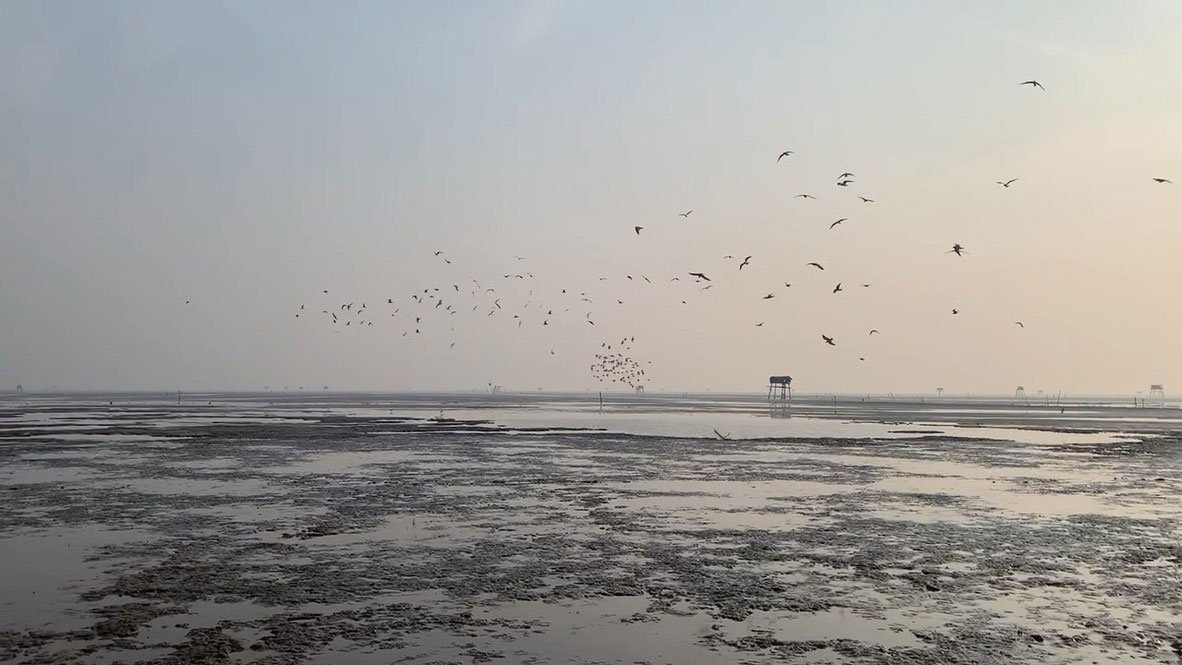
Fucking hell!” Toby shouts, his face still buried in the scope. “I found the spoonie!” He adjusts the focus and steps aside. I peer through the scope with an anticipatory thrill. At first, there’s just a little cloud of feathers. Slowly, the bird takes shape: white-and-grey tear-shaped body, black legs like two black twigs. Tail up, head down, beak busy. I think I can make out a tiny black spoon of a bill but honestly can’t be sure.
Ba looks next. I provide unsolicited commentary about its near extinction. He’s visibly struggling with the scope. Does he see the spoonie? “Well, I definitely see a bird,” Ba says, chuckling.
Then something spooks the shorebirds. All at once, they fly off as if a great wind has blown them away. “Oh no! There they go,” I say despairingly. “They’re leaving!” A little rush of sorrow. I’m not ready to say goodbye.
“You will see, they will go out, they will come back,” Toby replies reassuringly. “They fly, make a round, and they will come back.”
Come,” Toby says in English, “I will show you new species.” He proceeds to lead me across the mudflat, pointing out every kind of shorebird present. Black-bellied plover. White-faced plover. Red-necked stint. Common greenshank. Terek sandpiper. Marsh sandpiper. Curlew sandpiper.
We walk in the stop-and-start rhythm of birders, pausing in front of many groups of birds, keeping a respectful distance. Meanwhile, Ba hangs back with Toby’s assistant, Ngan, absorbed with a group of impressive Eurasian curlew.
“I will show you new species” becomes a refrain, as if Toby is naming creation. Far Eastern curlew. Great knot. Bar-tailed godwit. I know Toby is just doing his job, adding to the morning’s tally of species seen. Yet I also get the strong sense that he wants to show me the rich avian diversity and abundance at Tân Thành, and the ecological significance of these intertidal flats.
I can’t help hearing in Toby’s voice the sound of ecological worry, too. I have read the reports. I know shorebirds worldwide are experiencing steep, alarming declines throughout their range, with many species losing more than 50 per cent of their population over the last three decades.
To assess the present status and distribution of the spoon-billed sandpiper in Vietnam, an international team—led by Nguyễn Hoài Bảo and including Toby—conducted a dozen shorebird count surveys between September 2019 and March 2020. The group’s 2023 research paper identified Tân Thành as the most important wintering ground for the spoon-billed sandpiper in Vietnam, along with supporting many other threatened waterbird species on the East Asian–Australasian Flyway, one of the most significant migratory bird paths in the world. The team also discovered a few previously unknown wintering sites, and found evidence of habitat loss and the rampant use of mist nets.
Though Vietnam boasts an extensive coastline, few coastal wetland sites have been identified to support migratory shorebirds. A crucial stopover on the flyway, Tân Thành beach still lacks formal, strictly enforced legal protections. The researchers’ report underscores the urgent need to designate new protected areas for migratory birds in the Mekong Delta, so as to avoid losing precious wetland habitats like mangrove forests, salt marshes, and intertidal mudflats to poorly planned coastal development projects.
Will the spoon-billed sandpiper survive us and our twenty-first-century world? Conservationists are doing everything they can to make the answer “yes”.
Another spoonie! As I am checking in with Ba, who has been photographing a cooperative group of big Caspian terns parked on the flats, Toby scopes another spoon-billed sandpiper. Even more remarkable: this spoonie is leg-flagged.
Flags and bands, carrying unique alpha-numeric codes, have long been used by conservation biologists to study the movements, behaviour, and survival of birds. The bird is too far away, and too active, for Toby to make out the letters on the flag. He’ll need to obtain a documentary photo.
Since Toby left his camera back at the hotel in Gò Công, Ba happily hands his over. Toby crabwalks 10, 20 yards towards the target spoonie. I try to follow, but my knees give out and I nearly faceplant in the mud, which makes Ba and Ngan laugh. After a few attempts, Toby looks back and gives us a thumbs-up. We huddle and stare at images of a small, white-and-grey shorebird foraging the mudflat. I can clearly see the sandpiper’s spatulate bill: it looks like a tiny ice cream spoon sticking out of its little face. Toby recites the letters on the leg-flag aloud: “H-O”. The slightly stunned expression on his face is hard to read.
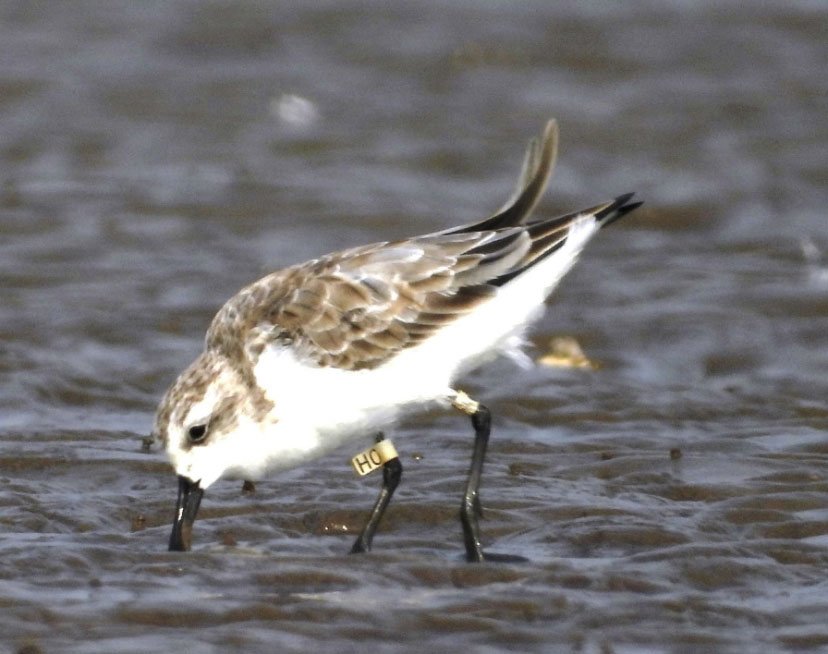
Ba looks pleasantly shocked. “Really? ‘H-O’?” I know what he is thinking. We haven’t learnt anything yet about the bird’s life history, but to us, and many others in the Vietnamese diaspora, “H-O” stands for “Humanitarian Operation”, immediately calling to mind the HO immigration programmes of the 1980s and 1990s that resettled former South Vietnamese political detainees and their families to the US.
My family did not come to the US through the HO programme. Ba would have qualified, given the four years he spent after the war in “re-education” camps, but the HO process could take years. Instead, in late December of 1981, we became those who “vượt biên”—fleeing the country on the same kind of fishing boats we saw stranded on the backshore.
I don’t know what Ba makes of these converging lines of flight: our escape from Vietnam as political refugees over forty years ago, and our return to the country as birdwatching ecotourists. He simply smiles his toothy smile while I ponder signs and omens.
It doesn’t take long before someone associated with the Spoon-billed Sandpiper Task Force responds to Toby’s post on Facebook. Here’s what we learn: SBS White HO came out of a breeding programme where conservationists in northeast Russia collect eggs, hatch them in captivity, and hand-rear chicks before releasing them back into the wild. SBS White HO hatched on 7 July 2021, the offspring of two other tagged sandpipers, White 1H and Lime 88; two weeks later, on 26 July, SBS White HO was released around Meynypilgyno.
These facts help me see the spoonbill as an individual with a specific life history. I imagine his summers amid the flowering meadows and ponds of the tundra, his migration flight, his mornings on the mudflats at Tân Thành.
It’s actually the third time Toby has crossed paths with SBS White HO, and the second for Ngan. Their first time had been in December 2021, when they were conducting an environmental impact report on the Tân Phú Đông Offshore Wind Farm, whose towers and turbines are now fixtures in the landscape. Toby’s second time was a year later, while leading a private birding tour. He hadn’t seen SBS White HO in 2023, nor had there been any reported sightings on eBird. Had the bird succumbed from exhaustion during its 8,000-kilometre journey? Had it dropped out of the sky, or been caught in a farmer’s net? Or had it decided to follow other spoon-billed sandpipers, a significant number of whom could be found wintering in coastal Myanmar and Bangladesh? But here SBS White HO was again.
I venture a question for Toby in my broken Vietnamese: “And how do you feel seeing this spoonie again here this morning?”
“I feel đầy hy vọng,” Toby says, and asks what that means in English.
“Hopeful,” I answer. Toby repeats it after me: hope-full.
A quicksilver band of blue thickens the horizon line, the tide coming in. Ngan whispers something in Vietnamese to Toby, who then says, “We go now.” But we all stay where we are, our feet planted in the mud.
I take a parting look through the scope. He’s still there, a cloudy puff of feathers wrestling a tiny crab, and I feel what Toby felt—đầy hy vọng, as if discovering a new species of hope. I’m weary, however, of extracting sweeping insights and grand metaphors from our encounter. I want to let the spoonie just be. A little shorebird foraging for something to eat, safe in this sanctuary between the tides. I want to soak it
all in. But I can’t, not completely. After all, I’m a human who uses words and lives by metaphors, who needs beauty as much as truth.
As we turn to go, “White HO” flashes before my eyes and I remember my Vietnamese tongue: place an underdot (dấu nặng) under the vowel “o” to denote a low dropping pitch, and “ho” becomes “họ”, which sounds something like “haw” or “awe”. It’s the Vietnamese word for “family name”. (My tên họ, for example, is Phan.)
This is what I’ve wanted, before setting foot on the mudflats, even before returning to Vietnam—it’s what I thought I wanted, and pursued with uncharacteristic determination—a greater connection to the country of my birth through birds rare, and at least by my eyes, never before seen.
Here is SBS White HO signalling: we are kin. That’s what I want to read in these random letters, just as I’ve been attempting to wrest meaning—of belonging, of hope—out of our encounter with the spoon-billed sandpiper and other birds of Vietnam. But the spoon-billed sandpiper is no omen, sign, or prophecy, and does not want to be a rare thing.
Walking on these mudflats reminds me that it’s been the common all along that has provided the greatest points of connection: the air bright with flashing wings and rainless clouds, the mud alive with its million tiny inhabitants. The tide rising now carries the same waters that cover the earth, and I know there’s a deeper, more complicated history to be found in the sky, sea, and mud. My own life history has brought me back here. I can see the country through the eyes of my father as he rediscovers his homeland, and through my own eyes, with the help of guides like Toby, as I learn to see everything, not for the last time but hopefully just the first.
I look back and watch the birds race once more towards the sea, twisting, flashing, and rolling, as if writing something on the sky; see them break apart and scatter across the shining mudflats, like letters to a lost alphabet.

More from Mekong Review
-

Poetry from Phan Nhien Hao
-

How Hanoi’s cartoonists fought hardship with humour
-

A quarantine, and food, in Ho Chi Minh City
- Tags: Hai-Dang Phan, Issue 11, Vietnam
