

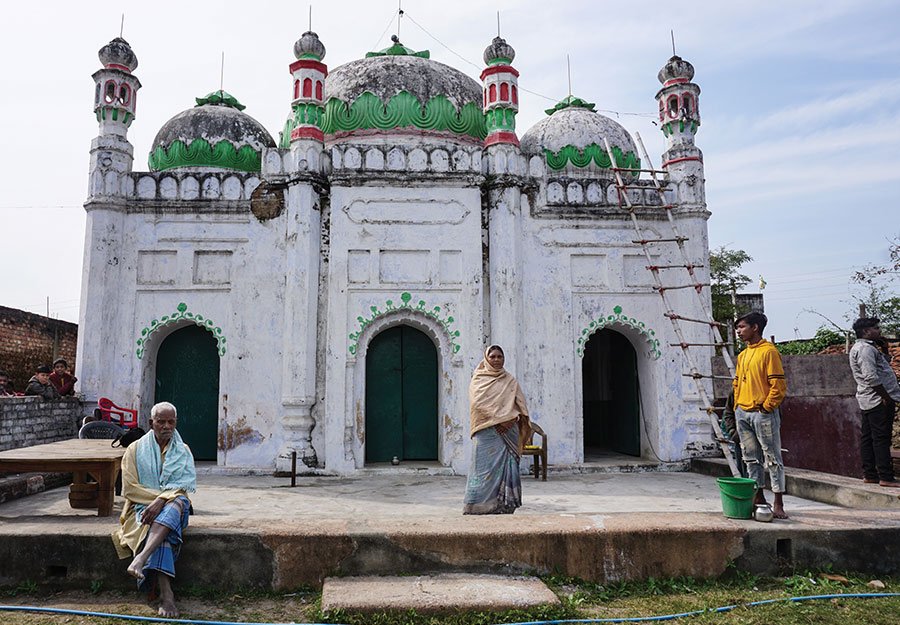
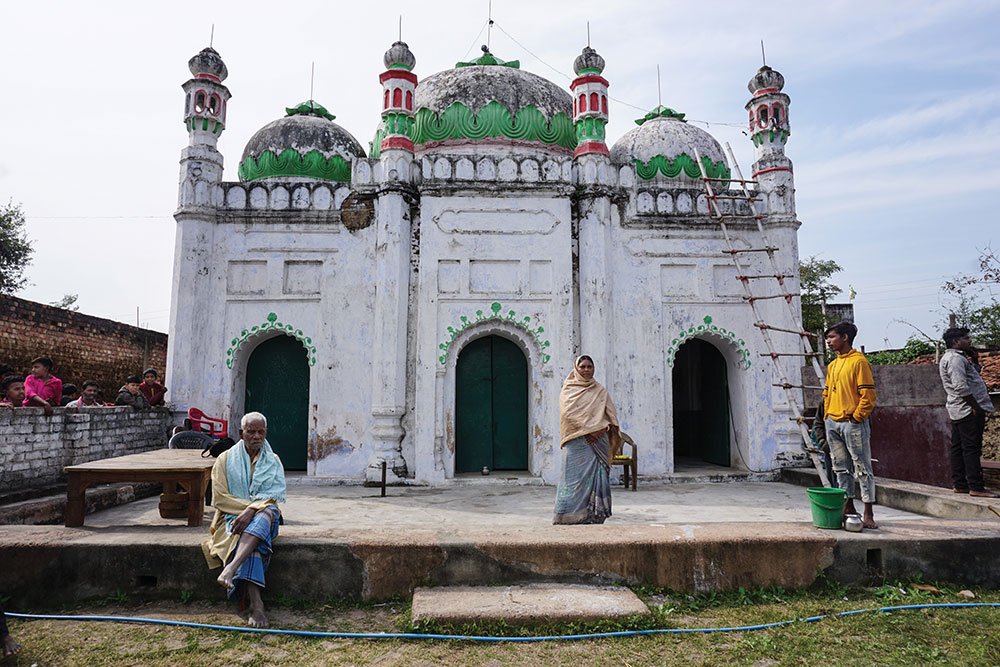
When I arrived in Mari, a largely Hindu village in eastern India, a group of men were gathered outside the local mosque, looking up at it. It was a hot, windy day, and there were children kicking a football around the courtyard. A radio played in the distance. Dogs barked. I stood among the men and watched as one propped a bamboo ladder against the mosque’s rain-worn walls and began climbing to the rooftop. “A wire is broken,” he called down to the others below. He wanted to fix the mosque’s loudspeaker so that they could play a recording of the azaan, or call to prayer.
No Muslims were there to hear it, though. Once an interfaith village, Mari no longer has any Muslim residents—the last families left decades ago. Yet, for the past few years, the Hindus of Mari have been tending to the village’s empty mosque, treating the ancient Sufi tomb that sits beside it with reverence. Local news outlets described it as an act of intercommunal harmony in a country with long-standing religious tensions and sectarian violence. But what does this act mean in a village where one community remains while the other has gone?
Located in the state of Bihar, Mari lies about 30 kilometres from the region’s biggest city, Bihar Sharif, and not far from the ruins of Nalanda, the renowned Buddhist monastic university destroyed around the turn of the thirteenth century. The village is accessible through a highway and a labyrinth of dirt roads. The first time I visited, on a winter day in 2024, I was accompanied by Khalid Alam Bhutto, the grandson of the man who built the mosque about two centuries earlier. Now in his fifties, Alam is tall and soft-spoken, with a pencil moustache, while his wife Rubina has the bubbly energy of a schoolteacher. The couple work in education and live in Bihar Sharif, visiting Mari every few months to check in with the community. Many of the villagers still tend to fields that Alam’s family has owned for generations. The family had been landholders in Mari under the zamindari system established during Mughal rule, sustained by the British colonial powers, and eventually abolished after India’s independence. Generations later, the family’s standing in the village is still palpable.
More from Mekong Review
-

Snacking in Calcutta
-

Modern-day India, where societal oppression is balanced by personal freedom
-

Nothing happens in Salt Lake, and that's all right.
- Tags: India, Issue 44, Tricia Taormina