

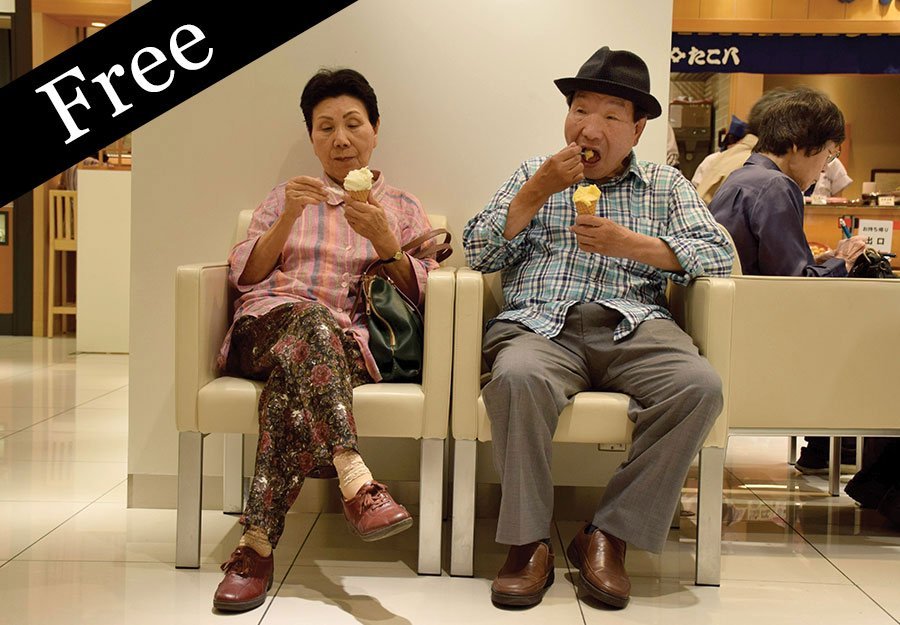
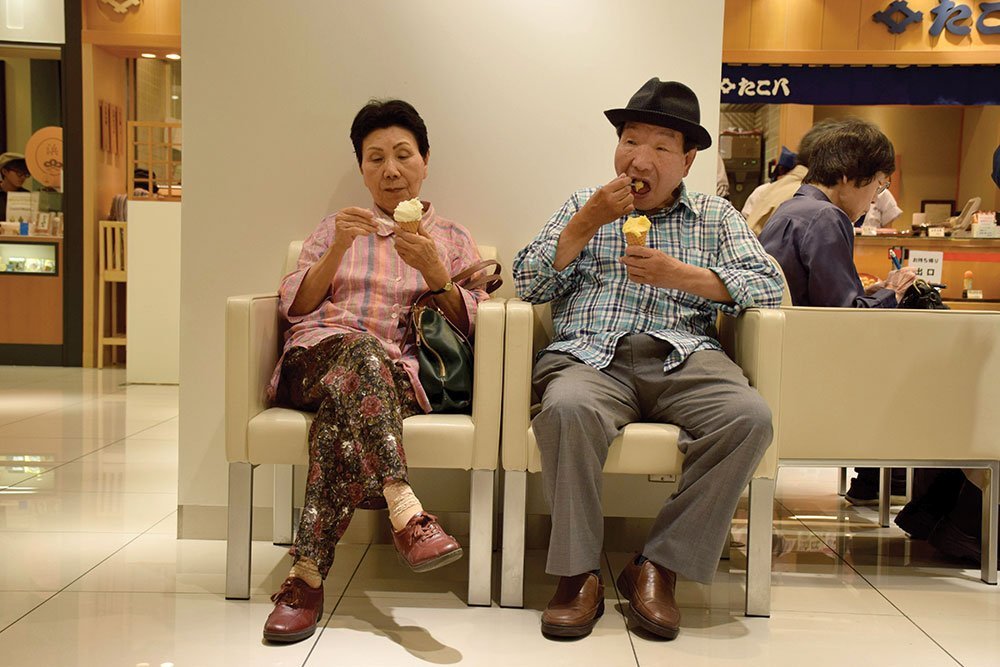
He was innocent. There was never any question of giving up.”
This is how Hakamata Hideko sums up what she’s done for her younger brother, Iwao. She’s so matter-of-fact you’d think she’s talking about some minor neighbourly squabble, and not a fifty-six-year struggle to get Iwao acquitted of multiple murders. By the time Iwao was released from prison in 2014, pending a retrial, he’d spent forty-six years on death row, making him likely the world’s longest-serving death row prisoner. It took another ten years before he was exonerated, at the age of eighty-eight.
When it comes to the death penalty, people focus on the individual—arguing over their guilt or whether they deserve such a harsh, irreversible punishment. But a death sentence is often felt by entire families, thrust into a bewildering world of lawyers, prosecutors, judges, prison officials, probing journalists, and wagging tongues. Some families turn inwards, refusing to speak about what has befallen them. Others choose to take a public stand to fight for their loved ones.
Hideko is one of the latter.
Interviewing Hideko, who’s ninety-two, is a rather convoluted affair. After some back-and-forth (in English and Japanese) over email, five of us gather on a Zoom call. Sitting at home in Hamamatsu, Shizuoka Prefecture, Hideko is accompanied by the friend who handled our email exchange and helps her with the technical requirements of a virtual meeting. Then there’s me and two interpreters. Occasionally, when Hideko has trouble hearing us, her friend repeats the question to her. It’s not the most natural way to have a conversation, but Hideko is patient and open, a polite smile lingering on her face. She doesn’t come across as someone who’s easily fazed or overwhelmed. (“Very stoic,” one of the interpreters observes at the end of the call.)
Hideko’s calm manner contrasts sharply with the harrowing events she describes. On 18 August 1966, police officers showed up suddenly, rounding up the Hakamata family. Each family member was questioned separately. The family home was searched, as were the homes of Hideko and Iwao’s two older sisters.
“At first, I didn’t really understand what was happening. It was my first time experiencing something like this,” she recalls. She remembers being put in a small room with three detectives and kept at the police station from morning to evening. “I wasn’t scared… I just thought, ‘What’s this about?’ and went along.”
The police arrested Iwao that day, and the family gradually realised what he was accused of. He’d been working at a miso processing plant; in June that year, his boss was stabbed to death, along with his wife and their two children, and their home set on fire. The authorities accused Iwao, a former featherweight boxer, of killing them and stealing ¥200,000 (about US$500 in 1966) in cash.
Hideko knew what her youngest brother was like: quiet, reserved, obedient. It seemed absolutely ludicrous that Iwao could be capable of such violence. “At home, we thought there was no way he’d do such a stupid thing, so I wasn’t particularly bothered about it.”
Then, almost a month later, Hideko heard on the news that Iwao had confessed. She was gobsmacked. Later, at his trial, Iwao would recant, telling the court that he’d only confessed after beatings and threats. (It emerged that the police had interrogated him, without a lawyer, for an average of twelve hours a day—sometimes up to seventeen hours in a single day. They also denied him water and bathroom breaks.) That evening, though, Hideko had no choice but to break the news to their mother.
“When I told her, her first words were, ‘We should have kept to a small social circle.’” Despite her disbelief, their mother’s first instinct was for the family to withdraw, to shrink their lives and presence within society. Having a family member identified in the media as a killer and arsonist would be difficult and traumatic anywhere; it was especially so in Japan, where social stigma against criminality runs deep.
Iwao was convicted and sentenced to death by the Shizuoka District Court in September 1968, despite criticism of the prosecution’s case. An appeal to the Tokyo High Court was denied, and the Supreme Court of Japan confirmed his sentence in 1980.
Attempts to seek retrial were made over the years, plodding through the Japanese legal system at an excruciatingly slow pace. In 2007, the chief judge in the three-judge panel who’d convicted Iwao came out in favour of a retrial; he said he’d doubted Iwao’s guilt from the beginning, but had failed to convince his two older colleagues. Even this wasn’t enough to convince the court to allow a retrial. Iwao languished in solitary confinement on death row, his mental health deteriorating. Outside prison, Hideko stood firm as his staunchest supporter and advocate.
The way she tells it, she’d assumed the role quite naturally. She’s always been close to Iwao; the extroverted, expressive older sister to the placid introvert of few words. The youngest two in a family with six children, they never fought. She wasn’t about to turn her back on him—especially since she was convinced the authorities had got the wrong guy.
The biggest motivation, though, was their mother, who struggled to come to terms with her son’s situation. She died without seeing Iwao’s name cleared.
“I suppose you might say that I carry that burden of my mother’s feelings,” Hideko says. “That’s why, after my mother died, having witnessed her anguish and sorrow firsthand, I thought I had to do something about it.”
Hideko attributes her ability to shoulder this responsibility to her circumstances. Unlike her other siblings, who were married and had their own families, Hideko was single. (She had married at twenty-two, but separated from her spouse a year later.) She had a full-time job as an accountant and was financially independent. Iwao could be her main priority.
“Things like visiting him in prison—I did that,” she says. “I didn’t understand the legal side, so I left that to the lawyer. But going for face-to-face visits… It was about seeing him in person and encouraging him.”
In Japan, families aren’t given notice of an execution; the prisoners themselves are only told the morning of their hanging. As long as the courts refused to reopen his case, every day Iwao spent on death row could potentially have been his last.
From time to time, Hideko would hear that someone had been hanged. It feels a little awkward or uncomfortable to put it this way, she admits—someone’s life was taken, after all—but whenever she heard the news, she always thought “it was fortunate it wasn’t Iwao”. Still, it never really felt like her brother could be put to death. “If they were going to execute an innocent man, I felt like saying, ‘Go ahead and try it if you can.’”
To focus on her brother’s case, Hideko distanced herself from society—no class reunions, no parties during festive seasons. I ask if it made her sad to miss out on the things other people enjoy with their friends.
She gives a little shrug. “I never felt lonely, not at all.” She didn’t need those class reunions anyway.
Finally, in 2014: the Shizuoka District Court agreed to reopen Iwao’s case and release him. He’d been sent to death row in his early thirties; he walked out of prison a seventy-eight-year-old man.
Hideko was overjoyed, but the years had taken a heavy toll on her brother. After leaving prison, he spent some time in a psychiatric hospital before moving in with his sister. Once at home, he’d switch on all the lights, even during the day. It’s a hangover from death row, where the lights are left on so the prisoners can’t take their own lives.
When the retrial finally started almost ten years later, it was Hideko who appeared in court on her brother’s behalf, because his mental state left him unfit to attend hearings. In September 2024, the court concluded that key evidence—such as items of bloodstained clothing—had likely been fabricated. At last, a full acquittal for Iwao.
Today, there’s a volunteer group that supports the two elderly siblings, but Hideko is Iwao’s main caregiver. They’ve received apologies from the head of the Shizuoka District Public Prosecutor’s Office and the chief of Shizuoka Prefectural Police. This March, the court granted Iwao an unprecedented payout of ¥217 million (US$1.45 million) in compensation for everything the state had put him through.
Hideko says she feels no resentment or anger. “It doesn’t resolve anything,” she says in her sensible, pragmatic way. What she cares most about is living well with Iwao. She wants to give him “a quiet place bathed in sunlight” to live in peace for the rest of his days.
When the police first showed up at their door in 1966, there was no way Hideko could have predicted what lay ahead for her and her family. She could only put one foot in front of another, again and again.
“Looking back now, fifty-six years is indeed a long time. But when I was fighting, I didn’t have time to think about what year it was, what month, what day. I never once thought, ‘How many years have I fought? Five years? Six? Ten? Thirty?’ I just kept pushing forward.”

More from Mekong Review
-

As discussions of a so-called nuclear power renaissance resurface, Return to Fukushima pushes us to (re)consider not only the ways we live but also the exploitative systems through which energy is produced and consumed.
-

A poem by Pannir Selvam Pranthaman.
-
A poem from Jake Dennis
- Tags: Hakamata Hideko, Hakamata Iwao, Issue 41, Japan, Kirsten Han
