

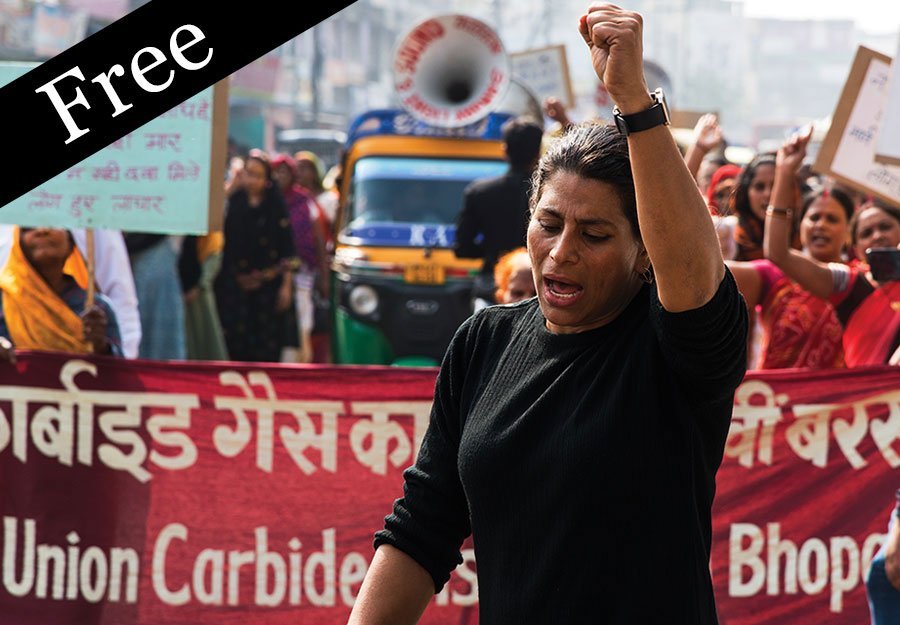

Forty years later, the situation in Bhopal is getting even worse.”
It’s not uncommon to hear such a strong statement from the survivors and activists of Bhopal in the state of Madhya Pradesh, India. The rusting and crumbling carcass of the Union Carbide India Limited plant—the site of the world’s worst industrial disaster—is still visible from many of the surrounding neighbourhoods and slums. A short walk through its grounds, where vegetation has grown wild and unruly, makes clear that not enough has been done to clear up the area. The leakage of dangerous pollutants into the groundwater has been affecting communities around the plant for decades now.
Built at the end of the 1960s by Union Carbide India Limited—majority-owned by Union Carbide Corporation (UCC) in the US—the plant produced Sevin, a pesticide that uses the highly reactive and lethal methyl isocyanate (MIC) as an intermediate chemical. The plant was supposed to serve the “Green Revolution”, a programme introduced in the 1960s by the US and Indian governments, with support from US philanthropic organisations, to transition from traditional small-scale, multi-crop organic agriculture to highly mechanised, chemical-driven practices that would increase crop yields. But instead of providing jobs and boosting Bhopal’s economic development, the plant ended up becoming its greatest curse. On 3 December 1984, more than 500,000 residents of Bhopal woke up to the hell of a gas leak of forty tonnes of MIC blowing over their city.
The disaster had been a long time in the making. There’d been a deliberate policy of cutting costs and corners at the plant. For example, in order to save on building costs, plant standards in Bhopal were well below those met by another UCC plant in West Virginia in the US. The night of the disaster, an alarm system that would have warned people outside the plant of leaks had been switched off. There was also very little knowledge or information of the sort of hazardous materials handled at the plant; even local healthcare workers had no idea what they were up against. At the time, few truly understood the scale of the catastrophe they were about to face. By the time most people found out about the leak, it was too late to escape exposure.
Victims recall similar stories of being awakened in the middle of the night by desperate shouts of “run away!” in the streets. When they stepped out of their homes, their eyes and lungs burned unbearably. The more they ran, breathing heavily to take in more oxygen, the worse it got. Many lost control of their sphincters and fell unconscious. Many died. Estimates of fatalities vary; according to Amnesty International, between 7,000 and 10,000 people died within three days of the leak. Activists put the overall death toll at up to 25,000… and counting.

I arrived in Bhopal two weeks before the fortieth anniversary of the tragedy. Local activists were holding daily commemoration events with testimonies, speeches and poetry, as well as a temporary museum displaying victims’ belongings and photographs of the tragedy. They set up a gathering point in front of the UCC plant, drawing in people from the surrounding neighbourhoods. Most were women accompanied by their daughters, men with significant disabilities and children. There were mothers whose children hadn’t even been born at the time of the leak but still suffer from conditions and disabilities caused by the contamination—one of the most appalling legacies of the tragedy.
Faris Ali had only been three years old when the disaster struck. His mother had run desperately, with her youngest baby daughter in her arms, before she fell unconscious under a dying buffalo. She died, but Faris’s sister survived. Both siblings continue to suffer from chronic, debilitating conditions: respiratory issues, hypertension and loss of appetite. “I’m not able to do any hard work because of my respiratory problems, so I rent a car for 300 rupees (US$3.50) per day and work as a driver. I barely repay the rent of the car,” Faris told me. He received 50,000 rupees (US$583) in compensation for the leak but spent almost 400,000 rupees (US$4,664) on medical costs for his father, who developed throat cancer after exposure.
The issue of compensation is a thorny one. The Indian government and UCC arrived at a settlement of US$470 million in 1989, working out to compensation of about US$500 per person. UCC had pressured the government to classify injuries as mere “temporary disability” or “minor injury” so they wouldn’t have to pay out so much.
This has been the company’s strategy from the very beginning: to downplay the effects of the toxic gas. On the night of the disaster, when hospitals were overwhelmed with thousands of patients and doctors watched helplessly as people died in their arms, UCC’s doctors went around assuring people that the MIC gas was similar to a “strong teargas” and that no chemical would enter the bloodstream. They insisted that, apart from the burning sensation in lungs and eyes, there would be no effect on any other organ or foetuses in wombs.
These claims have been conclusively disproved. Studies have found that between 100,000 and 200,000 people still suffer from a laundry list of serious chronic conditions: reduced breathing capacity and vision, damaged immunity systems, joint pains, neurological disorders, kidney diseases, cancers, cardiovascular problems or reproductive issues. The incidence of children with intellectual and physical disabilities born to mothers who’d been exposed to MIC is seven times higher than that of non-exposed mothers.
In 1991, the Central Bureau for Investigation filed criminal charges against UCC, Union Carbide India Limited, Union Carbide Eastern (another subsidiary that ceased operations that year) and nine individuals. A year later, the Chief Judicial Magistrate’s Court declared that UCC and Warren Anderson, its chief executive, had absconded from justice by not participating in the legal proceedings. In 2001, UCC was bought by Dow Chemicals, another multinational company from the US; Anderson never returned to India and died in 2014. In 2010, Union Carbide India Limited and seven Indian individuals were found guilty of causing death by negligence. The individuals were fined and sentenced to two years in prison each—four of them have since died and appeals are still ongoing for the rest. Union Carbide India Limited was fined 500,000 Indian rupees (US$10,870 at the time).
Two groups—the Bhopal Group for Information and Action and International Campaign for Justice in Bhopal—have spent decades fighting for proper compensation for victims and the prosecution of UCC. They accuse Dow Chemicals of sheltering a proclaimed absconder. It took them twenty-three years, seven summons and an order from the US Department of Justice to force Dow Chemicals to appear in an Indian court in 2023 and explain UCC’s absence in the legal proceedings.
I attended a hearing at the Bhopal District Court in December 2024. Dow Chemicals had engaged one of the most prominent law firms in the country to represent them. A team of ten lawyers, all dressed in black, showed up in court that day. During the hearing, they stood around Ravindra Shrivastava, a senior counsel sitting in front of the judge. Their presence loomed over the small courtroom, blocking the view of two elderly survivors sitting behind them. The lawyers argued that Dow Chemicals was a firm from the US and that the Indian courts did not have jurisdiction over it. The Central Bureau for Investigation has since countered that, under Indian law, jurisdiction flows not from the nationality of the accused but where the alleged offence was committed. The case continues to drag on.
The ghost of the Bhopal tragedy continues to haunt Bhopalis, but it hasn’t stopped there. Residents of Pithampur, about 250 kilometres away, fear what they call a “slow motion Bhopal”. In June 2023, the government of Madhya Pradesh announced its intention to spend approximately US$15 million to incinerate 337 tonnes of hazardous waste from the UCC plant near Pithampur. This is a tiny proportion of the total amount of waste to be dealt with—even after all these years, a comprehensive scientific assessment of the depth and spread of contamination has yet to be carried out. Despite strong opposition from survivors and Pithampur Bachao Samiti (PBS), a local organisation, the government pressed on. On the first day of 2025, twelve trucks loaded with the waste showed up at an incineration plant, owned by Ramky Waste Management, in Tarpura village on the outskirts of Pithampur.
Protests erupted across Pithampur shortly after; two protesters even attempted to self-immolate. In response, district authorities imposed Section 163 of the official criminal code, which prohibits gatherings of five or more people. When I visited Tarpura in early March 2025, I found that the small rural village had been invaded by dozens of factories. The Ramky incineration facility was uncomfortably close to the community—its boundary wall is mere metres away from residential homes and just a few dozen metres from the ancient Bokaneshwar temple. Police were deployed everywhere to suppress resistance: not only were gatherings prohibited, people were also banned from climbing up to their own rooftops and, apparently, communicating with journalists. Not long after my arrival, a police officer approached me, demanding that I either provide proof of permission to speak with people or leave the area immediately.
Hemant Hirole, a representative of PBS, told me of a trial incineration of ten tonnes of hazardous waste carried out in 2015. Many aspects of that trial—as well as revelations documented in the minutes of meetings held by the Ministry of Environment, Forest and Climate Change in 2023—are deeply concerning to activists: during the trial in 2015, ambient air quality monitoring data showed an alarming increase in the concentration of nickel. Although no chemical analysis of the remaining ashes were provided, it’s believed that it very likely contained high concentrations of heavy metals and other toxic compounds. It was then reported in 2023 that, because a high quantity of reagent is required, the incineration of 337 tonnes of waste is expected to generate 900 tonnes of residue. “These 900 tonnes will have a high concentration of poisonous chemicals and heavy metals, which will then be buried in so-called secure landfills at Pithampur that have been leaking poisonous leachate for some years now,” states a December 2024 press release issued by four activist organisations. “The officials have no way to ensure that the poisons from 900 tonnes of residue will not contaminate the sources of water in and around Pithampur. As per official plans, the incineration is to be carried out for up to three-and-a-half months. The population likely to be exposed to airborne poisons and particulate matters for such a long period is well over a hundred thousand. It is nothing short of deliberately creating a public health disaster.”
The activists also point to a history of operational failures at the Ramky incineration plant: a mere eleven days before the waste was transported to their facility, the Madhya Pradesh Pollution Control Board notified Ramky that they were initiating legal action against the company for violating the Water (Prevention and Control of Pollution) Act because various possible contaminants had been detected in the area. Ramky responded to the notice on 2 January 2025—a day after receiving the twelve trucks loaded with hazardous material—but the matter hasn’t been resolved yet. How then, activists demand, can the authorities entrust such a high-stakes undertaking to a company they themselves are accusing of having breached contamination prevention regulations?
Three trials of ten tonnes of waste each were carried out in early March. No previous environmental impact assessment—which is required by law—nor documentation regarding the exact composition of the waste has been made public, but a report prepared by the Madhya Pradesh Pollution Control Board and Central Pollution Control Board stated that all three trials met the required standards in terms of emissions. On 27 March 2025, the High Court of Madhya Pradesh ruled that the incineration of the remaining 307 tonnes of waste could proceed over a period of seventy-two days.
PBS and other local activists are refusing to give up. They’ve filed a new petition to the High Court of Madhya Pradesh, listing all their objections to the incineration. They’ve also proposed alternative solutions, one of them based on the ‘polluter pays’ principle: since the source of the problem was a majority US-owned plant, Dow Chemicals should be involved in fixing this mess once and for all, as was the case in 2003 when the Tamil Nadu Pollution Control Board compelled the British multinational company Unilever to transport about 300 tonnes of its hazardous waste to New York for safe disposal. But Dow Chemicals has refused to take on this responsibility; not only do they refuse to accept Indian jurisdiction, they also argue that they should not be required to deal with this problem because they didn’t own UCC at the time of the gas leak.
While disputes over compensation and safe disposal of the leftover waste continue to rage, activists are forced to struggle with one other challenge: that of adequate treatment in government healthcare facilities.
Satinat Sarangi arrived in Bhopal as a volunteer in the immediate aftermath of the disaster. In conversations with the victims and survivors, he and his fellow volunteers realised that most of them had been given huge amounts of medicines—mainly antibiotics, painkillers and steroids—that were ineffective at best or, in more serious cases, actually harmful. This shocking discovery pushed him to start the Sambhavna Trust Clinic in 1996 to study and provide effective healthcare, combining Western and Ayurvedic medicine with yoga to address people’s needs. Today, the clinic is a key fixture in the community and has registered more than 37,000 patients for long-term care.
They’ve got their work cut out for them. As if the MIC gas hadn’t done enough damage, people in Bhopal have also been exposed to contaminated water leaking from the solar evaporation ponds UCC constructed in 1977 to store hazardous chemical wastes and byproducts. Both the company and government bodies had been aware of leaks and seepage from these ponds even years before the 1984 disaster, but nothing had ever really been done. Multiple studies report the presence of toxic chemicals and heavy metals as far as three-and-a-half kilometres from the plant; survivors’ organisations are still petitioning the central and Madhya Pradesh governments to take action.
Clean drinking water supplies have been slow to materialise in this area. Efforts to provide communities around the UCC plant with water tanks only began twenty years after the gas leak and many have fallen through the cracks. Although the Supreme Court ordered the state government of Madhya Pradesh to provide safe drinking water to twenty more communities in 2018—bringing the total with access to safe water sources to just over forty—several dozen continue to drink contaminated water from handpumps.
I met Chote Khan and his family near the solar evaporation ponds. They’d relocated to a home nearby some years after the disaster and, completely unaware of the contamination, had drunk from the ponds for a long time. Both his children and grandchildren are now suffering the effects of exposure to both toxic gas and water. Mohammad Shafique, a friend and neighbour, told me that the water had even corroded crockery and clothes washed in it, but there had been no alternative until tankers and piped water were finally provided.
Forty years after the winds blew deadly gas over their streets and homes, the victims, survivors and activists of Bhopal are still locked in an exhausting, ongoing fight for justice and well-being. The odds continue to be stacked against them and the ill effects felt through the generations, but the community remains steadfast.
I asked Banoo Bi, a victim and activist, how she feels about the future. She said: “I still believe in justice. I still believe that it is possible to receive it from this system. But under one condition, namely collective work. We can get justice if we all work together and if everybody gives us support for it.”

For updates related to the legal proceedings, check https://www.bhopal.net/category/press-releases/

More from Mekong Review
-

Snacking in Calcutta
-

Modern-day India, where societal oppression is balanced by personal freedom
-

Nothing happens in Salt Lake, and that's all right.
- Tags: Bhopal, Claudio Avella, Free to read, India, Issue 39
