


I hear Basu before I see him, his rapid-fire Bengali filling the stairwell outside my second-floor office. And there he is: perched on the banister, a Samsung flip-phone cradled to his cheek. It sounds serious, so I hover by the water dispenser till he’s done, but he shrugs it off when I ask what’s wrong.
Just at home things, he says, then corrects himself. Things at home.
Home, I learn, is Madaripur, a district outside Dhaka where Basu has lived nearly all his life. His parents live there too, with two younger siblings who are still at school. For now, he rents a bed in a dormitory by the MRT tracks near Woodlands, and is part of a four-man team doing repairs on our building. I’ve noticed their lorry parked downstairs in the mornings, with tools and cables stacked in the back. Always close enough to leave spare parts in, but a safe distance from the officers’ coveted lots.
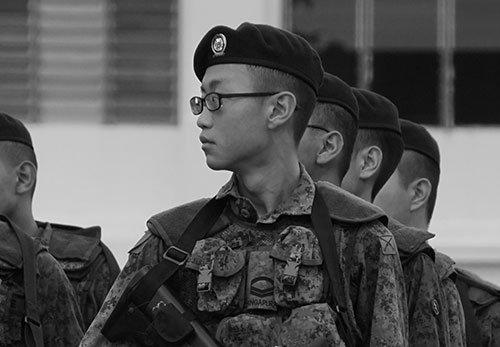
The building, part of a sprawling facility in the north of the island, has seen better days. The camp was established in 1994, the year I was born, its boundaries have been extended over the decades to house different units of the Singapore Armed Forces. It’s my home too, for a year and a half as I complete my national service — a rite of passage that, for most of my countrymen, is synonymous with citizenship itself. Popular films and songs refer to it as a coming of age; you aren’t quite a grown man till you’ve given up “two years of [your] time” in mandatory conscription. But I’m less convinced. Having spent four years abroad, advocating for refugee rights and attending open-borders protests, it’s hard to square those arguments from a colder climate with the reality of my obligations here.
More from Mekong Review
-

A poem by Theophilus Kwek
-

The taste of home
-
A poem by Theophilus Kwek
- Tags: Issue 17, Singapore, Theophilus Kwek