

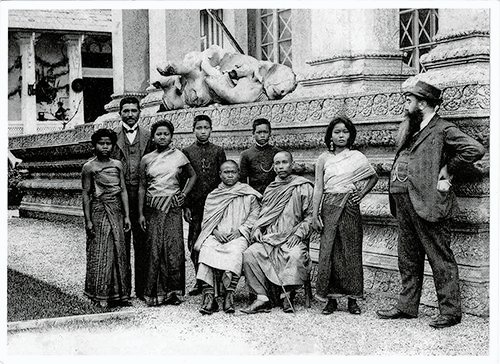
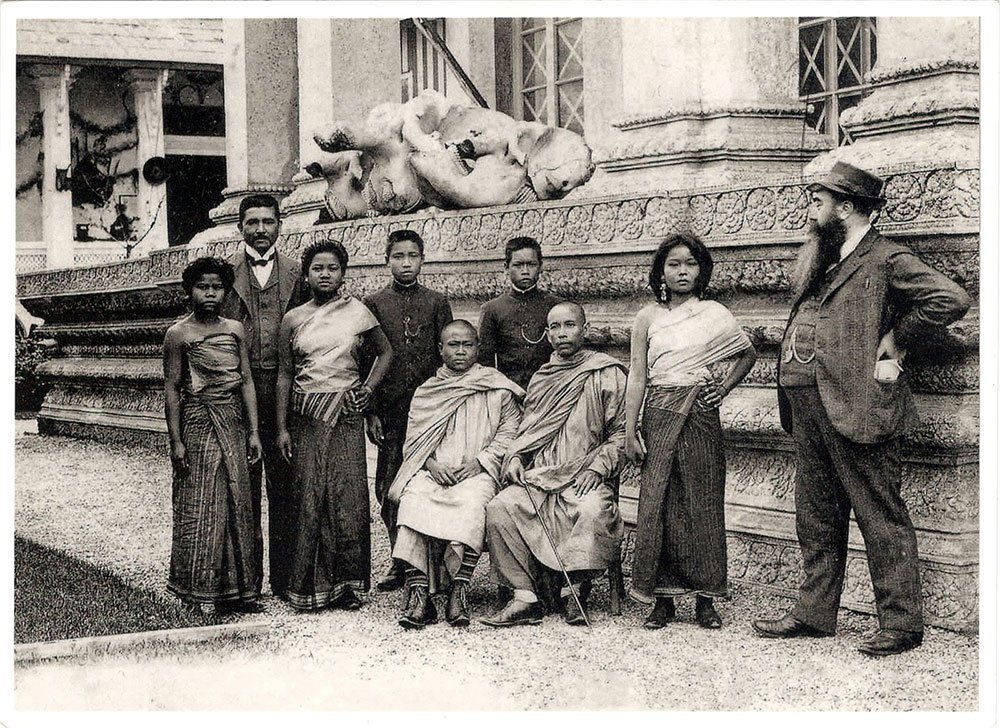
The name “Alfred Raquez” may be familiar to scholars of the history of Indochina, particularly Laos. Remembered today primarily for his 1902 book Pages Laotiennes and his nearly 200 postcards of Laos, in his own day he was admired primarily as an explorer and travel writer. Raquez travelled constantly during his eight years in Southeast Asia and left descriptions of every place he visited, from major entrepôts like Singapore and Bangkok to small towns like Lao Cai and Muang Sing, often published in periodicals affiliated with the French Parti Colonial, both in Paris and in Hanoi.
After his death in 1907, it was revealed that Raquez was the pseudonym of Joseph Gervais, a disgraced lawyer who abandoned his wife and three children when he fled France in 1898 after he was declared bankrupt as a result of running a Ponzi scheme and stealing money from a lay Catholic organisation he had helped to found. After the revelation, his work was quietly forgotten, and only recently has his native talent as a writer and explorer of the Far East at the fin de siècle undergone a reassessment with the publication of scholarly translations of Raquez’s travel narratives In the Land of Pagodas (NIAS Press: 2017) and Laotian Pages (NIAS Press: 2018).
Raquez visited Phnom Penh often and occasionally wrote about those experiences in now neglected descriptions of the city. His earliest sketches date from his first visit in June 1898, not long after he first materialised in Indochina, in the Mekong Delta town of My Tho, seemingly out of thin air.
We know from a confidential telegram sent by the young deputy administrator of My Tho, Louis Victor Cudenet, to his superior Édouard Picanon, lieutenant governor of Cochinchina, that Raquez was travelling with two men named Mitchell-Innes and Orts, both of whom were watched closely by the colonial administration because they had until very recently been in the employ of Chulalongkorn, King of Siam.
Alfred Mitchell-Innes was a British diplomat assigned as a financial adviser to the Siamese court in 1896. He was tasked with modernising the Siamese financial system, but he seemed not to have ingratiated himself with his hosts and left before his tenure was complete. He is remembered today primarily for two articles he published in 1913 and 1914 titled “What is Money” and “The Credit Theory of Money”, which are recognised as seminal for modern theories of economics.
Pierre Orts was a young Belgian assistant to the powerful Gustave Rolin-Jaequemyns, a Belgian lawyer who was appointed as the top European adviser to Chulalongkorn in 1892. Orts arrived in Bangkok that same year and quickly proved his usefulness, earning the praise of his superiors. He would later enjoy an illustrious career as an international diplomat, helping to draft the armistice that ended the First World War and later participating in the first meetings of the United Nations in 1946.
It is not known why Raquez was travelling with these two individuals or when they first met. The Bangkok Times (31 May and 3 June 1898) relates that Mitchell-Innes and Orts travelled together to Indochina to visit Angkor Wat prior to taking planned leaves of absence in Europe, and it is known that Raquez arrived in Saigon on 14 June aboard the Donai, the ship on which Mitchell-Innes and Orts were also travelling (Le Courrier de Saigon, 15 June 1898).
The evidence suggests Raquez probably met them aboard ship. It is not known if he travelled all the way to Angkor Wat with them. He would later reminisce about his journey with “two charming comrades, Michel Innes and Robert Artz, one Irish, the other Belgian” (“De Saïgon au Golfe de Siam par Terre”, La Revue Indochinoise, 2 November 1903). The misspelling of their names and incorrect nationality for Mitchell-Innes, who was in fact Scottish, indicates a lack of closeness between them. Nonetheless, from My Tho, Raquez accompanied them to Phnom Penh aboard the Tiampa, a small steamship provided by Étienne Ducos, the resident superior of Cambodia.
Raquez’s descriptions of this 1898 visit were originally part of a longer manuscript titled Feuillets détachés, which at one point he was preparing for publication. But other than a few excerpts that later appeared in periodicals, it never made it to print. These excerpts include three vignettes of Phnom Penh, which we have translated and edited and present together here (“Harem Royal”, L’Avenir du Tonkin, 1 January 1902; “Variétés: Pnom-Penh”, La Revue Indochinoise, 10 February 1902; “Variétés: Dans Pnom-Penh”, La Revue Indochinoise, 17 February 1902).
At its best, Raquez’s style is remarkably modern, often concisely written in single-sentence paragraphs that show him keeping a sharp eye for the telling detail and mostly free of the lurid piling up of details or sentimental formulas of his contemporaries. The early examples presented here are not his finest writing, which is perhaps why Feuillets détachés was never published in full, but they remain valuable for their descriptions of French perceptions of Phnom Penh and the Cambodian monarch Norodom in 1898.
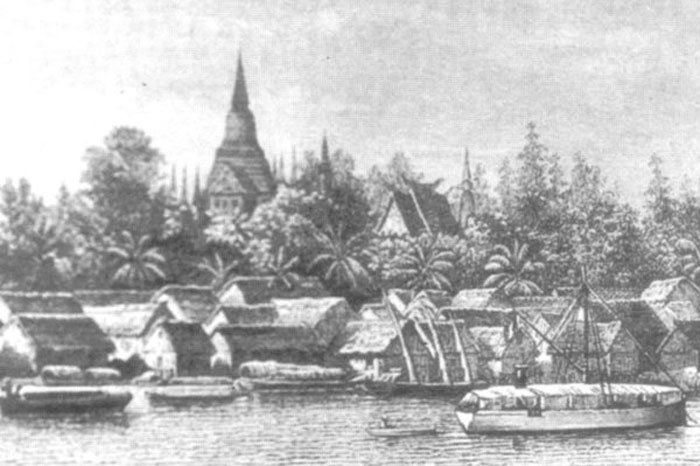
At the time, the city was undergoing a building spree, which, as Penny Edwards has shown in her study Cambodge: The Cultivation of a Nation, was largely a French phantasmagoria of faux-Khmer style and Parisian geometry. Raquez notes some of the city’s attractions, including the naga bridge (a French design completed in 1892) and the eponymous phnom, renovated by Daniel Fabre, the same architect who built the naga bridge and who also designed the fanciful Cambodian pavilion for the 1889 Universal Exposition in Paris. Raquez also praises more overtly colonial erections such as the recently completed treasury building as well as Wat Phra Kaew, also known as the Silver Pagoda, which opened in 1902 within the walls of Norodom’s palace, itself purpose-built by the French as a pleasure dome for the king’s benefit after they declared Phnom Penh the capital of the protectorate in 1866.
The king was himself as much of an attraction as his palace, and from his mode of dress to his overactive libido, Raquez depicts Norodom as a clown. This is of a piece with French efforts at the time to portray the king as unfit to rule: duplicitous yet buffoonish, decrepit yet lascivious. It was clearly in the best interests of the protectorate if France could usurp as much of the king’s temporal powers as possible. By 1898, the stripping of the monarch’s powers was largely complete, and the old king was left a mere figurehead, ripe for ridicule. He would die in 1902.
Raquez gives particular emphasis to Norodom’s “harem”, which numbered in the hundreds, a point of fascination for European readers. As Milton Osborne has shown in his study Phnom Penh: A Cultural History, while many of these women were indeed royal concubines, many others were daughters of senior officials whose role was to maintain political balance. But of course sex sells newsprint, and Raquez has no qualms about spreading rumours that Norodom’s French navy doctors administered injections of Brown-Séquard’s elixir to help revive his potency.
Charles-Édouard Brown-Séquard is remembered for his 1850 discovery of Brown-Séquard Syndrome, a rare neurological condition caused by damage to the spinal cord, but he was also one of the first medical men to postulate the existence of hormones. His elixir was synthesised from fluids taken from the testicles of guinea pigs and dogs, and, like the monkey gland injections taken by a later generation, was believed to restore flagging vigour. Given that Norodom was addicted to opium and apparently a heavy drinker, it may well be that he needed a boost. But as Raquez relates, the injections led to unforeseen consequences.
During this visit, Raquez also attended an entertainment at the palace, starring an illusionist styling himself as “Master Léopold of Paris”, but whose real name was Léopold Bernard, and concluding with a “cinematographic” display. The first public film screening in history by the Lumière brothers had occurred only three years earlier in Paris. Instantly popular, the new medium rapidly spread around the world. Early pioneers of cinema screenings were often magicians, who used the novelty of the technology, a trick of light and shadow, to supplement their stage act. Yet Bernard would soon outgrow magic; he is now remembered as a successful businessman who opened the first chain of cinemas in Cochinchina.
The screening in Phnom Penh in June 1898, most likely the first films ever shown in Cambodia, was an event so unusual as to merit a brief mention in the “Faits Divers” section of Le Courrier de Saigon of 22 June, which notes that the “highlight of the evening was the cinematograph”.
Before the projection started, the centrepiece of Master Léopold’s performance was a “spirit cabinet”, an illusion created by the Davenport Brothers, an American spiritualist act who first performed it in the 1850s. Audience members would bind the illusionist’s hands and feet, then close the doors or curtains of the cabinet. After a while, strange apparitions would begin to appear and odd music could be heard coming from within; but when the doors were opened, the magician would still be tied up. Still, it was the films that stole the show.
Bernard screened several films that night, and Raquez tells us the title of one of them: Le Bain de la Parisienne. This could refer to two films of the same name. The first was produced in 1896-97 by Eugène Pirou, a photographer and producer of naughty postcards and later short films, which depicts a lady being bathed by her maid. Alternately, it may be Georges Méliès’ notorious 1897 film Après le bal, le tub, also known as Le Bain de la Parisienne, which depicts the same subject in nearly the same staging and is notable for being the first film to depict full nudity, even though the actress Jehanne d’Alcy, later Méliès’ wife, used a body stocking to preserve her modesty. No matter which bathing beauty was first projected on screen in Cambodia, Norodom’s reaction to this salacious imagery completes Raquez’s 1898 tour of Phnom Penh.

More from Mekong Review
-
A glimpse of 19th century life in the Cambodian capital
-
William J. Rust sheds new light on postwar Cambodia
-
A killing remembered in Cambodia
