


Ajoomma
He Shuming (director)
Giraffe Pictures, 2022
.
A joomma. Translated into English, it refers to a middle-aged, married woman. But it also means so much more than that, evoking a familiar figure of (often) permed hair, proclamations and fussing. The Singaporean equivalent that springs to my mind is ‘auntie’. The word conjures images of the older women in our lives who nag, spoil and care for us. It is an intimacy that can but doesn’t require blood ties. It’s hard to comprehensively define in words, but we recognise an auntie when we see one.
So it was with me when I watched Ajoomma, a Singaporean-South Korean production directed by He Shuming. From the moment Lim Bee Hwa (played by Hong Huifang, and generally addressed as Auntie throughout the film) appeared on screen, I immediately recognised her character. I’d seen her before. The loose-fitting clothes, chosen for comfort and convenience in the hot Singaporean climate and likely worn for years so as not to ‘waste money’. The morning group dances, as much an excuse to gossip with friends as for exercise. The preparation of food for loved ones, always prioritising their taste buds over her own. And, of course, the addiction to melodramatic Korean serials.
The thing about the term ‘auntie’ is that it describes a person in relation to others. An auntie is an auntie because of who they are to the people around them. Such has been Lim Bee Hwa’s life: she’s been a caregiver to a parent, a husband and a son. She cooks and cleans and tidies, so that when her adult son returns at night, there is food on the table in their comfortable public housing flat. But now both her mother and spouse have passed on, and her son springs a surprise: he’s been asked to fly to America for an urgent job interview and can’t accompany her on a much-anticipated Korean drama–themed tour of South Korea after all. Auntie initially tries to cancel their booking with the travel agency. But when she discovers that the holiday is non-refundable, frugality and desire collide into an impulsive decision to go on the tour by herself.
Who is Auntie when she’s alone? She’s a fish out of water the moment she lands at Incheon Airport: she’s clumsy with the routine of international travel, unfamiliar with immigration cards. It turns out she’s the only Singaporean in a tour group dominated by mainland Chinese tourists. And, to cap it all off, her jaded and beleaguered guide Kwon-woo (Kang Hyung-seok) accidentally leaves her behind at a nondescript housing estate on her very first night in the country of her drama fantasies. The only person willing to help her is Jung Su (Jung Dong-hwan), an elderly uncle of a security guard who barely speaks a word of English. An unexpectedly dramatic coincidence brings Kwon-woo, Jung Su and Auntie together, leaving them to catch up with the rest of the tour group.
When I first heard about this film, I imagined some sort of madcap cross-country adventure involving Auntie and a couple of oddball misfits—perhaps something that would fit in with the implausible setups of comedic-yet-heartfelt K-drama favourites like Crash Landing on You. Instead, what Ajoomma offers is a delicate meditation on familiarity amid the unfamiliar. Auntie and Jung Su struggle to surmount the language barrier, but realise that they’re both empty nesters, left to their own devices after years of providing for children now grown. Language isn’t needed when experiences are shared.
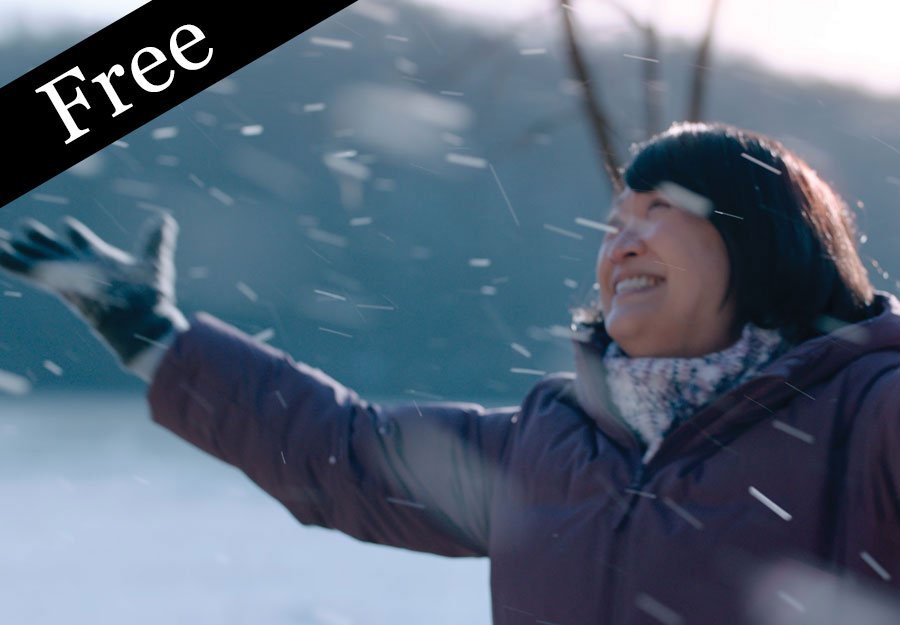
In Ajoomma, Auntie’s journey of self-discovery isn’t about finding a place where she’s comfortable or where she fits. This resonates: we often learn the most about ourselves when we end up in situations where things don’t go right, and we’re forced to rise to the occasion. After a lifetime defined as a daughter, a wife, a mother, Auntie arrives in South Korea and finds that, even when stranded without her things in a country where she only knows not-very-useful phrases from her favourite dramas, she can still manage remarkably well and enjoy herself. In one endearing scene, she sees snow for what is possibly the first time ever. Auntie cheers and dances amid the gently falling flakes. In that moment, the unassuming older woman who’s spent years living for others turns into a giddy, giggling girl, savouring the moment only for herself, oblivious to the bemusement of her Korean companions.
The theme of finding oneself isn’t limited to coming-of-age stories involving teenagers and young adults. Anyone, at any stage of their life, can have questions about who they are and surprise themselves. Ajoomma tells a story about finding peace in one’s heart even if one hasn’t particularly been looking. Auntie hadn’t been dissatisfied or unhappy with her life. She hadn’t wanted to run away—in fact, she initially hadn’t wanted to go on a solo trip at all. She’d just wanted a holiday to visit the sites of her favourite TV shows. But the trip turned out to be more than she’d bargained for, in the very best way, and she grew into herself in ways she hadn’t realised she’d needed. When her son drops another surprise on her over a video call partway through her trip, he seems nervous about how she might react, but she handles it with equanimity. “What haven’t I seen before?” she says. It’s a comment that gains extra resonance considering what she’d just been through.
Nothing particularly earth-shattering happens in this film. And that’s all right. Sometimes adventures don’t need to be apparent to anyone else except the ones who went on them. It was just enough of a balm for the heart to see Auntie go on hers.

More from Mekong Review
-

A lone figure walks Seoul's Cheonggyecheon waterway
-
The taste of home
-

Baek Sehee writes: “The world tends to focus too much on the very bright or the very dark.” She steers clear of both extremes in her book. For this alone, it merits attention.
- Tags: Free to read, He Shuming, Issue 30, Kirsten Han, Singapore, South Korea
