

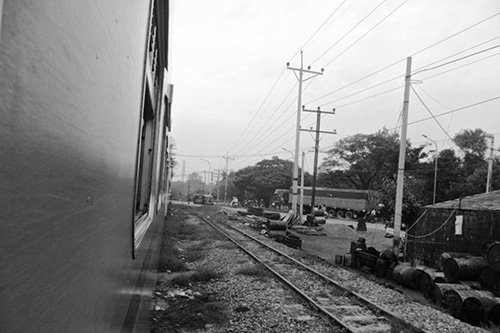
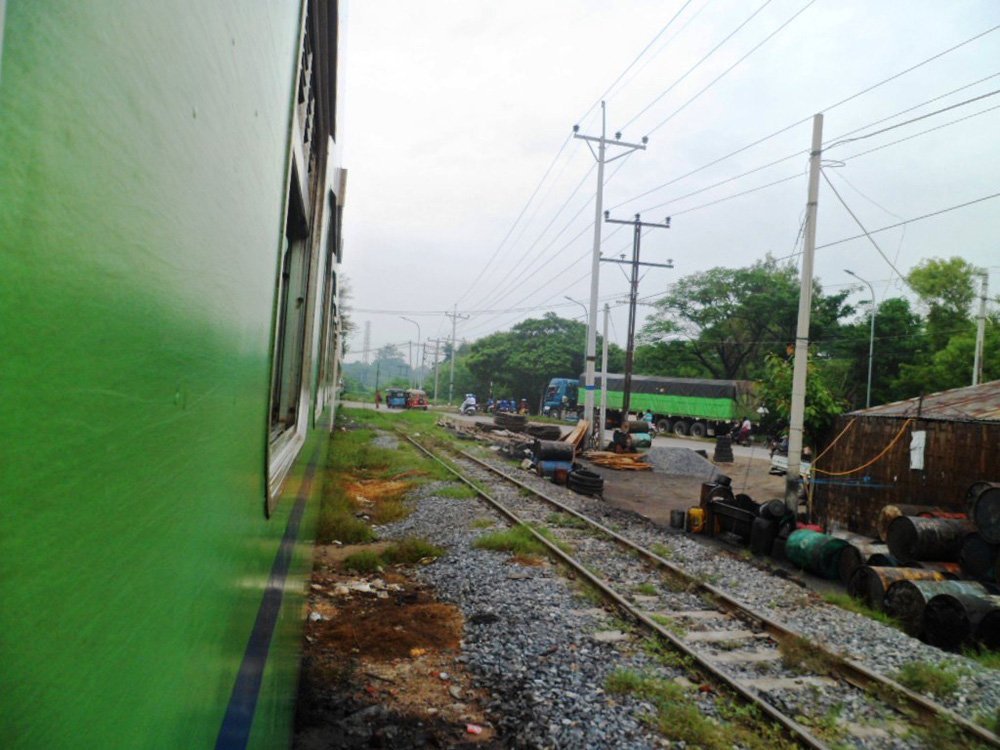
From Yangon, some would prefer to go to Mandalay by plane, boat or bus, but I chose to go by train, as Paul Theroux had done in 1970. I was heading north to attend the fifth Irrawaddy Literary Festival and to catch up with Keith Lyons, a travel writer and the editor of Opening Up Hidden Burma: Journeys with or without Dr Bob Percival, a tribute to our late friend. We’d both be staying at the A.D.1 Hotel, a favourite of Bob’s when he was in town.
The train to Mandalay is slower than the express bus, but it’s also cheaper. To travel by rail is to better see the surrounding countryside, where paddy fields flank the tracks and shaggy huts shelter farmers guarding their crop. To travel by rail is also to be able to relieve oneself at ease; bus passengers have to wait until the bus stops at a designated food house or somewhere similar.
During the holidays, however, and especially on the full-moon day of Tazaungdaing (in November), the bus and train terminals in downtown Yangon are full of people who have been waiting to get tickets since 3 or 4 a.m. On Bogyoke Aung San Road, as soon as the train ticket office opens they rush to buy the upper-class and first-class tickets. Within two or three hours, these tickets are sold out. Normally, Myanma Railways sell tickets three days ahead for upper class and one day ahead for first class.
In The Great Railway Bazaar (1975), Theroux writes more about buying tickets than riding the train. After being told by a nonchalant clerk to come back to the ticket office in the morning — the sales window was “closed” despite being open — Theroux eventually reached Mandalay. His journey did not end there, however: he carried on to Goteik Viaduct, in Shan State, ninety kilometres to the northeast, even though it was “forbidden for foreign tourists to see the viaduct”.
*
While riding a train, it’s common to make friends with fellow passengers. Some people like to share snacks, including pickled tea-leaf salad, potato chips and sunflower seeds. Accepting such snacks is a good way to start a conversation, which will inevitably lead to questions about your work or the reason for your trip. Normally, people ask whether you’re travelling for business or on a government assignment and whether you’re from the area. My conversation lasted for a few minutes before the railway employees called out for requests to borrow books or comics or to purchase food. They had soft drinks, water, snow towers, even instant coffee and tea for those who needed a hit of caffeine.
Our compartment had fans on the ceiling, along with CCTV cameras. A couple next to me said they last took this trip ten years ago. Now, during the Tazaungdaing festival, they were taking the train because her stylish husband preferred it over the bus. They asked where I’d be staying in Mandalay — they wanted to stay there, too — and whether train tickets were sold the same way in Mandalay as in Yangon. The girl in the seat behind me said they were. They seemed satisfied by that, but when they found out the cost of a single room at my hotel was around 16,000 kyats (US$11) a night, they wanted to look for somewhere else.
At one station, the train stopped for only a few minutes. By the time we reached Taungoo, the midpoint of our journey, it was around 11 p.m., but even at that hour vendors and sellers boarded the train and hawked their goods: dried banana, mangosteen, steamed sticky rice, fried peanuts, crispy sesame. It was then time to sleep.
*
Around 7:30 the next morning, our train pulled into Mandalay, the second-largest city in Myanmar, with a population of around 1 million. Founded in 1857 by King Mindon as the new royal capital of the Konbaung dynasty, Mandalay sits on the east bank of the Irrawaddy River. During World War II, the Japanese conquest of Burma, as it was then known, caused much damage to the city, but as soon as 1948 Mandalay was thriving in the newly independent Union of Burma. Today, Mandalay is not only the economic centre of upper Myanmar but also the nexus of Burmese culture: ten kinds of handcrafts are still booming here.
Mandalay and Gaw Wain Jetty cannot be separated. The name Gaw Wain is familiar to all history students in Myanmar; it was where the British, in 1885, took the last king of the Kaungbaung dynasty when exiling him to Ratnagiri, India, after the Third Anglo-Burmese War. Historically, the jetty has much value. The film Never Shall We Be Enslaved (1997) includes a scene in which the Myanmar king and queen are captured and brought to a ship. Since then, I’ve been wanting to see what the jetty looks like in person. I invited Keith to join me.
The jetty is in a vital spot on the Irrawaddy River. In 1864, its docks were built by the visionary Prince Kanaung, a younger brother of King Mindon. Taking a minicab, we reached the jetty in less than twenty minutes. The jetty and its surroundings were unshielded from the mid-morning November sun. A series of barges and small boats were tied to the banks. Women were washing their linen and clothes at the edges of the brownish water, occasionally beating it with their wooden clubbers. They didn’t have access to tap water like in cosmopolitan Yangon.
Along the strand, roadside teashops and snack shops had been set up. Some people were squatting and sitting on the concrete steps that led down to the private and government-run jetties. Approaching the washers and bathers, we saw a small boat in which an old lady prepared her morning meal while her cat slept on a side plank. It was such a contrasting and enlivening sight. Other, more well-decorated boats were moored at the bank, waiting for their turn to take tourists up and down the Irrawaddy. Life along the river seemed steady and calm. In the meantime, at a distance, a boat carried goods downstream.
Beside the road stood large, shady banyan trees with distinctive patterns in their hard bark. Our quiet morning walk lasted about forty minutes, until we called another minicab to take us to a crowded tea house in Mandalay called Karaweik, named after a mythical bird renowned for its auspiciousness. We stopped at the famous Naing Lon ice-cream shop and then admired some graffiti art on a nearby wall. We moved on to the clock tower in the centre of the city and then bought books at the well-known Tun Oo bookshop, the main seller of its type in upper Myanmar.
*
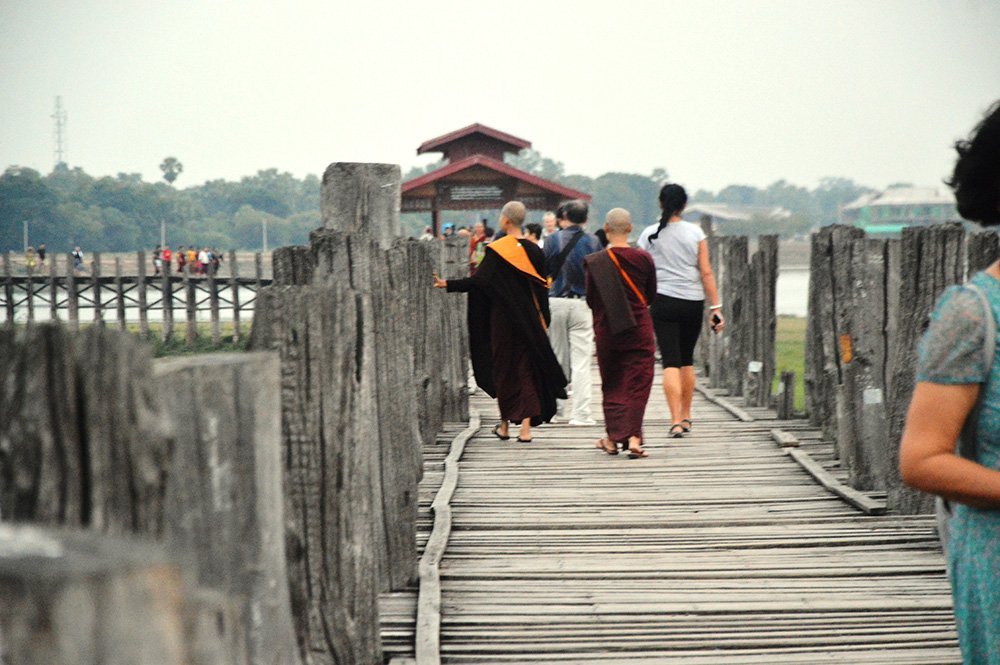
At noon, we stopped off at the hotel where the literary festival was taking place. Keith and I thought that before we went our separate ways we should go and see U Bein Bridge, which spans the Taungthaman Lake near Amarapura. Built around 1850, and 1.2 kilometres long, it is believed to be the oldest and longest teakwood bridge in the world. It was made of wood reclaimed from the former royal palace in Innwa, about twenty kilometres south of Mandalay, and originally comprised around a thousand pillars that shot out of the water, some of which have been replaced with concrete blocks. Others drifted away in floods during World War II.
The bridge’s construction started when the capital of Ava (Innwa) Kingdom moved to Amarapura. (The bridge is named after the mayor who had it built.) In recent years, it has become a tourist attraction as well as a significant source of income for souvenir sellers and food sellers.It is particularly busy during July and August, at the peak of the tourist season, when the lake is at its highest.
Keith’s friend Paul Muller (she takes a male foreign name) in Mandalay drove us to U Bein Bridge — about thirty minutes away — in their van. There, we saw people preparing mote lone yay paw (floating rice balls), a popular snack made of pieces of jaggery studded inside glutinous balls. They gave them to people out of pure generosity.
I was amazed to see dozens of visitors walking across the wooden bridge on the eve of the full moon day of Tazaungdaing. Taking photos and posing, everyone seemed jovial. Herons glided over the lake while seemingly carefree egresses rested at its edges. The stump of a big tree was visible from the bridge, and a group of tourists on the boat were trying to take photos of the bridge and the people on it. Ducks breeding on farms on an island in the middle of the lake emitted a series of quacks.
Soon darkness would fall, obscuring everything and casting the bridge into silhouette until the moon rose. Looking towards the bank from the unlit bridge, we saw shimmering lights reflecting on the surface of the water. It was almost time to return to where we had parked our van, in the compound of a pagoda, and to head to the heart of the city.

More from Mekong Review
-

Yangon's Lim Chin Tsong Palace
-
Japan's kintsuba sweetshops blend informal spontaneity with old-world elegance
-
Tripe to trotters, brains to balls—Bangkok is learning to love the whole pig
- Tags: food, Free to read, Irrawaddy, Mandalay, San Lin Tun
