

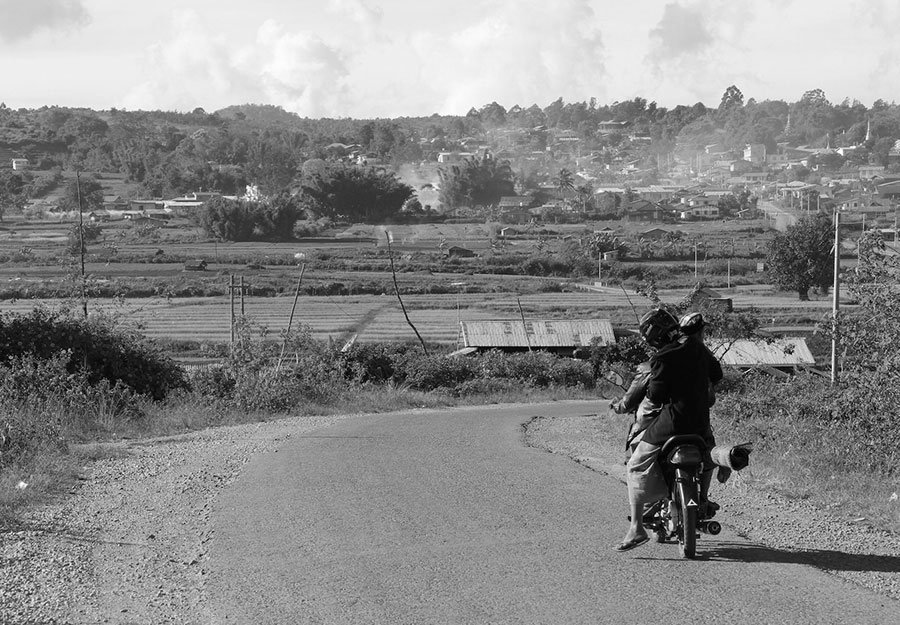
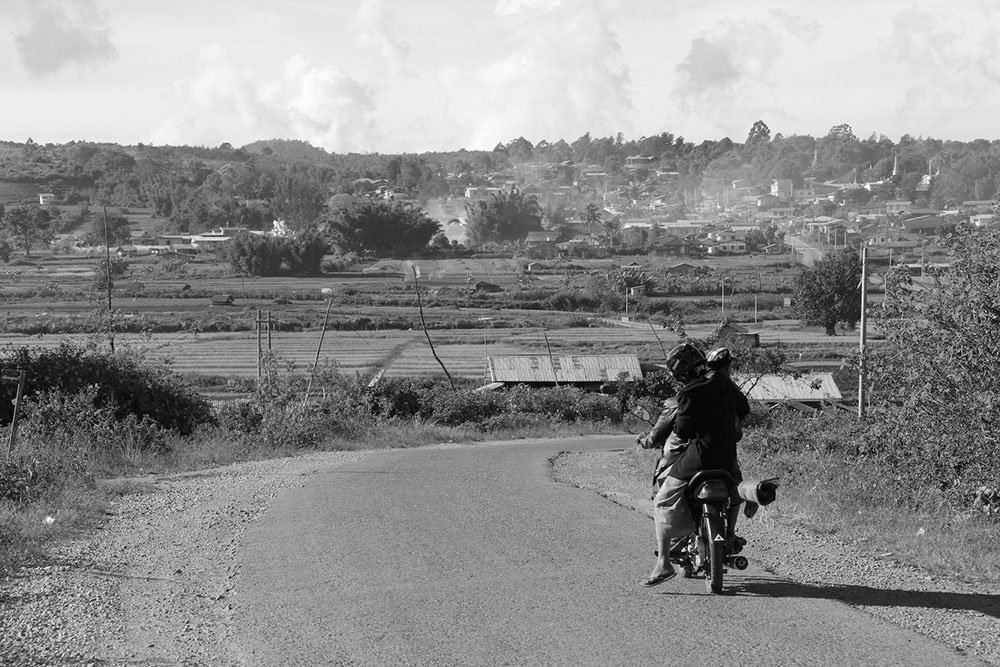
This small town in Myanmar is set in the basin of a valley. A patchwork of fields and mango groves sweep over the hills to the north, east and south. Between them twist white roads splintering into smaller tracks of cracked red earth that lead to twinkling pagodas standing erect upon the crests. Mountains climb to the west of the town where monasteries sit upon rocky outcrops strung together by covered pathways.
Brittle tea plants are planted with polka dot precision. During the dry season, in the courtyards of brick houses with maroon shutters, mounds of leaves are laid out to be sorted: the best used locally in tea leaf salad, the rest to be sent to the tea shops of Yangon and Mandalay.
I left Yangon for this small town in the middle of March. In Yangon, the demonstrators that had initiated the start of the resistance to the military coup of 1 February were being dispersed by police using live rounds. Students armed with sling shots began building barricades of sandbags and tires. They wore hard hats and rucksacks filled with books in the hope that this might protect them from bullets. In response, battle-hardened light infantry battalions were deployed and much of the city descended into warfare.
In this small town, the resistance has been more sedate. Jogging under banyan trees each morning I pass graffiti which reads: ‘The Military are Terrorists.’ Every few days I hear the sound of two dozen motorcyclists riding stubbornly around the town, demanding that democracy be restored.
But mostly it is quiet.
One morning I sit with an elderly gentleman under the awnings of his small shop across from the central market. He drinks black coffee with a wedge of lime. His right eye is clouded with a cataract and he has wispy white hair. This man was arrested in 1988 for taking part in pro-democracy demonstrations. The military tactics today are just the same, he tells me: cut communication, instil fear, show no mercy.
‘The world must act!’
From Yangon I have brought Japanese jasmine and padauk flowers for a family I know in passing. They feed me the Burmese New Year snack of coconut and jaggery. Their small teenage son speaks to me in the stilted language of English learned from a book, carefully crafting each sentence. Since the military cut mobile data a month ago, his family has had no access to the internet.
‘They are taking everything.’
His mother, who speaks no English, beams at me as he says this. Before I leave, in a fervour of hospitality she raids her larder to prepare me a hamper: sugar, coffee, about a dozen melons and a great sack of loose tea. She tells me that if I need anything I must come to her.
This town is a two-hour bicycle ride from one of Myanmar’s most famous natural features. With the opening to outsiders over the past decade the town has seen a steady increase of travellers, leading to the blooming of a small tourism industry: trekking guides, coffee shops and restaurants overlooking the lake serving tamarind salad and spicy pork.
The hotel I am staying at is made up of a dozen bamboo rooms and small stone cottages situated in a garden of towering banana and pomelo trees. The fabrics in the rooms are handwoven in the town of Pakkoku on the banks of the Irrawaddy River. The soap in the bathrooms is made from the garden plants. Squirrels come to steal the fruit and I am woken each morning by the neighbour’s boisterous rooster. I am told he is being prepped for his first cockfight.
In previous years I have taken treks through the tea fields and over the mountains into the coffee plantations. Farmers would show me the red cherry bushes intercropped with macadamia nuts and then take us to the roasteries for tasting.
My guide—let’s call him KT—has a small office in the centre of the town. On its wooden doors he has drawn in white chalk a map of the main trekking routes underneath the jubilantly scrawled word Bienvenue!
I poke my head inside and see that KT has changed his line of business. Gone are the backpacks and camping stoves and in their place are shoes imported from China. His portly figure emerges from behind a pile of boxes, his thick eyebrows furrowed and an anxious smile on his face. This, at least, hasn’t changed. KT was always a harassed, albeit obliging, guide, generally lagging behind his clients, panting and stumbling, losing his footing and slipping off the path into the foliage.
He is pleased to see me and dismisses the shoes with a noncommittal wave of his hand. We climb into his pick-up truck and travel an hour west through the mountains, eventually descending down a dusty track and park up next to a creek. We wade up the river and discover a waterfall and plunge pool crowned with creepers and papaya trees. We eat papaya and drink whiskey sitting on a large rock in the middle of the water. KT enthuses on how travellers would go mad for this place and we merrily debate where the best place would be to pitch the tents.
A few days later all Wi-Fi is cut. At the town’s beer station the television set is occasionally switched to one of the independent broadcasters who haven’t had their satellite dishes dismantled. We watch fishermen protesting in boats at Inle Lake, farmers in ox carts in Bagan and monks in Mandalay. The news reels invariably end with screams and the crackle of gunfire.
One evening when leaving the beer station by motorbike, a friend and I see a convoy of military trucks stationed by the lake. We drive past quickly and quietly. We have both seen footage from across the country of soldiers taking pot-shots at people on scooters. Later they return the corpses with a certificate stating death by traffic accident.
As we arrive back at our hotel, power to the city is cut. Not an uncommon occurrence in Myanmar, but unnerving in the current climate. For over an hour we sit in silence on the hotel terrace, our ears straining to ascertain whether the sounds of dogs barking and children shouting are the normal sounds of a town at nightfall or something more sinister.
The next day two old hand expatriates and their Burmese wives check in. They have had access to the internet more recently than us and deliver the news: the students with slingshots are fleeing into the jungle to be armed and trained by the ethnic militias stationed in Myanmar’s borderlands. Neither side is backing down and the international community is unable to muster an effective response.
On the table across from ours sit half a dozen young men from the town wearing AC/DC T-shirts and shorts from the Premier League. Late in the evening we join forces, them fortified by alcohol and us in need of cigarettes. One of the old hands tells a twenty-year-old that he must be ready to die if he wants his country back. The twenty-year-old says that he is.
We drink beer. Everyone is furious. The fury of the young men is at the injustice and the brutality. Our fury is at the whole bloody waste of it all.
I have been lucky to call Myanmar home for the last six years. Lucky to see, in places such as this town, travellers swoon at the generosity of the Myanmar people and the country’s raw beauty.
Peace still reigns in this small town. But it is a nervous peace that will not last. Something eventually must break. The country is in an extended inflection point. This small town, and other small towns—tea fields, papaya groves, all of it—are held in suspension. Poised to tumble into the abyss.

More from Mekong Review
-

Growing up a troublemaker in Myanmar
-

A poem from a protester in Myanmar
-

A military coup in Myanmar
- Tags: Bertie Alexander, Free to read, Myanmar, Notebook
