

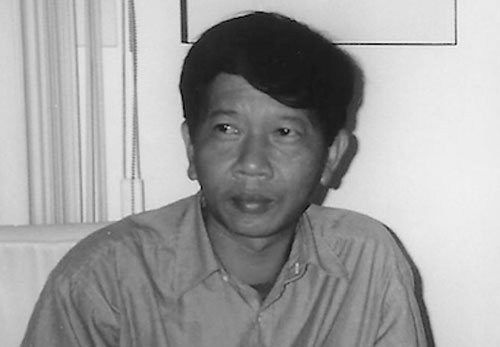

I first encountered Nguyen Huy Thiep, who died on 20 March at the age of seventy-one, while working as an English teacher at the University of Hanoi in the summer of 1990 during the thick of the Doi Moi (Renovation) era. While my salary was paid by the Stanford service programme, Volunteers in Asia, the university contributed additional renumeration in the form of free Vietnamese lessons taught by a junior cadre from the International Relations Office. To my great good fortune, I was assigned Phan Quang Minh, an intense and idealistic returnee from the Soviet Union in his early twenties who used our class to introduce me to his many Doi Moi-era passions including the writing of a relatively new writer.
Perhaps because he knew that I was also a History PhD student, Minh taught an early lesson on ‘Vang Lua’ (Fired Gold), Nguyen Huy Thiep’s scandalous historical story that had provoked a flurry of harsh attacks and ardent defences in the local press. As fascinating to me as the story’s revisionist history, blunt language and structural eccentricity (it features three endings) was Minh’s immense enthusiasm for it. ‘Can you believe what Nguyen Du says here?’ Minh would exclaim, his voice rising. Awed by the story and eager to improve my Vietnamese, I translated it into English and sent it to a small quasi-academic journal that published it alongside an extended introduction; my first scholarly publication.
Right before my eighteen months at Hanoi University came to an end, a fellow teacher at the university and an amateur writer heard about my translation and offered to introduce me to Thiep whom he knew casually. In January 1992, I spent an afternoon with the writer in the shadow of the enormous cement Buddha that he had recently erected in the front yard of his home in a village, located now in a southeast suburb of Hanoi known as Thanh Xuan. He was a gracious host and answered my crudely academic questions about the meaning of aspects of his stories—why the three endings?—with remarkable patience and generosity.
When I returned to the United States, I visited a Vietnamese bookstore in northern Virginia’s Eden Center and was delighted to see they sold pirated copies of Thiep’s work. Its owner introduced me to a group of Vietnamese American intellectuals, including Truong Hong Son and Tran Qui Phiet, who had been following closely the unfolding of Doi Moi. With them and the Harvard historian Hue Tam Ho-Tai, I organised a panel on Doi Moi literature at the Association of Asian Studies Conference at which I presented a talk on ‘Fired Gold’.
The following summer, I returned to Hanoi with the idea of interviewing Doi Moi writers together with my future wife Nguyen Nguyet Cam, a Hanoi resident. Owing to the growing impact within Vietnam of the fall of the Eastern Bloc, the mood in Hanoi had changed by the time I touched down in the summer of 1993 with the party putting a break on cultural Doi Moi and clamping down on many of its leading figures. In this constricted atmosphere, Thiep reluctantly accepted our request for an interview but the project fell apart before our conversation could take place. I was able to return to Hanoi the following year to run an exchange programme for American students and to finish my PhD.
To distract from the agony of dissertation writing, I pursued several Thiep-related projects during that year (1994-95) in Hanoi, including translations of two more stories, ‘Pham Tiet’ (Chastity) and ‘Kiem Sac’ (Sharp Sword). I wrote an essay “Declassifying Nguyen Huy Thiep” that rejected Greg Lockhart’s classification of Thiep as a Vietnamese post-modernist. (Lockhart was the translator of Thiep’s The General Retires and Other Stories.) The real significance of the writer’s work, I suggested, lay in its bold intervention in late-communist Vietnamese politics and culture rather than in its kinship with a fading global literary trend. Through writing this piece, I supplemented my readings of Thiep’s fiction with a broad survey of the transnational critical discourse about the writer and came to better appreciate the depth and breadth of his impact on the cultural scene. Living in Hanoi, I was thrilled to be able to consult directly with the writer on these projects. Cam and I grew close to Thiep that year and he attended our wedding in December 1994.
After relocating to Berkeley to take up a job at the University of California, Cam and I spent time with Thiep in the US during a State Department-sponsored trip that he took in 1996. We met him in New York where he agreed to sit for the long-postponed interview, which I eventually published in the Journal of Vietnamese Studies. We also travelled with him and a small entourage during one week in Manhattan, including a memorable night in which he read his work, translated by the Philadelphia poet Linh Dinh, at the ultra-hip Nuyorican Poets Café in Alphabet City.
Several years later in 1998, I invited Thiep to return to the US for a West Coast trip. At Berkeley, he delivered a talk that was protested by a loud group of Vietnamese American anti-communist extremists who attacked him absurdly as a ‘plant’ from Hanoi. They waved banners: ‘Da Dao Nguyen Huy Thiep!’ (Down with Nguyen Huy Thiep).
Later that trip, I travelled with Thiep to ‘Little Saigon’ in Orange County where we met with cultural leaders from the local community including some luminaries from the Republic of Vietnam. I was especially struck by the humility and kindness that he displayed toward the eminent but aging southern writer Vo Phien and by the way he hit it off with the great composer Pham Duy. Thiep, in those days, was at the height of his fame; it was just over a decade since the publication of ‘The General Retires’. He was the closest thing at that moment to a Vietnamese literary rock star.
During the twenty years since Thiep’s California trip, Cam and I visited with him during every one of our annual trips back to Vietnam. While we occasionally visited his home in order to see his wife, Trang, we more frequently met at Café Nhan on Hang Hanh Street together with his dear friend Bao Sinh. Nguyen Huy Thiep’s trajectory fell abruptly during these last two decades as his productivity waned and his new work failed to make the impact of his writing from the late 1980s and early 1990s. He was a sad figure during his final years, living in the past and openly disgruntled about the eclipse of his fame.
But to me and my family he was always immensely kind and solicitous, a great writer and a true friend.
More from Mekong Review
-

Memories are let loose in a Ho Chi Minh City quarantine facility
-
Race and beauty in Vietnam
-
Why Vietnam's young writers are going online
- Tags: Free to read, Nguyen Huy Thiep, Peter Zinoman, Vietnam
