


Recently I took my mother out for a health check in the middle of a lockdown in Hanoi. We were both anxious, as we didn’t have the travel permit required to leave our ward. My mother had tried to obtain one but none of the instructions online covered medical needs. But we had a doctor’s note, surely that would be enough.
The road we were on was empty. We passed a police checkpoint, but no one stopped us. The street leading to Bach Mai Hospital’s side gate was unrecognisable. What was usually a bottleneck junction—a kaleidoscope of green, white and blue taxis and motorbikes—was a vacant lot. Hanoi’s largest hospital was ghostly quiet. ‘This is probably one of the safest places you can visit now,’ my mother’s doctor said. ‘Everyone here is vaccinated.’
We learned that many of the young staff, mainly men, had gone south to assist in the Delta outbreak. The southern provinces are at breaking point, contrary to state media reports, which have started to focus on the numbers of recoveries at a time when deaths were rising. Single-day records for case counts continue to be broken, going beyond the 10,000 mark. Daily deaths are in the hundreds and climbing too.
On TikTok, you can watch a video of masked people sitting or lying on bamboo mats, some connected to an IV drip, all crammed into a warehouse, presumably in Binh Duong, the country’s biggest Covid-19 hotspot after Ho Chi Minh City. A few swipes later, I see footage of angry people trying to escape what looks like a factory. Rumours of unrest in Binh Duong’s Tan Uyen town circulated that weekend, after some Covid-positive patients, including a pregnant woman, allegedly died in quarantine. I found no confirmation of the story in the local media but came across an article announcing the suspension of the director of Tan Uyen’s medical centre for ‘not doing a good job’.
Back in Hanoi, with its dozens of cases a day, the health crisis in the south seems remote. I don’t know anyone with Covid-19 in the capital, but I do know plenty of people who have been vaccinated. They are university lecturers and a researcher, some tech workers, retirees and a banker. Most of them managed to jump the vaccine queue, thanks to connections with employers, friends and family. My family signed up with the local ward for vaccination in early August. We don’t know when our turn will come. Our neighbour is holding out for a Pfizer vaccine when it becomes available.

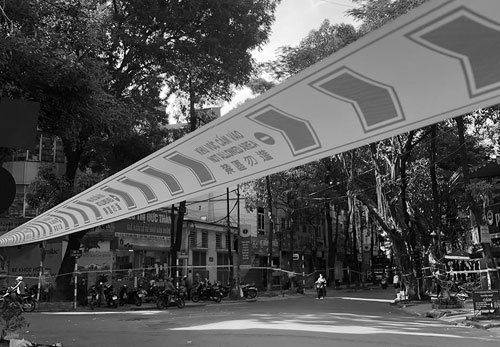
Since Hanoi’s lockdown was extended in August, I have been hearing sirens almost everyday, not from ambulances but a mobile loudspeaker. It’s how announcements on the latest Covid-19 rules are preceded, followed by orders to stay put and go nowhere. We are allowed to go out only for groceries on designated days using a market pass issued by the government. The supermarket and wet market I usually go to are covered in cordon tape with red and white stripes telling passers-by not to enter. But people still do.
I feel an uneasy assurance living in Vietnam’s capital city: what a friend has referred to as ‘hiding under the big mandarin’s shadow’.
But my bubble was burst one day when my mother forwarded me a message from the neighbourhood warden. It’s the same message from the department of information and communications, posted on the messaging app Zalo and the government Facebook page: anyone who’s been to x shop in the past two weeks must immediately contact health authorities.
After multiple calls, I finally managed to get through and was told to come to the local clinic in the evening for a test. When I arrived, there was chaos in the front yard of the clinic. Some people were filling out forms, others were handing in forms, while many more were just standing around looking disoriented and not observing social distancing. I finally found the person in charge, who told me and others to go home and self-isolate without any further explanation.
So I went home and isolated myself from the rest of my family. I tried to do some work, with little success. Later that week I was tested as part of the government’s effort to screen my ward. Only a small fraction of residents answered the call. People are scared that mass testing is a sign that an outbreak is imminent. Their fears were heightened when the government announced it was going to relocate 1,000 residents of two badly hit alleys to a university dorm to avoid further spread. ‘Whoever refuses to go, will be forced to do so,’ we were told.
Meanwhile, a friend from Ho Chi Minh City wrote to let me know that, after a week of fever and coughs, she has Covid-19. The only outsiders she’s had contact with were courier drivers, on whom she’s been relying for the past month or so for unessential essentials like a replacement laptop. We Hanoians tell ourselves we can’t afford an outbreak like the one in Ho Chi Minh City, for, as we are learning from friends there, if that were to happen, even money can’t guarantee there will be enough food on the table.

More from Mekong Review
-

Thanks to the pandemic, Tet in Vietnam won't be quite the same this year
-
Readers respond to our review of Ken Burns and Lynn Novick’s The Vietnam War
-
Photographer Yvan Cohen in Bangkok's disappearing Chinatown
- Tags: Free to read, Lam Le, Notebook, Vietnam
