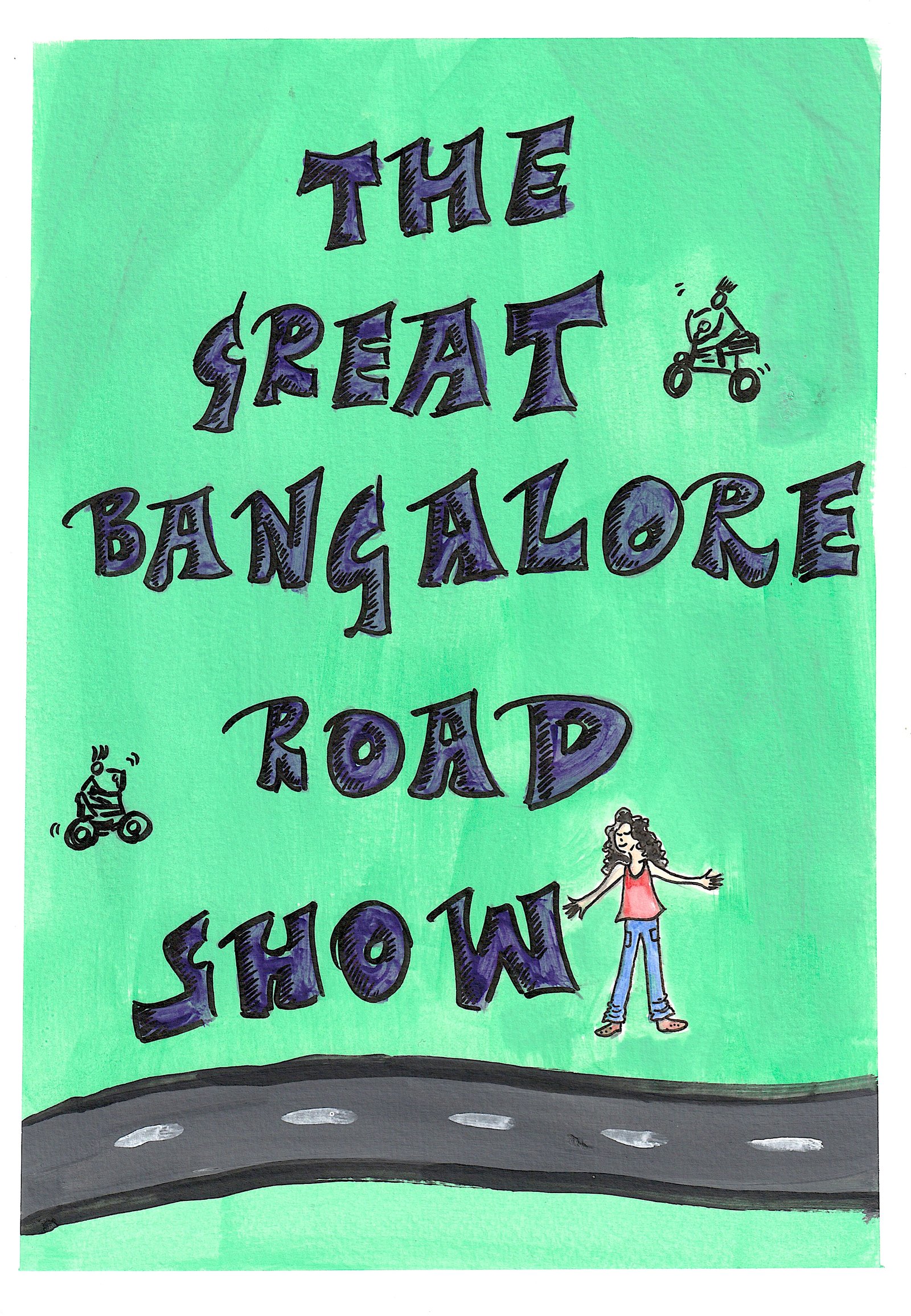
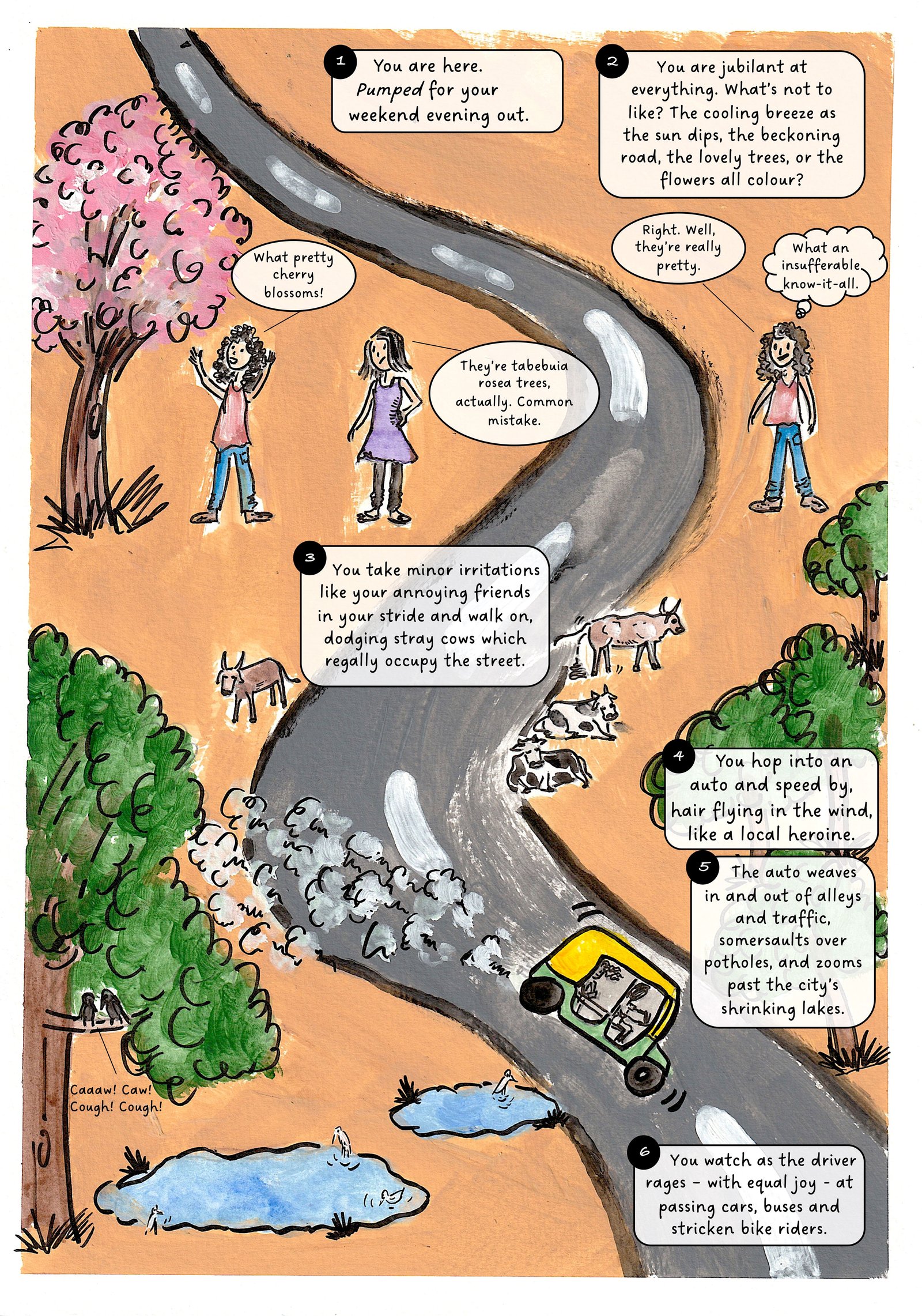
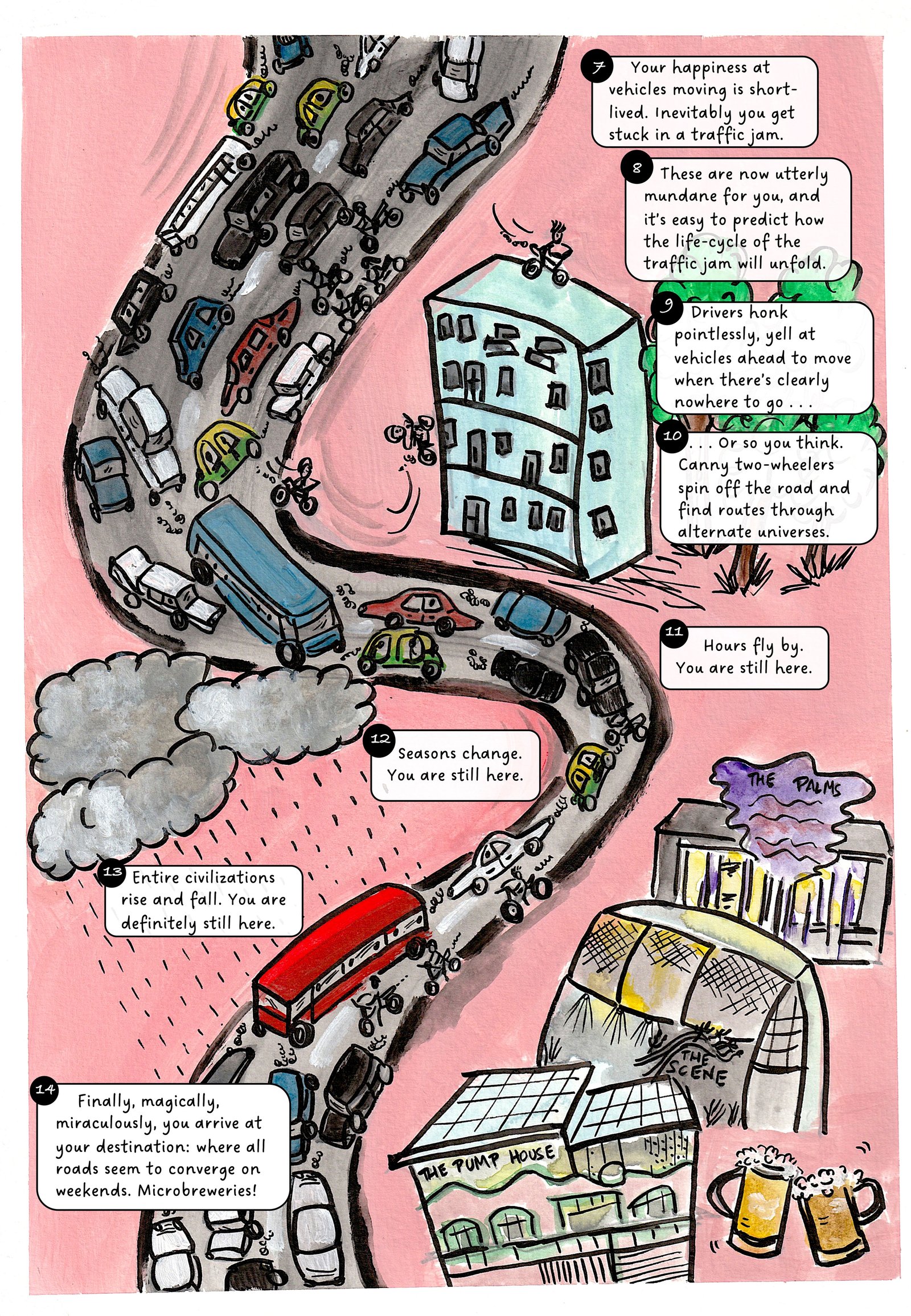
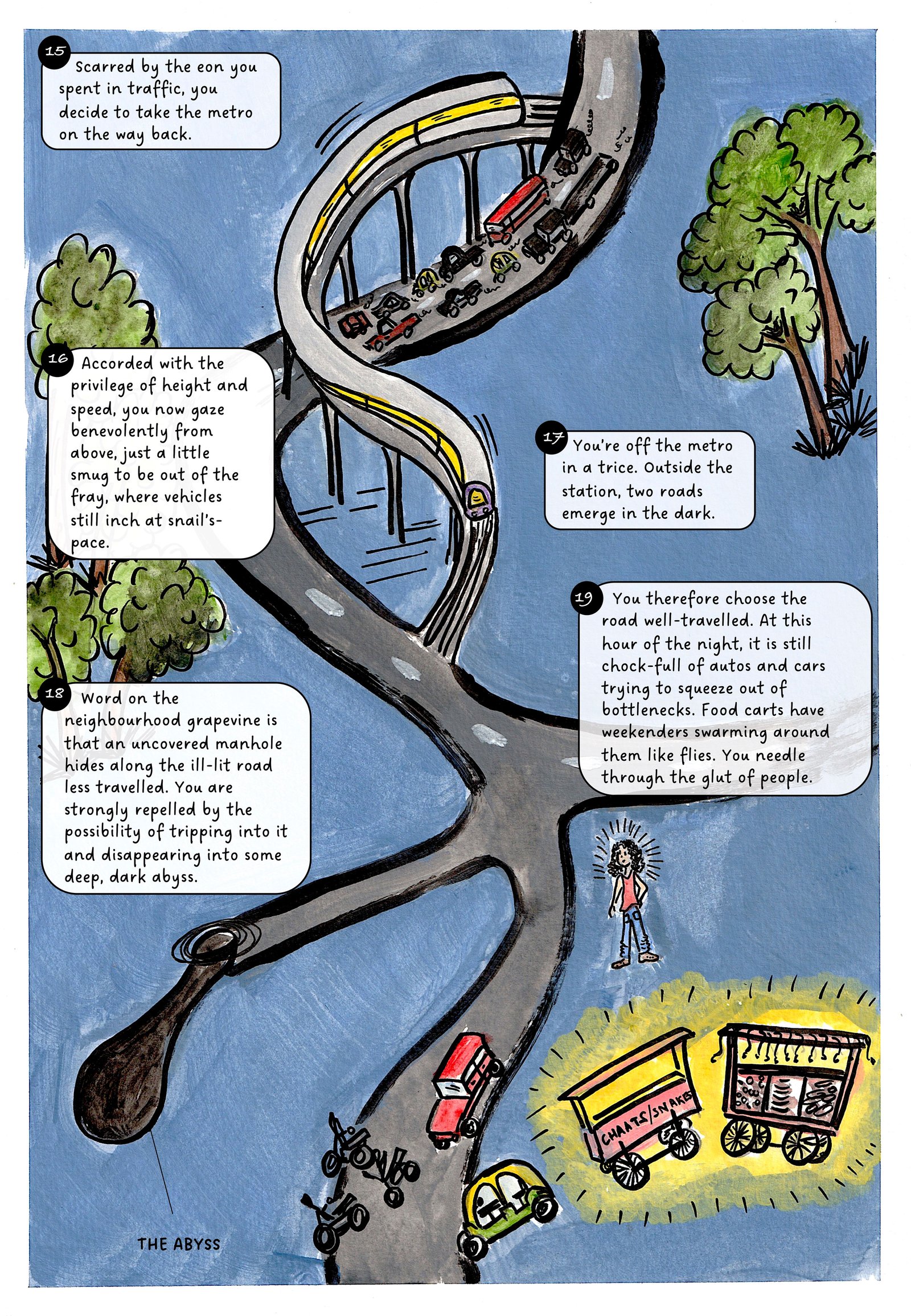
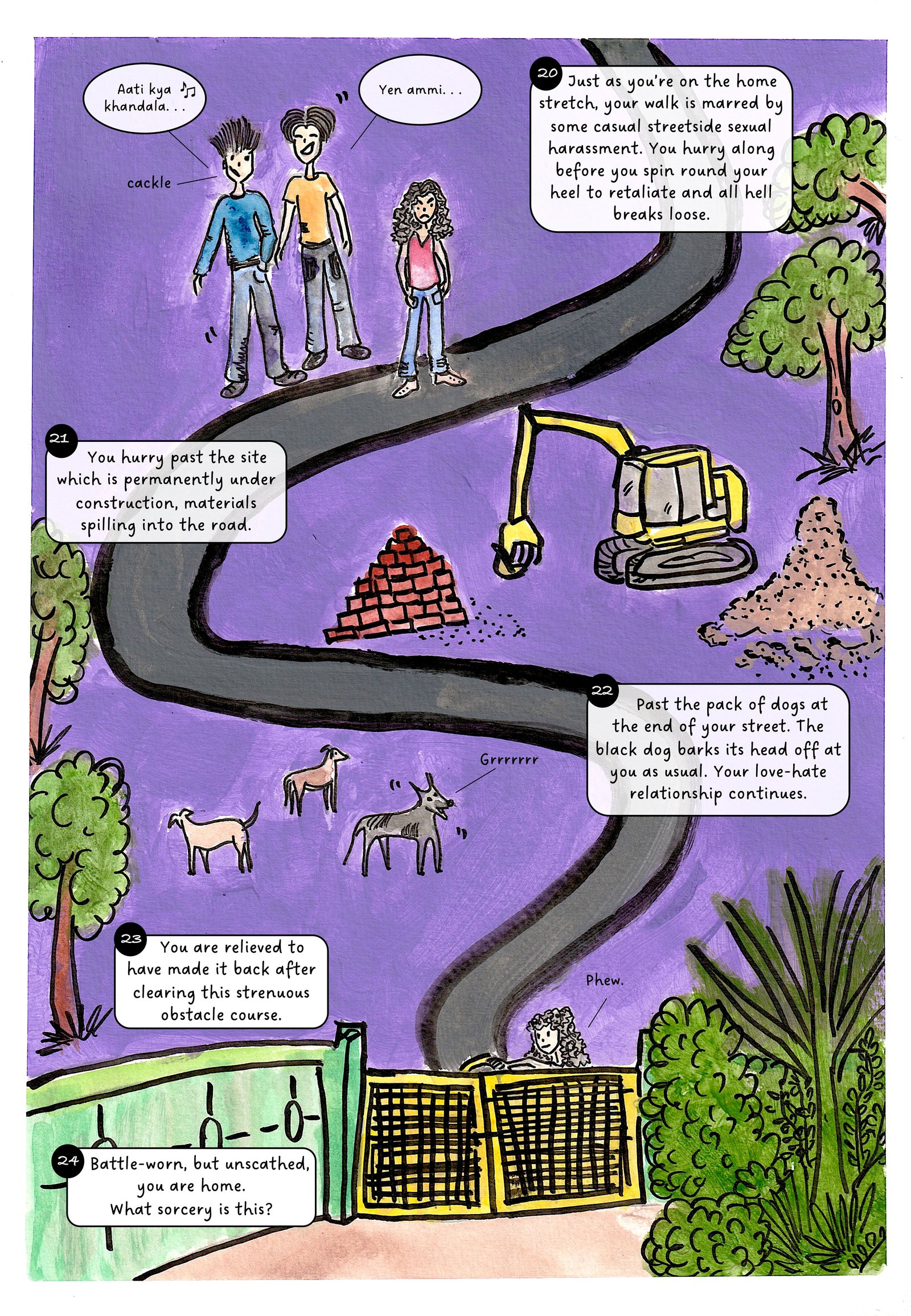
In this short four-page comic, The Great Bangalore Road Show, I experiment with the comics form to narrate the lived realities of daily commuting in Bangalore (officially, Bengaluru). Two oft-repeated claims about living in Bangalore that people around the city—even the country—grasp at instinctively are its great weather and its terrible traffic. The weather can be brooding, rainy, or pleasant, the city green and lush, but also, equally, the city full of pollution, with roads constantly jammed with traffic. All are markers of quotidian life in Bangalore.
As the cartoonist and comics theorist Scott McCloud notes, the more familiar comics form is one comprising panels in “deliberate sequence”; however, the form I have used here is quite different. The road featured here—which is key to the comic—runs down its spine and traces the heroine’s journey through a day in the city. Using this format has allowed me to explore the ways in which time can assume strange and interesting dimensions within the comic form. To refer to McCloud, while comics panels can overtly spatialise time in (often linear) sequence, an open-plan format like this one allows multiple things to happen simultaneously. For me, this was better representative of urban space, where commuters’ agonies, changing weather, and urban wildlife may all occupy space at the same time, but shape experiences of the city in different ways. The road, rolling on seemingly endlessly, imitates the way in which—as McCloud further suggests—time may be thought of as functioning like “a rope” within the comics form. The road acts as a time-'line', threading across the diverse experiences and lives of city-dwellers, guiding the reading eye. When encountered digitally, the continuous scroll function of a webpage enhances this experience of the comic.
In addition to this open-plan format, I have also used the second-person 'you' as the narrative address, alluding to a cartographic aesthetic common to city maps and board games, where characters’ positions (“You are here”) determine how their adventure—and movement in space—begins, and how it may unfold. My previous artwork in my sketchbooks and illustrated zines largely features watercolours mixed with other media such as ink, coloured pencils, and gouache. In this comic, however, using acrylic paint helped me achieve a flat, solid effect—somewhat like a game board—on top of which I chose to ink in cartoon figures.
Through these aesthetic choices and narrative elements, my intention was to create a comic that is, in terms of its affect, both fun and funny. At the same time, through its portrayal of the everydayness of the heroine’s experiences, I wanted to underscore the dangerous normalisation of broken city infrastructure, street-side sexual harassment, the slow disappearance of public spaces, and environmental degradation, all of which form the backdrop to Bangalore’s contemporary urban life.