

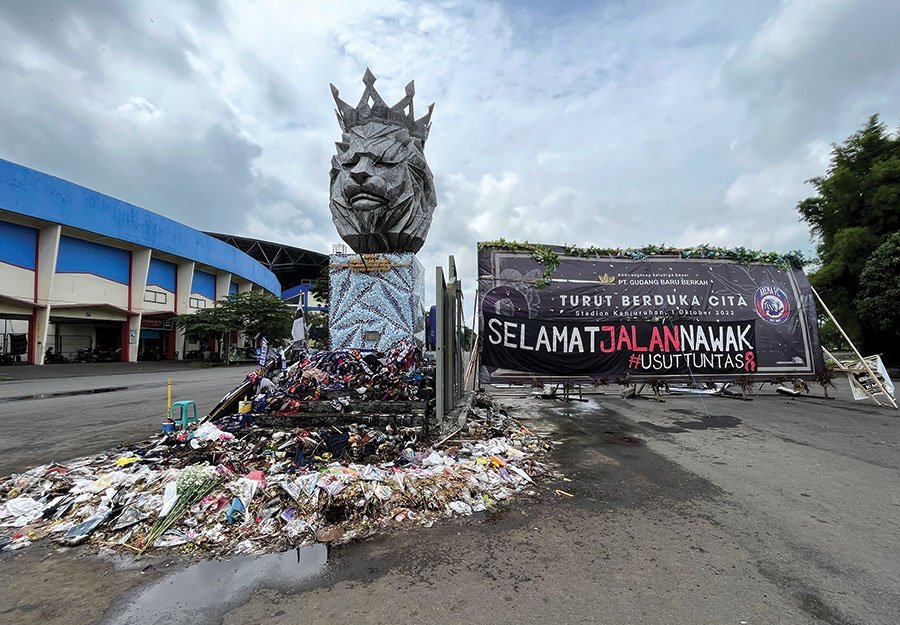

entrance of Kanjuruhan Stadium’s parking lot. Photo: Bayu Dwityo Wicaksono
Devi Athok regularly delivers sugar cane from Situbondo to Malang, but his journey on 1 October 2022, a Saturday, was different. His fourteen-year-old daughter, Naila Anggraini, was calling him repeatedly, even though he couldn’t pick up while driving. They hadn’t had time to meet up before he’d started work. She’d wanted to watch a football match in Kanjuruhan Stadium.
The match was between Arema Football Club and Persebaya Surabaya. The meeting of the two East Java clubs was a big deal in Indonesia, comparable to a Spanish meeting between Real Madrid and Barcelona. Devi himself had been an Aremania, the name given to Arema FC devotees, since he’d been a teenager. He knew that it wasn’t uncommon for chaos, even bloodshed, to erupt between supporters at matches. He’d wanted to accompany her, and told his daughter—known to loved ones as Lala—that he’d got tickets for them and her older sister, Natasya Ramadani, who was sixteen. He’d even made sure to order two club jerseys for Natasya (or Tasya for short) and himself.
Despite all his careful preparation, Devi ended up missing the match because of work. But he’d kept tabs on the game’s progress, so he knew that Arema FC had been defeated. It was the first time the club had lost a home game to Persebaya in twenty-three years.
Much worse news came in. Iwan, a close friend and fellow hardcore Aremania, was dead. “I didn’t believe it. It can’t be, it must have been wrong information,” Devi tells Mekong Review. “I double-checked, and it was true.”
Devi decided to head towards Kanjuruhan Stadium, about fifteen minutes’ drive from the sugar factory where he’d delivered the sugar cane. He thought that Iwan had perhaps died after getting beaten up by other spectators. When he arrived, he realised that something else had happened. Tear gas was wafting out of the stadium into the courtyard.
After Arema FC’s loss, a couple of Aremania had made their way on to the field. There’s no consensus on why they’d done it. One version claims that they’d merely wanted to console the losing players. But their action inspired copycats: thousands of other fans forced their way on to the pitch.
What happened next was a terrible decision that sparked a tragedy. In trying to disperse the crowd that had invaded the pitch, the police deployed tear gas—an act prohibited by FIFA, football’s world governing body, in its regulations on stadium safety and security. To make matters worse, the officers didn’t just fire into the field; they also shot tear gas into the stands. Football fans tried to escape the gas, but some of the stadium gates were open only about half a metre, while others were still closed. People were crushed and suffocated in a desperate stampede. Others, choking on the gas, asphyxiated in the stands. This horrific incident left 135 dead and more than 550 others injured.
Seeing the chaos, Devi immediately thought of his two daughters. He couldn’t contact them, though, because he’d left his mobile phone at the factory and had to double back to get it. In that time, there were dozens of missed calls.
Every phone call reported tragedy. “There are children among the victims,” an Aremania told him. Then a colleague called.
“He said, ‘Tasya… Tasya…’” Devi begins. He breaks off to look up at the ceiling, trying to hold back tears as he recounts the worst night of his life.
Devi had raised his eldest daughter to be a committed Aremania, bringing her along to her first match when she was just six months old. They’d grieved losses and celebrated wins, and even travelled to attend away games together. “We’d sleep on the bus, or on the side of the road, eating improvised meals. All for the sake of Arema FC,” he says. That October night, he arrived at the stadium not to collect an ecstatic teenager but to look for his child’s body.
She wasn’t there. Devi was told that she’d been loaded on to a truck and taken away. He visited multiple hospitals, finally locating her around midnight among dozens of bodies covered by blankets at the Wava Husada Hospital.
Devi hugged his daughter tightly, breaking down in tears. The night wasn’t over: his calls to his younger daughter, Lala, and ex-wife, Gebi Asta, who had accompanied the children, were going unanswered.
“Then a friend said he’d seen an Aremania Curva Nord shirt, similar to the one I’d bought for Tasya,” he recalls. Could Lala have borrowed it? He was directed towards a corpse. He pulled back the blanket. There was Lala, wearing her sibling’s shirt. There were no bruises or wounds on her. She looked like she was sleeping. The only indication of the painful truth was green foam around her mouth. “I’m sure it was because of the tear gas fired by the police,” Devi says.
Gebi was also dead. It was all too much for Devi to take. He collapsed then, and still can’t think of what happened without feeling the anger rising inside him.
That terrible night is also etched in the memory of another Aremania: twenty-five-year-old Fauzi. He’d been in the stands, and remembers very clearly how the tear gas had come from almost all sides. The positive atmosphere turned into disaster in seconds.
More from Mekong Review
-
For those curious about Indonesian music, Padang Moonrise: The Birth of the Modern Indonesian Recording Industry (1955-69) is a fascinating portrait of a precarious young country trying to protect its cultural identity while opening itself to the world.
-
Written in the late 1950s while Mochtar Lubis was under house arrest, Twilight in Jakarta was smuggled overseas, translated by Clarie Holt, and published by Hutchinson & Co in 1963. A revised version by John McGlynn was published by the Lontar Foundation in 2014.
-

Ducky Tse was an established photographer in Hong Kong when, at the age of fifty, he decided to uproot and relocate to Taiwan. He bought a van and refurbished it, driving it around the country. Through his photographs, he reflects on a new chapter of his life.