


What if I get an iPad?”
It started as a joke to his wife. Kevin Raymundo, an accomplished digital animator, had finally finished a full movie on his own, reaching the end of a gruelling four-year endeavour. The job, though, left him burnt out and empty—a frustrating state for creatives. To make matters worse, the Covid-19 pandemic had caused his nerves to fray. He decided it was the perfect excuse: justifying the expense as necessary for his mental health, Raymundo splurged on the device. At the time, he had no idea how it would change his life and work.
Covid-19 brought many plans to a standstill and upended lives. People lived in fear. Rumours about lockdowns and closed borders circulated in the Philippines. Filipinos were given only three days to travel back to their provinces. There was an exodus from Metro Manila; the airport was jam-packed and flights fully booked. People flooded to the bus terminals and camped out, waiting for the next ride.
Amid this chaos and confusion, President Rodrigo Duterte announced that he would address the nation late on a weeknight. Many anticipated answers to their desperate questions: When will the lockdown end? How will we earn our daily wage? What happens if someone in our household gets Covid?
“The [Covid-19 test] kit is the kit,” Duterte responded. His rambling meandered through topics like the Spanish flu, the Roman empire and witch hunts. By the time his address ended, people were none the wiser about what to do, or how the government would be supporting them through this difficult time.
Raymundo was one of the many Filipinos who’d stayed up late to watch the president mumble nonsense during a national address. He was fed up. He picked up his Apple Pencil and started sketching.
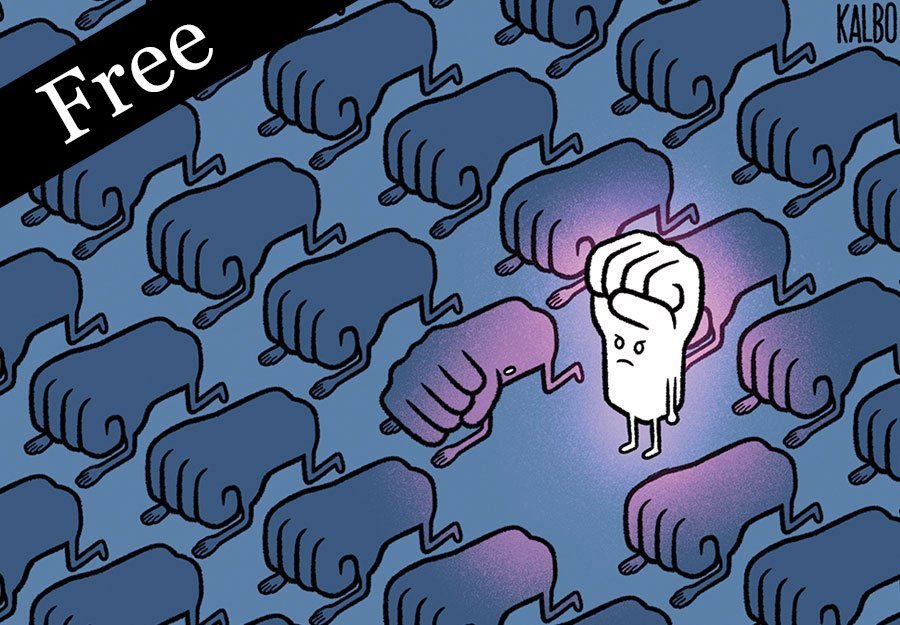
Raymundo adopted the alias ‘Tarantadong Kalbo’, which translates to ‘Vulgar Bald Man’ in English. He created a protagonist that took jabs at the government, often infusing his work with dark humour and Gen Z lingo that caught people’s attention on social media. His cryptic art sparked the curiosity of an audience who worked on puzzling out the message behind each post. Things really took off in 2021 when Raymundo released an artwork featuring clenched fists—a hand gesture associated in the Philippines with support for Duterte. He created a sea of anthropomorphised fists kowtowing to an unseen power… except for one standing tall in anger and defiance. He called the piece ‘Tumindig’, meaning ‘stand up’ in Filipino.

‘Tumindig’ went viral. Raymundo’s fans started creating their own fist-themed avatars. Fellow cartoonists joined in and advertising agencies jumped on the bandwagon. It became a symbol of protest against the government as lockdown restrictions dragged on in the country. The impact was so big it spilled out of digital spaces. ‘Tumindig’ became a battle cry during demonstrations and rallies—something that Raymundo, who had never seen himself as a political activist, hadn’t imagined would ever happen.
Raymundo produced three books, all containing political cartoons, during the pandemic. But not everyone loves his work. On the eve of a book signing in a mall, an online troll threatened to attack him with muriatic acid. That threat gave him a taste of the life he would live if he chose to continue criticising Duterte’s regime. The famed cartoonist who once struggled with anxiety now experiences a different kind of fear.
Raymundo isn’t the only one. Andoy Edoria, more popularly known online as Andoyman, is a graphic designer at an independent news organisation that extensively covered Duterte’s war on drugs. The extrajudicial killings weighed heavily on his heart. Through his job, he’d seen far too many photos of the bodies of lifeless teenagers who had merely been suspected of drug crimes.

His anger and disillusionment grew as he covered the 2016 presidential election and watched most of his compatriots vote for a leader who violated human rights and cared little for true justice. Edoria decided to show his audience how real and morbid the drug war is, and began publishing political cartoons on social media.
The efforts of the news outlet that employs Edoria to hold the government accountable has resulted in repeated threats from the Duterte administration, in the form of warnings about closure orders and libel cases. When Edoria hears motorcyclists zooming past him on the street at night, he scurries away quickly, praying that he will not be a target of unknown assailants. There is good reason for this fear—the Philippines can be a deadly place for journalists and dissidents. Between 2016 and December 2021, twenty-two journalists and media workers were killed in the country.
Grappling with constant worry and paranoia was draining, and Edoria wondered about the point of his work as he burnt out. But the 2022 presidential election gave him a new purpose. This time, the fight was between Leni Robredo, seen as the antithesis to what the country had experienced with the Duterte administration, and Ferdinand ‘Bongbong’ Marcos Jr, the son of the corrupt former dictator Ferdinand Marcos. The stakes were high. Edoria knew that he needed to continue creating his art.

The election result was disappointing: the younger Marcos won the presidency after a campaign period reported to be rife with misinformation, historical white-washing and harassment on social media. There is no way Edoria can stop now.
Raymundo describes his political art as “a calling”. Fear has driven him to thoughts of retirement; he says he wishes he could just make comic strips for fun. But when his fans ask “What’s going to happen now?”, he knows in his heart that Tarantadong Kalbo needs to live on.

More from Mekong Review
-

Poetry from Lawdenmarc Decamora
-

Poetry from Tilde Acuña
-
A poem by Jeric Olay.
