

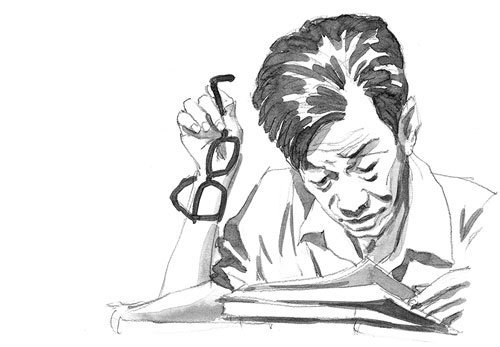
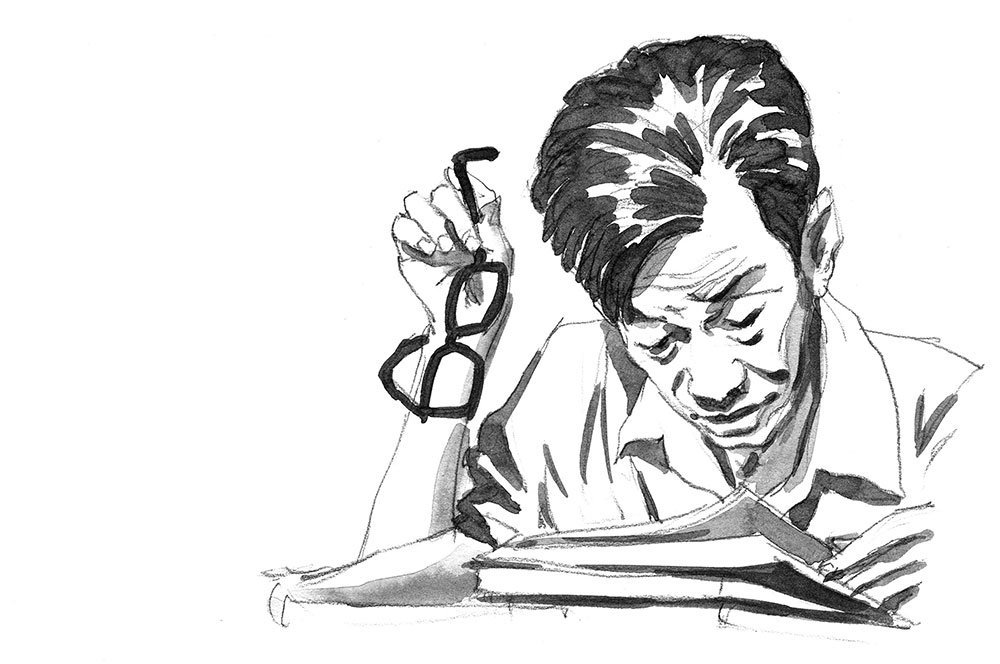
Son Nam (originally Pham Minh Tai) was born on 11 December 1926 in Dong Thai village: a small, mixed Khmer and Vietnamese village, near Rach Gia, nestled on the edge of the Go Quao Forest, abutting the Bay of Thailand on the western shore of the Mekong Delta. Son Nam’s sickly mother couldn’t produce enough milk, so he was wet nursed by an ethnically Khmer neighbour. She became a close family friend, and Son Nam took the pen name Son, a common Khmer surname, to honour her. The name Nam (“south”) pays homage to his southern roots.
In a speech celebrating a fellow Mekong poet’s seventieth birthday, Son Nam described their hometown as “a poor, backwards land where the government was non-existent and pirates scourged the coasts … Our childhoods flickered like tamanu oil lamps. No one dared dream that this place could give birth to laureates and lyricists. To us, great authors only emerged from the far north beyond Hue.” Despite the stifling rural poverty of his birthplace, Son Nam was an excellent student. He received a highly competitive colonial-state scholarship to study the Primaire Elementaire at the local provincial school, and after passing the Certificat d’Etudes Primaire Franco-Indigene, he was given a scholarship to study for the Diplome in Can Tho.
The largest city in the Mekong Delta, Can Tho was more than a hundred kilometres away. By the time he attended (1937), it was a bustling and comparatively modern urban centre replete with movie theatres, cafes, radio, large markets and the latest Vietnamese and French language books and newspapers. It was here that Son Nam experienced the terminal decline of Indochinese colonialism, heralded by the outbreak of the Second World War. First, French defeat at the hands of Nazi Germany in June 1940 gave the resulting Vichy regime a tenuous grasp over the colony. Three months later the French reluctantly submitted to Japanese demands to station forces throughout the colony, highlighting French weakness and further undermining racialist notions of colonial legitimacy. In November a series of rebellions, called Nam Ky Khoi Nghia (“Cochinchina Uprisings”), exploded throughout the delta. Witnessing at first hand the widespread public discontent, the blood-drenched military vehicles and the merciless public execution of suspected subversives left an indelible impression on the teenage author. Although the rebellions were quickly and brutally put down, this period of heightened Vichy-French, Japanese and revolutionary propaganda stimulated the development of his nationalism.
More from Mekong Review
-

Translated fiction from southern Vietnam
-

An American protester in Ho Chi Minh City
-
Vietnamese women who marry Taiwanese men
- Tags: Anthony Morreale, Issue 13, Son Nam, Vietnam