

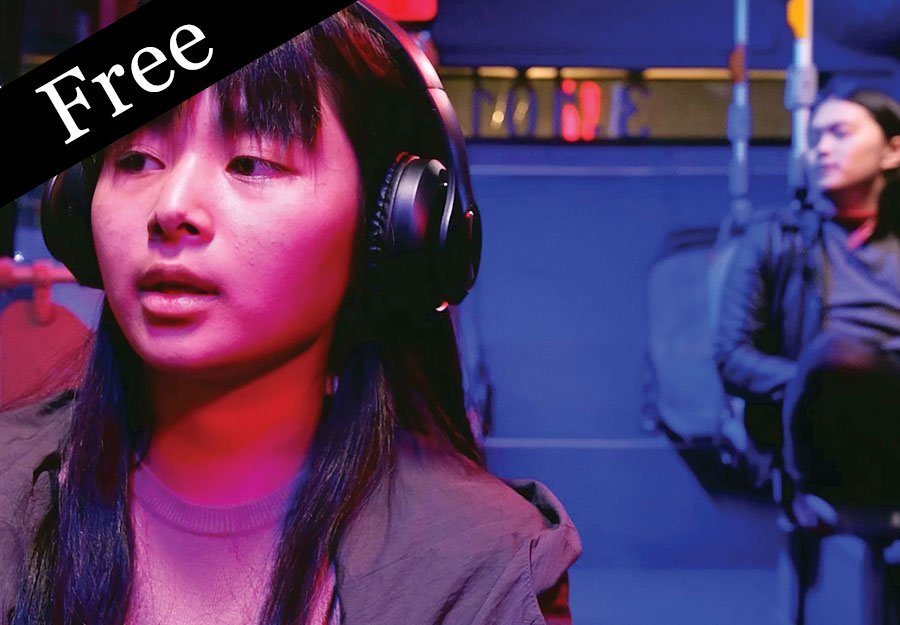

The Sales Girl
Sengedorj Janchivdorj (Director)
Nomadia Pictures: 2021
.
If Only I Could Hibernate
Zoljargal Purevdash (Director)
Amygdala Pictures, Urban Factory: 2023
.
Thank you for spending two hours experiencing a small part of us Mongolians’ lives,” the director Sengedorj Janchivdorj told his audience at the end of a post-screening Zoom interview during the Osaka Asian Film Festival in March 2022. He then quickly corrected himself: “part of contemporary Mongolian youths’ lives”. The correction was apt, since modern youths were perhaps the most crucial element in the success of his latest directorial effort, The Sales Girl.
In the film, a poker-faced nuclear engineering student, Saruul, agrees to sub in as a sales and delivery girl at a sex shop when a classmate who works there part-time breaks her leg. Here’s a Mongolian film foreign audiences have never seen before. No weeping camels, no religious rituals, no Genghis Khan. Instead, Sengedorj, a veteran director in the oft-overlooked Mongolian film industry, treats audiences to a coming-of-age story set in the country’s capital, Ulaanbaatar—with dildos and blow-up dolls thrown in.
The Sales Girl didn’t exactly set off to a great start. Before its international premiere in Osaka, the film didn’t have a theatrical release in Mongolia and went directly to video-on-demand services in October 2021 due to the Covid-19 pandemic. It was largely panned by domestic audiences. Part of it had to do with the rather theatrical delivery of lines by the cast, whose pronunciation of every single syllable had a jarring effect on Mongolian native speakers. But a bigger reason was that its marketing ploy had backfired. The film’s poster, which featured a scantily clad Saruul in a pink room, suggested yet another risqué addition to local streaming services that were already oversaturated with ‘film content’ for adults.
Rather than being an erotic thriller or a raunchy comedy, however, Sengedorj’s film is an amusing, wholesome story of a college freshman’s self-discovery, of which sex is just one aspect. At the end of her shift, Saruul delivers the day’s earnings to Katya, the sexually liberated and posh owner of the shop. Saruul’s gloomy looks and drab clothes couldn’t provide a sharper contrast to her new job. But as Katya decides to take her under her wing and teach her “the art of living”, Saruul starts to become sensitive to her physical and, more importantly, emotional needs. The sex shop is “just bait to [lure] an audience”, said the director in a recent interview. “If Katya was an owner of a grocery store, I don’t think the audience would have been flattered with the idea.”

While the toys and talk of sex serve their attention-grabbing purpose, the film doesn’t give way to vulgarity and lewdness. Its humour, too, remains genuine throughout without relying on bawdy jokes and raucous dialogue. When Saruul’s mother asks what it is she’s selling at her secretive temp job, she thinks of the dildos and replies, “Human organs.” During one of her deliveries, she gets caught in a police raid at a seedy hotel. Informed by the cops that the state is confiscating her goods, she asks with a straight face if the state is going to sell them now.
It’s this irresistible deadpan humour and the quirky manner of Bayartsetseg Bayangerel—the first-year acting major who plays Saruul—that makes for such a memorable protagonist. Saruul attends engineering courses but her mind is always busy with something else, be it doodling during lectures or listening to indie songs with her inseparable headphones on. Katya, played by the seasoned stage actress Enkhtuul Oidovjamts returning from a near-thirty-year hiatus, teaches Saruul to be confident and to appreciate the finer things in life, such as a Pink Floyd vinyl imbued with “the smell of the 70s”.
The film’s music adds a touch of surrealism. Bayasgalan Dulguun, better known as the indie-folk singer-songwriter Magnolian, appears in the background whenever Saruul puts on her headphones to listen to his mellow, but not melancholy, tunes. There’s one such beautiful scene early in the film, which offers us a glimpse into the protagonist’s psychology: blue-red-purple neon lighting is well-paired with Bayasgalan’s musical number on a bus, all while Saruul quietly gazes out the window.
Under Katya’s tutelage and through her own trial and error, Saruul slowly goes through a transformation, subtly presented through her relationships, rather than a drastic Hollywood-style red-carpet-ready change of appearances. For her poignant portrayal, Bayartsetseg was honoured with the Yakushi Pearl Award for best performance in Osaka.
Despite the lukewarm reception at home, The Sales Girl had a successful and long festival run. After Osaka, the film went on to win the top prizes at the New York Asian Film Festival in July 2022 and the Vesoul International Film Festival of Asian Cinema in March—a first for Mongolian cinema in both cases.
On the heels of these accomplishments, there came more good news for the Mongolian film industry. Zoljargal Purevdash’s If Only I Could Hibernate became the first feature film from the country to be included in the official selection of the prestigious Cannes Film Festival.

At first glance, the similarities between Hibernate and The Sales Girl are apparent. Both are contemporary coming-of-age stories set in Ulaanbaatar that thwart most viewers’ expectations of Mongolian cinema. But Zoljargal’s film is a more grounded, realistic social drama that sees a family of five dying to survive in Ulaanbaatar, the world’s most polluted and coldest capital city.
The story starts inside a ger—a portable tent-like dwelling for nomadic people—but there are no endless green steppes or eternal blue sky outside. What the audience is presented with instead is a dense, sprawling ger district encircling the city, covered in snow and shrouded by thick smoke. Here lives Ulzii, a poor but proud fifteen-year-old physics prodigy, with his mother and three younger siblings. They are but one of many households in the district who’ve migrated from the countryside to the city in search of better opportunities. Just as Ulzii starts making strides in the national physics competition with his eyes on the prize—a scholarship at a private high school—his mother takes her youngest and departs for a job in a distant province.
The premise of three young children being left on their own to pull through the winter seems like a plea for pity, but the story largely fends off excessive sentimentalism, drawing attention instead to the issue at the core. Poverty, seen through the lenses of education and the environment, is the main issue that Zoljargal cool-headedly tackles in her debut feature. After seeing her short film Yellow Bus, which premiered at the Tampere Film Festival earlier this year and tells the story of a bus conductor whose livelihood is threatened by a smart-card reader, I described Zoljargal as “arguably the most socially conscientious filmmaker in Mongolia today”. With Hibernate, she proves that the word “arguably” can be omitted.
A 2016 air pollution protest in Ulaanbaatar inspired Zoljargal to make Hibernate. What appalled her then was not government inaction but the demonstrators’ stance against residents of the ger districts, such as herself, who burn raw coal to heat their home during the harsh minus-thirty-five-degree winter. “I grew up in this district and I still live there. I know that no one burns coal just to poison people on the other side of town,” the filmmaker explained. “What we’re inhaling is not smoke, it’s poverty.”
It’s the crippling and costly burden of this poverty that Ulzii comes to bear in the film. He’s just a teenager with nothing better to do than play video games and drink at his friend’s house. But he’s thrust into the role of de facto parent and his balancing act of being a student and a breadwinner becomes increasingly strenuous.
Seeing Ulzii, played by the first-timer Battsooj Uurtsaikh with raw anger and pain, I felt represented on screen for the first time. As someone who grew up in a ger district and studied his way out of poverty, I found the similarities striking, not coming through various degrees of projection. Even the smallest details, such as a brief scene in which Ulzii and his two friends play basketball with a soda bottle, reminded me of the days when my classmates and I played ‘bottle cap soccer’ in our school gym. The film’s realistic approach is also apparent in the dialogue (one of The Sales Girl’s flaws), which Zoljargal peppers with plenty of foul language and big talk that feel quintessentially natural for the teenage characters.
It took Zoljargal seven years to complete Hibernate—at one point she and her husband sold their apartment to fill a financing gap—and she eventually celebrated its premiere on the Croisette as part of the Un Certain Regard competition for up-and-coming arthouse directors. But the film’s significance as a social project and its representation mean more than a Cannes label.
For the three siblings in the story, Zoljargal cast actors who live in a ger district. The decision was made not just out of an intention to provide more opportunities to less-privileged actors, but also out of practicality. The cast and crew had to shoot outdoors in a temperature as low as minus-forty-two degrees. And just a day after the Cannes press conference, at which the film’s selection was announced, Zoljargal took to social media to help find funding for the three lead actors’ travel costs to the festival.
The film highlights Mongolia’s glaring socioeconomic disparity in scenes when Ulzii steps into downtown. While helping his neighbour with deliveries of frozen meat, he goes to towering apartment buildings with fancy names such as Crystal Tower and Luxury Village. These high-rises, constituting much of the concrete jungle in the heart of the city, contrast sharply with the living conditions of the ger districts where there’s neither running water nor central heating. However, the apartment-dwelling middle class still lives off the herders and their livestock, all while treating them with apathy or even disdain. In one subtle scene, Zoljargal manages to mention the devastating effect of climate change and reveal the reason behind Ulzii’s frustration with his condition. While talking to the neighbour, Ulzii laments that their family once had more than a thousand livestock, half of which died over just one winter due to a dzud, a severe winter condition combining heavy snowfall and cold windstorms. The disaster drove his family to the city soon afterwards and the loss has since then become part of the reason behind Ulzii’s pride.
The ending of the film is left masterfully ambiguous, but what’s clear is Zoljargal’s call to action as well as the first signs of a nascent political cinema, which has been markedly absent for a country that’s often called “an oasis of democracy in the heart of Asia”. If The Sales Girl presents a new vision of Mongolia to foreign audiences, Hibernate offers a much-needed representation not only of Mongolia to the world, but also and more importantly, of the ger district to the rest of the country.
Zoljargal, who’s also the producer of Hibernate, set the film’s domestic theatrical release in mid-January 2024, when it’s coldest in Ulaanbaatar. The timing is a conscious choice to coincide with a period “when all activism gets set in motion again” and when the film is likely to have the greatest possible impact on the audience. “If we don’t understand, feel or embrace the pain and glory of each other’s lives,” Zoljargal asks, “how can we solve our problems together?”

More from Mekong Review
-

A poem by Jeric Olay.
-
The Indonesian film industry is often underrated and overlooked, but Timo Tjahjanto is one of its directors to have attracted international attention for his work.
-
A poem by Jeric Olay.
