



If you live in a city—especially if it’s a big one—you probably think about noise more often than you’d like. As I write this, I’m mindful of the (very loud) work being done on sewers in the street outside my building. I am allowed a moment to collect my thoughts while they’re on a short break, but it won’t last. A city is a composition of sounds, a public performance without a single composer but with many would-be conductors.
Cities, states and city-states conduct their harmonies in sequences of highs and lows, intensities and breaks. Sometimes there are celebrations, which require their own sounds. I recently ran into one example of noise music—a genre that I presume is not very well-known—in called Spectral Arrows: Singapore. It’s a live recording of a single iteration out of a long-term series of performances by the musician Marco Fusinato. The work bears no particular relation to Singapore, beyond having been recorded at the Institute of Contemporary Arts Singapore in August 2015, and later released by the Singapore-based label Ujikaji Records.
More from Mekong Review
-

There is only one place to eat this
-
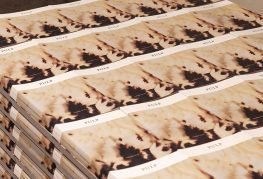
What unfolds in Pulp III: An Intimate Inventory of the Banished Book is Shubigi Rao’s documentation of her encounters with texts in varying formats that, at some point in the past, confronted ‘banishment’.
-

What sets Rachel Heng’s historical fiction apart is how she moves beyond this understanding of History (with a capital H) by showing how grand events are mediated by everyday interactions.
- Tags: Issue 33, Mikko Toivanen, Singapore