


.
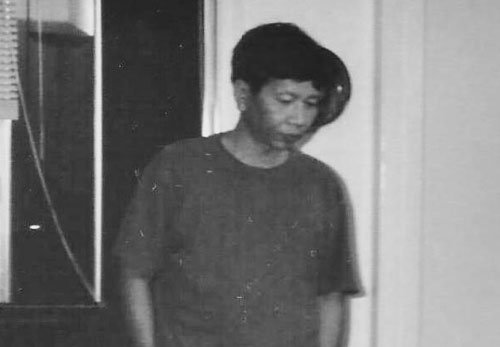
Nguyen Huy Thiep arrives for our meeting in a long-sleeved white shirt, open at the neck, dark blue slacks, and sandals. His face is slicked with perspiration, and he apologises for being late, explaining that he has just ridden fifteen kilometres on the hybrid bike that he peddles around Hanoi for exercise, even on a day when the temperatures are in the thirties Celsius, with high humidity to match. Thiep presents me with a couple of Vietnamese magazines, their pages opened to articles he has written, discussing how he came to publish his famous story ‘The General Retires’. I sense that these articles represent a happy turn in his life. After thirty years of living in Vietnam’s political deep freeze, he is finally seeing a ray of sunshine.
Thiep has the high cheekbones of a northerner, in a face that remains unlined and puckish at sixty-five. He smiles easily. He gets the joke. Imagine Picasso transplanted from the Riviera to Hanoi and given brown, glancing eyes. Thiep speaks in rolling sentences that stretch back eight hundred years to the time when Cham slaves were brought north to Hanoi, where they settled in Thiep’s ancestral village on the outskirts of the city and introduced the Buddhism that Thiep’s mother and then Thiep himself began to practice. I notice that Thiep, under his thatch of silver-brown hair, possesses the large, ropey earlobes that are known to Vietnamese as ‘Buddha ears’.
The leading figure of the Renovation movement of the 1980s, although perhaps not as well known outside the country as Bao Ninh or Duong Thu Huong, Thiep is Vietnam’s most famous author. He is the country’s preeminent literary stylist and creator of a kind of multifaceted storytelling that in one fell swoop catapulted Vietnamese literature from socialist realism to modernism. After Thiep appeared on the scene, no one could write the way they had written before. He redefined the canon, as month-after-month he published stories that became instant classics.
Thiep began his meteoric career in 1987, and already by 1988 he had published his collected works and celebrated what everyone was calling ‘the year of Nguyen Huy Thiep’. In 1989, the film of ‘The General Retires’ was released, and by 1990 Thiep was being installed as a member of the Writers’ Association. But this is also the year that copies of his works began disappearing from book stores. Nhan Dan, the party newspaper, published two essays attacking Thiep, claiming that he had ‘betrayed the Vietnamese Revolution by toppling sacred heroes in Vietnamese history’ and that he was ‘deceived by the chimera of pre-1975 Saigon’. The denunciation campaign continued until 1991, when the police raided Thiep’s house, carried off his books and manuscripts, and provoked a turning point in his life. This also marks a turning point in Vietnamese literature, when the country’s brief, five-year experiment with Renovation ended in the dark age that persists today.
‘I want to lead a normal life,’ says Thiep, repeating what I have come to recognise as the mantra of every Vietnamese artist and writer who is hoping to avoid prison. ‘I am not comfortable with political figures. It is the tradition for people here to stay away from politics.’
I have arranged to spend the afternoon with Thiep at Nhan Café, his favourite meeting place in the city. This hangout for artists and writers occupies a building near the Lake of the Redeemed Sword, which marks the historic centre of Hanoi. After his twenty-minute ride from the suburbs into the city, Thiep orders a mixture of kudzu powder and water, which is believed to be good for cooling overheated bodies.
‘My family history was the inspiration for “The General Retires”,’ he says. ‘My grandfather had two wives. The second wife was cruel, like the wife in the story. She was so cruel that my father was forced to leave the north and move to Saigon. He worked for the Chinese community and then went to college to study engineering. He got a job as a supervisor on the colonial railroad, where he specialised in building bridges and roads. The French paid him well. He stayed in the south until 1945, when he joined the revolutionary forces and went to live in the northwest, where he worked for the court. He was a high ranking official, who rode a horse and wore a white suit.’
Thiep mentions how his father got in trouble for demanding that a chain gang of prisoners be released. This incident reappears in another one of Thiep’s stories. Thiep’s family is one of the oldest in Hanoi, he says. They can trace their lineage back eight hundred years. They began losing their land, piece by piece, during Vietnam’s twentieth-century wars. There was nothing left, until one parcel—a garden plot outside Hanoi, where the family used to go for breaks from the city heat—was returned to them in 1960. This is where Thiep lives today.
I realise that I am talking to an aristocrat on a bicycle, an old Hanoian who rolls around town like a market vendor, except that his bike is an expensive hybrid with pebbled tires. None of the biographical material that I have read on Thiep mentions his father on horseback or the white suit. It discusses only his mother and how she was forced during the American war to leave the city and live as a peasant in the countryside.
Having seen a photo shot by a mutual friend, I know that a giant sculpture of Buddha presides over the garden at Thiep’s house. ‘I built the Buddha in 1991,’ he says. ‘I built it when I got in trouble. It was my reaction to the government. It took three and a half months to build the statue and cost as much as a house. Religion helped me balance the conflicts that were swirling around me.’
I ask him to explain. ‘In 1991 the police raided my house,’ Thiep says. ‘They took all my books and writings and accused me of destroying the success of socialism. I was interrogated for ten days in a row. They treated me like a dissident. I was shocked. This was a wake-up call for me.’
Doi moi, Vietnam’s brief experiment with perestroika, was over. ‘This is when the government started terrorising authors in Vietnam,’ Thiep says. ‘I realised my work might affect my family. They called me a traitor. They treated me like a political dissident. I decided to go slow. I would pause in my writing. The risks were too great.
‘I didn’t stop writing, but I stopped being naïve,’ he says. ‘I would write more cautiously. I would tame my writing. I would be more careful. I changed my subjects and my language. Before I was eccentric and arrogant. Now I would be more circumspect.’
Thiep began writing obscure essays on Buddhism and cloaking his statements in esoteric thought. ‘I decided to write more upbeat stories, brighter stories,’ he says.
I ask if the culture police returned his books and manuscripts. ‘No, they did not. They were rubbish anyway,’ he says of his early writings.
I pause for a moment, before remembering that Thiep is speaking about his stories published before 1991, in other words, about the stories for which he is famous.
‘Politics in the East is like a dragon,’ he says. ‘When it’s happy, you can play with it, but when it gets angry, it may eat you alive.’
He returns to talking about the Buddha in his garden. ‘Writing is like a religion. Writers sit in meditation. You have to keep your religious mind. You get hurt if you lose your contemplative mind.’
When Thiep visited the United States in 1998, many people who turned out to meet the great author were disappointed. He was so arcane and convoluted in his philosophiding that his translators got lost. The deeper Thiep allowed his mind to float into Buddhist abstractions, the more the censors had won.
I steer the conversation back to his early career. ‘Before 1991 I wrote from instinct,’ he says. ‘I loved to write as a child, although my father opposed my becoming a writer.’ Thiep’s literary background mixes Chinese classics with French literature. There is also a big dose of Vietnamese folk tales, which Thiep heard during a decade spent living in Vietnam’s northwestern mountains. ‘I wanted to combine eastern and western culture,’ he says of an oeuvre that includes fifty short stories, seven full length plays, numerous essays, three films, and a novel published in French, A Nos Vingt Ans.

Thiep was raised by a Buddhist mother, a maternal grandfather who introduced him to Chinese literature, and other teachers, including a Catholic priest and his professors at Hanoi’s Teacher Training College, where he studied history. After graduating in 1970, Thiep was sent to live among the Hmong and other ethnic minorities in Vietnam’s northwestern mountains. He stayed there for a decade, teaching remedial classes to communist cadre. He enjoyed learning about the spirit-filled world of the mountain people, and, apparently, they appreciated learning about his mythic world. Thiep’s teaching method consisted of borrowing books from a provincial library that had been evacuated to the mountains for safekeeping. He read widely in world literature and history and then told stories about these books to his students. Dostoevsky and Camus got mixed with tomes on economics and philosophy and then narrated in what must have been fabulous lectures. Thiep didn’t need to borrow magic realism. He was living it.
In 1980, Thiep was driven out of the jungle by hunger and boredom. He worked for another seven years as a painter, stone mason, and black marketeer, before getting his first story published in Literature and Art, the official journal of the Vietnam Writers’ Association. ‘In 1986, the social conditions in Vietnam were bad,’ he says. ‘Society was chaotic and poor. As it lost support from the Soviet Union, Vietnam opened to the outside world. It became easier to write. Before 1986, writers had been arrested. But after 1986 and the onset of doi moi there was an opening in society and writing became possible.
‘I was lucky. My timing was right,’ Thiep says of his first story, published in 1987. ‘I hit at just the right moment. I wrote from instinct. I wrote for the joy of it. People waited for my stories to come out.’
Thiep is animated as he talks. He smiles and laughs and stomps his foot for emphasis.
I ask Thiep if he had trouble getting his work published after his house was raided by the culture police. ‘Yes, after 1991 there was a secret command from the leadership. No one could mention my name or publish my work. My work had to be “reviewed”. It took longer and longer to publish.
‘I tried to adapt my writing to the social needs,’ he says. ‘I censored the content myself. Sometimes it was corrected by the editors. Often, they were too enthusiastic or too creative, putting their comments on top of my stories. I had to accept that my stories would be censored by untutored people with no idea of what literature was about. Vietnamese literature was born in a revolutionary era. It was used as a political tool, which makes it too ideological. It is not refined enough. It is very hard to be a writer in Vietnam.’
As evening settles over the city, we decide to stretch our legs with a walk around Hoan Kiem Lake, which lies a few steps from the front door of the café. Thiep unchains his bike and pushes it beside him. The lakeshore is crowded with people getting off work, meeting for lovers’ assignations, playing Chinese chess, practicing Tai Chi, or strolling, like us, in the warm evening air.
I am staring across the water at the small temple that stands on the little green island that marks the historic centre of Hanoi when Thiep suggests that we cross the street. The traffic parts around us as we wade into the rush of motorbikes and cars. Thiep rolls his bicycle up to the door of a fancy new hotel, the Apricot, which is named after the Hanoi art gallery that financed this posh operation. The owner, who happens to be standing on the front steps, gives Thiep a royal welcome and invites us inside for a tour. Thiep leaves his bicycle with the doorman.
We enter a chandeliered lobby with a pianist tinkling at a grand piano and stroll past paintings of Vietnam’s pastoral life. We ride the elevator to the second floor and walk back toward the front of the hotel. Here we find a series of glass display cases filled with dozens of porcelain plates. This gallery of his art work shows what Thiep does when he isn’t writing. The white plates are illustrated with bold blue drawings—self-portraits, lines of poetry, pictures of people working in the fields, illustrations from Vietnamese myths and stories. A couple of plates show Thiep during a recent illness. One plate shows a woman burning books. The image comes from a folk tale about a doctor who has died, and, because he is dead, his wife figures his writings are worthless. Brushed onto the back of the plates in flowing cursive are excerpts from Thiep’s journals or thoughts or comments on his everyday life.
Now I realise the source of Thiep’s puckish grin. Blocked by the censors from telling stories, our local Picasso survives by making dishes. He has made other dishes, as well. For many years, Thiep owned a popular restaurant, Hoa Ban, on the banks of the Red River. Locals called the restaurant Kiem Sac, ‘Sharp Sword’, after one of Thiep’s famous stories. But the name, in Vietnamese slang, also means to ‘slash’ or overcharge.
I ask the owner of the Apricot if Thiep’s porcelain plates are part of the hotel’s permanent collection or if they are for sale. ‘That depends on the price,’ he says.
Nguyen Huy Thiep’s most incendiary work is a trilogy of stories, set in the 1800s, called ‘A Sharp Sword’, ‘Fired Gold’, and ‘Chastity’. The stories animate characters from Vietnamese history. By reducing these figures to human scale, Thiep reveals their brutality and weakness. In ‘Fired Gold’, the mercenary soldier who narrates Thiep’s stories concludes that Vietnam ‘is like a virgin girl raped by Chinese civilisation. The girl simultaneously enjoys, despises, and is humiliated by the rape.’
Thiep’s narrator says that the child of this rape is Nguyen Du. Du is the famous poet who penned Vietnam’s national epic, The Tale of Kieu. Kieu itself is a tale of rape. It tells the story of a young girl who prostitutes herself in China in order to save her father from debtor’s prison. ‘Nguyen Du is the child of this virgin girl, and the blood that flows through his veins is laced with the qualities of the brutal man who raped his mother,’ says Phang, the story’s narrator.
This attack on Vietnam’s national poet shocked Thiep’s readers, but Thiep thought he was merely pointing out the obvious. Isn’t it strange that Vietnam’s national epic, the poem every Vietnamese school child learns by heart, tells the story of a girl sold into prostitution in China? ‘The Vietnamese community suffers from an inferiority complex,’ says Phang. ‘How small it is next to Chinese civilisation, a civilisation equally glorious, vile, and ruthless.’

Thiep’s first and still most famous story is ‘The General Retires’, the one he published in Literature and Art in 1987. It tells the story of an old warrior, unfit for life in modern Vietnam, who returns to his military unit to die. The mercenary nature of contemporary Vietnam is exemplified by the General’s daughter-in-law, Thuy. This is the character that Thiep said was drawn from his own family history. Thuy is a ‘modern woman’, a doctor at a maternity hospital, who spirits aborted foetuses out of her clinic to feed the Alsatian guard dogs that she raises to sell on the black market. Caught in the middle of this domestic drama is the General’s hapless son, who tries to navigate, unsuccessfully, between his wife’s commercial instincts and his father’s outdated moral code.
This provocative tale was published only because Nguyen Ngoc—newly-appointed as editor of Literature and Art—found it in the magazine’s slush pile and dared to print it. After working in obscurity for a decade, Thiep had lots of stories ready to go, and Ngoc published as many as he could, in rapid succession, until he was fired in 1988. This marked the beginning of the end for Vietnam’s brief cultural efflorescence, and soon the cultural police would be coming for Thiep himself.
In 2008, twenty years after he was sacked, Ngoc published an essay about contemporary Vietnamese literature in the Journal of Vietnamese Studies. Ngoc says that postwar Vietnam produced three great writers: novelist Bao Ninh, who no longer publishes novels, Pham Thi Hoai, who lives in exile in Berlin, and Nguyen Huy Thiep, whose life is currently devoted to Buddhist philosophy and making porcelain plates. Until Thiep arrived on the scene, Vietnamese literature was stuck in an endless re-run of socialist realist tales about brave soldiers and noble peasants. So bored was the audience that Literature and Art, had suspended publication, no longer having enough money to buy paper and pay the printer.
The first thing Ngoc did as the magazine’s new editor was to reach into the slush pile of stories rejected because they came ‘too near the burning issues of life’. As soon as it hit the stands, ‘The General Retires’ shoved socialist realism offstage. It introduced into Vietnamese literature modern subjects and the ambivalence of modern life. No longer was there one central point of view or moral authority. There was instead ambiguity and all the shadings and compromises of the present moment. Thiep had gone back to the past in Vietnamese literature, reinterpreted it, and catapulted it so far forward into the future that he managed to invent, in one fell swoop, all the literary forms that characterised Vietnam’s Renovation in the 1980s. He told stories of everyday life that shoved the frame akilter, so that revelatory gaps appeared in accepted reality. He reinterpreted Vietnamese folk tales with a modern spin. But most shocking of all were the three historical narratives that led to his house being raided by the culture police.
Thiep’s ‘work stirred up public opinion’, says Ngoc, who saw his magazine’s circulation skyrocket. ‘All writers, though they may not have said so openly, realised something very important: they could no longer write the way they had before.’
Shuffled offstage by Thiep’s literary bomb was what Ngoc calls Vietnam’s ‘epic literature full of revolutionary lyricism’, Instead of tales about brave warriors and noble peasants, new genres were invented or reinvigorated, including ‘novelistic reportage’, memoirs, nonfiction reports, and ‘a bumper crop of short stories’. With the exception of works by Bao Ninh and Pham Thi Hoai, ‘the power of the novel to generalise about society remained very weak’, says Ngoc. ‘Literature chose another genre to do the work that the novel was not yet able to do, a genre that by itself, as a result of its distinguishing characteristics, demands generalisation: the short story.
‘[T]he writer who stands out the most is … still Nguyen Huy Thiep, and next to him, Pham Thi Hoai,’ says Ngoc. ‘Very early he began writing from many differing angles, using an approach so multifaceted that it often left readers stunned … In the process he initiated in modern Vietnamese literature what we can call a literature of self-questioning. As a result, a breath of new vitality spread through Vietnamese literature, and from literature it entered society … One can say that this is the first time in literature that the Vietnamese people have become so decisively engaged in self-revelation.’

More from Mekong Review
-
Nguyen Huy Thiep, 1950-2021
-

Mekong Review amid the chaos
-
How Nguyen Huy Thiep changed contemporary Vietnamese literature
