

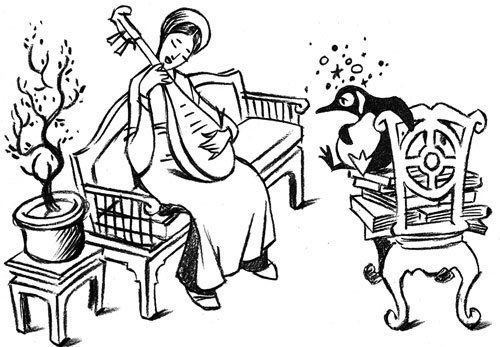

The Song of Kieu (translated by Timothy Allen)
Nguyen Du
Penguin: 2019
.
For those unfamiliar with the story, Kieu recounts the tale of a brilliant and beautiful adolescent gentry girl who chooses filial piety over fidelity to her romantic vows. She was sold to pay her father’s debts, and over fifteen years lived as a prostitute, a tortured second wife, a vengeful rebel princess and a monk, before finally returning to her family and her true love.
Nguyen Du, the author, was born in 1765. He was a scholar official for the Le dynasty, which was destroyed during thirty years of upheaval known as the Tay Son Rebellion. He continued as a relatively powerless appendage of the Nguyen dynasty, in which he served on tribute missions to Beijing. He adapted the rudiments of the Kieu story from a Chinese prose novel, Jin Yun Qiao Zhuan, which itself was vaguely inspired by a long-forgotten historical event. Nguyen Du composed his poem in chu nom (southern script). This was a nascent and unsystematised method of writing Vietnamese with Chinese characters.
Already in the nineteenth century, the poem was recognised as one of the most important works of chu nom literature. During the subsequent colonial-era development of mass literacy in the romanised script, the poem became a lightning rod for the consolidation of a nationalist consciousness, exemplified by Pham Quynh’s 1924 proclamation, “If the Kieu story remains, then our language remains, and our country remains.” The story was translated into French, and later into English and other languages. Currently, the most popular English translation is Huynh Sanh Thong’s, which was published by Yale University Press in 1983. Thong’s translation replicates the verse by using iambic pentameter, and is notable for its plentiful and informative endnotes, but the language is occasionally unnatural and doesn’t rhyme, leaving an opportunity for other ambitious writers and scholars to make further attempts.
For his translation, Timothy Allen has set out to “capture the flow of the story, the vividness of the characters, the sparkle and wit of its lyricism”. In this goal, he has largely succeeded: the characters come to life, the plot is engaging, and its tempo is a bright allegro.
More from Mekong Review
-

The art of Nguyen Manh Hung
-

Ocean Vuong’s debut novel
-

A poem by Aiden Heung
- Tags: Anthony Morreale, Issue 16, Nguyen Du, Timothy Allen, Vietnam