

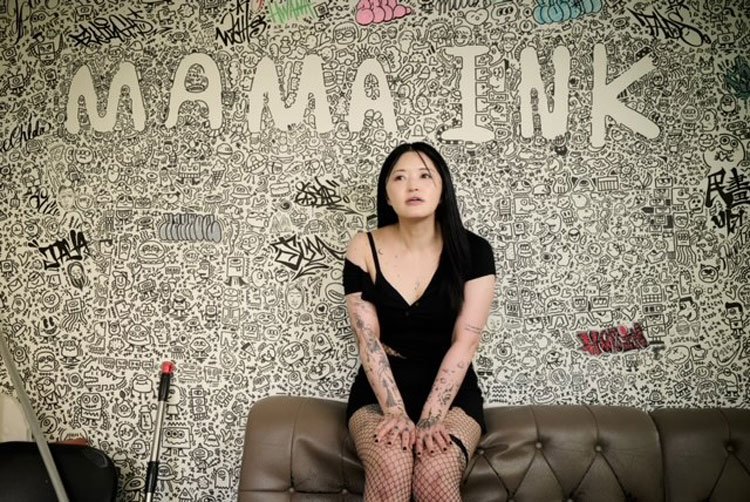
Fellow members of the millennial generation may recall with fondness The Addams Family films in which the gothy, deadpan Addams are chronically misunderstood and cold-shouldered as they attempt to navigate the pixelated, bubblegum-scented 1990s. It was their no-nonsense attitude, unwavering belief in their value system, and signature monochrome aesthetic that gave me a source of comfort in the confusing and alienating United States at the end of the twentieth century.
As a musical theatre–loving, Korean alt-girl with the same dry outlook on life as MTV’s Daria Morgendorffer and an unmistakable “aw gosh darn it!” Midwestern sensibility, I’d always felt a corn-fed disconnect between me and Korean people who grew up in Korea. I still often think about the Addams Family when appointments or obligations lead me to Seoul’s ritzier neighbourhoods like Gangnam or Yeouido.
I love Korea with all my heart, but until quite recently, I’d assumed that not quite fitting in would always be my default mode. It never occurred to me that I could stand in a space full of people proudly adorned with tattoos, dressed in black from head to toe, and have Korean faces just like mine grin and greet me with “안녕하세요!” every time we meet. I could never say this to these wonderful people directly, but it means the world to me.
This space is MamaInk Studio in Seoul. Around the corner and up the hill from Hyochang Park Station, MamaInk is a bright, open-plan studio crammed with shelves of books on topics such as fine art and tarot, potted plants, stacks of cup ramyeon, busts of Roman statues, a model ship, an iMac with a screensaver reading “Don’t play, draw” on repeat. Its exposed concrete walls proudly display the pencil sketches and practice silicone skins of artists and apprentices.
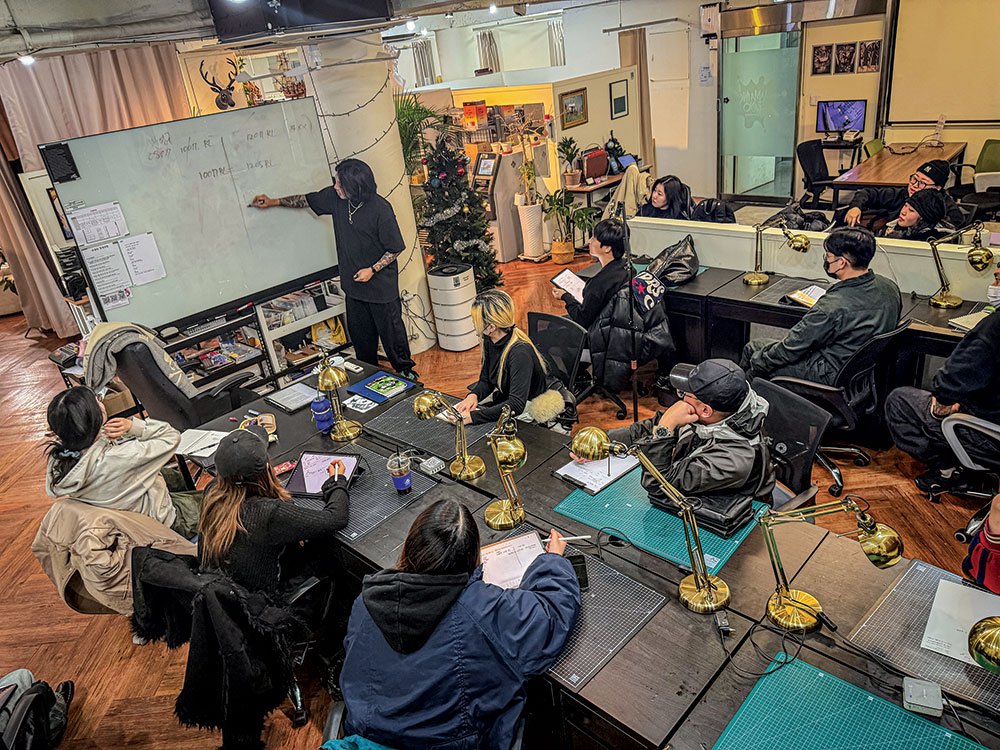
Perhaps it’s because the end of my PhD is looming on the horizon. Perhaps it’s due to the steady belief that MamaInk’s directors, Heo Junho and Kim Yongsang (more commonly known by his tattoo moniker, Ssab), have in all of us. Or perhaps it’s simply the fated midlife crisis that awaits me as a millennial. Although it was never part of the plan, I found myself at MamaInk; first as a freelancer, now as a trainee.
I only became aware of this space in May last year, so it’d be wrong to suggest that this is a studio in which I truly belong. What MamaInk has offered me is a respite from the daily doubts I have as a diasporic Korean pursuing a creative career in Korea. It’s a place where I can exhale and let my shoulders fall. I’m not Wednesday Addams in a sea of polished pastels in Gangnam or Yeouido. I am simply Taeyeon.
In small bits of free time between sketching, mentoring, and client appointments, a handful of MamaInk artists sat down with me to reflect on the moments that have remained resonant in our lives, how tattooing fosters a sense of belonging and self-expression, and how upcoming changes in legislation will impact the ongoing evolution of both the culture and industry of tattooing in Korea.
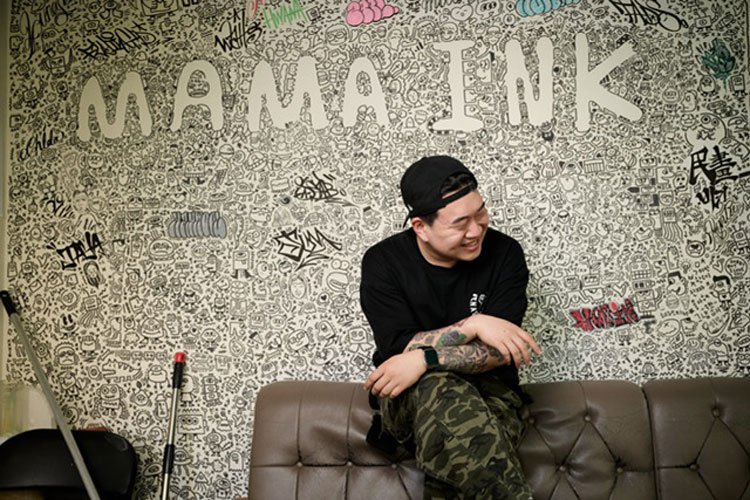
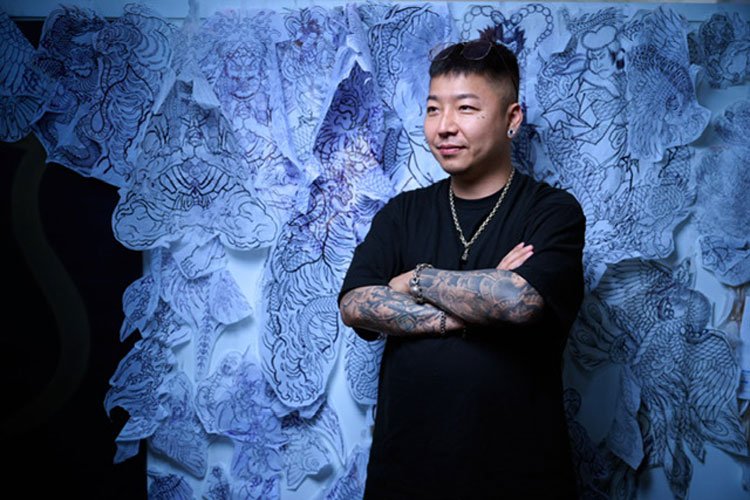
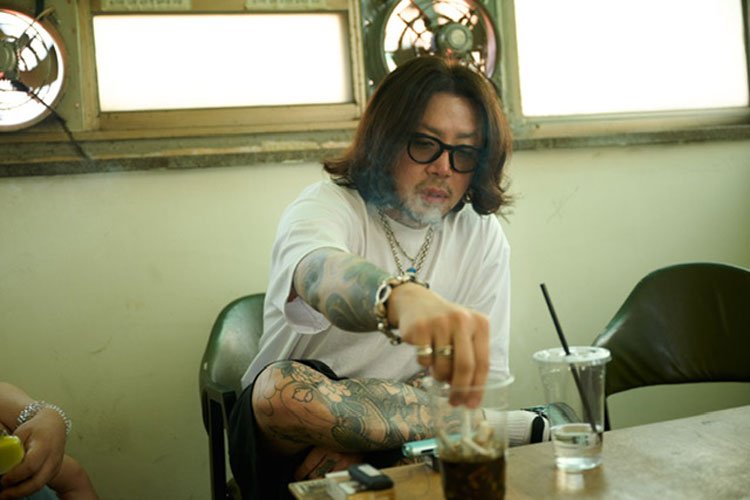
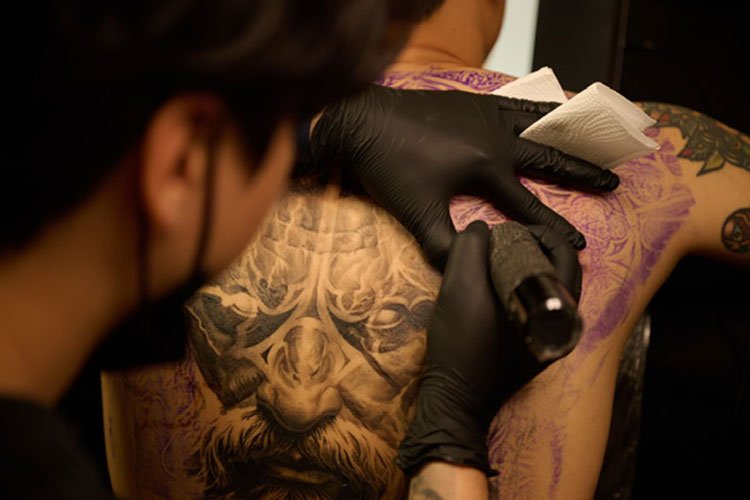
As a teen, my mother vehemently refused to let me wear black nail polish or get an undercut. In university, my then-boyfriend made a unilateral decision and declared, “You’re not getting a tattoo!” I immediately broke up with him, studied abroad in Ireland, and got my first tattoo in a random studio in Dublin’s Temple Bar district. And that was that. The MamaInk artists also described a similar gravitational pull towards tattooing.
Do you remember the first time you saw a tattoo? How did you get started?
Ssab: A close friend gave me the nickname Ssab. I loved drawing, so I always had coloured pencils on me. So they started calling me Sabi, as a play on words for the Korean word for ‘coloured pencil’, and then somehow that became Ssab.
Even though minors can’t get tattoos, my high school friend had gone and got one. That was the first time I’d seen a tattoo. While attending art college, as I kept drawing, I started drawing things closer to realism, and that’s how I started doing black and grey tattoos.
Watts: When I first learnt about tattooing, there wasn’t much information available that you could actually get your hands on in Korea, so I just kind of let it go and moved on with life. A long time went by before a tattoo-related post came up on Instagram. I thought, “Oh right, I used to want to do that when I was young. I’d better learn before I get any older.” That’s how I started.
Muntee: I’d been thinking about it since my school days, the idea of wanting to get a tattoo. I finally got it during my last leave from the military. I went out on leave, got the tattoo, came back and almost ended up in detention for breaking the rules. From the start, I simply had no sense of distance towards tattoos at all because my father has tattoos.
I think I felt attracted to the act of tattooing itself. The idea of being the one to engrave something that has meaning to another person—that seemed like an incredibly good thing to do.
Before the start of my training, I sat opposite Mr Heo in his office. He asked me what style I was most interested in.
“Lettering and script. I’m a writer, you know? And I guess, I’m just curious about ways to be creative with words. Like book quotes, song lyrics.” I continued: “Listen, I really need you to understand that I’ve never been to art school, and…”
“You’ll be fine,” he said.
“No, no, no! I’ve really never been to art school.” I drew a stick figure with a smiley face and held it up to him. “Like, this is it.”
He waved away my concerns. “That’s more than enough.”
Just as MamaInk’s space has a personality of its own, the artists speak of their creative practices with both the precision of academics and the gentle affection of parents.
Describe your chosen tattoo genre. What’s your approach to your craft? Koshi: When I draw, I try not to embed a meaning into the image. Instead, I want it to hold the thoughts of the person viewing it. Even when I upload images to social media, I don’t include any kind of description. It’s done in a way so that each viewer can come to their own conclusion.
Flea Canoz: I developed a strong interest in the Chicano lettering genre; something about it just really resonated with me, felt really close to who I am. Before this, I was a b-boy. As I kept dancing, at some point I wanted a career that would bring me closer to subculture, so I started tattooing. After doing it for a while, it felt like things finally clicked, that genre and me.
Hodle: Old school is simple. And if you’re going to make it simple, what you have to do is strip out everything that can be stripped out, but you cannot strip out the coolness itself. That’s what I consider most important. As simple as possible, but cool.
Hwal: I tend to design freely as I please. It’s a means to express that free feeling. The expressed creative work can then be carved onto the client. In that sense, you’re connected with the client, aren’t you? I find that fascinating to think about. I remember all the clients I’ve worked on.
Hongah: At first I liked Korean-style aesthetic sensitivity tattoos, that delicate kind with lots of fine lines, they felt like a good fit. I also liked drawing things that looked really realistic, like black and grey, so I started doing that too. Now, I mainly focus on clothing and plants, and I like this flow that sits between blackwork and realism. Light tones, multiple tones layered together.
Perhaps the way I feel most at ease at the studio is through unspoken micro-moments. On days that I am sad or tired, Ssab gives me space to be in my own thoughts. At dinner, a soju glass is silently filled with soda; everyone knows that alcohol makes me terribly sick. Patient and kind eyes are fully present when a lack of sleep or caffeine causes my Korean skills to betray me.
Joy, for the artists, is inseparable from their career trajectories and the ways in which they perceive themselves and their society. Tattooing is a space in which we can work in a comfortable silence and an inherently understood sense of gentle freedom.
How has tattooing informed your sense of belonging and your means of self-expression?
Hongah: By Korean standards, you’re always belonging to something. If you don’t fit in, you start wondering, am I different? Am I wrong? I’ve had thoughts like that, but I think… coming into these spaces there are all kinds of people, and you develop a broader perspective than when you were younger.
Koshi: While doing tattoos, I have come to wear what I want to wear, do what I want to do. But if I hadn’t been tattooing, I probably would have just studied with friends at school, followed what my parents did, like that. Right now, I love this feeling of freedom. Tattooing is the freedom of expressing yourself, isn’t it? But the moment I step outside of here, I start caring about what others think again.
Hwal: The feeling that Koreans have strict standards, I actually feel that, too. I think it comes from the social structure where you live and socialise in groups, where you have to mingle as part of a collective.
As for why Korean tattooists are more understanding and accepting of each other, what I think is there’s a tendency to see things without prejudice. When it comes to doing art, you don’t think “other people have to be exactly like me” because a tattoo is an expression of individuality. So when a person expresses their own individuality, they’re also expressing themselves and their own free will.
Flea Canoz: When I first came here, I genuinely didn’t say a word except “hello”, so at first, I had a hard time feeling like I belonged. But then at some point I thought, I’m here, I belong here, I’m learning the work I want to do, I can’t just keep being like this. Gradually my heart opened up and I got a lot closer to people, and now I really feel like I’ve settled in a lot. I’d say I gained a lot more confidence, too.
I think self-expression is the bigger part of tattooing. I fully consider tattooing to be in the realm of art, and if I had had some kind of hesitation about it, I think I would’ve wavered a lot about choosing this as a career. The fact that I’m still doing it anyway means I genuinely love this culture.
Muntee: Korean tattoo culture has strong bonds compared to professional groups in other fields. For the seniors, since they did it during a harder time than us, there seems to be this desire to guide the juniors a bit, under better conditions. And for friends who started at the same time, since they’re going through the same period together, I think that’s how bonds form a bit more tightly.
Care isn’t anything special, but even small things, by doing them, can leave a memory. That’s probably why I practice care. I always try to show respect and reverence towards other practitioners.
Watts: I’ve always been the one to talk to people first and approach them first. After getting into tattoo culture, if anything, that side of me just got a bit bigger. Approaching people and reaching out first, all of that became easier.
Hodle: It seems like many Koreans think ‘different’ means something bad. But a tattoo is individuality, it’s style, it stands out. So the people here… Everyone’s cool, knows what kind of person they are, and they’re trying to find their own style. And because of that, tattoo spaces are places where people who are already open-minded as a whole have gathered. It becomes more natural to just accept everyone.
In September 2025, the Korean National Assembly officially legalised tattooing by non-medical professionals, thereby ending a decades-long ban on the art. Although the legalisation was rendered with immediate effect, a two-year grace period has been given for tattooists to obtain the relevant licenses, and for studios to implement hygiene standards, safety training, and adherence with Korean tax law.
This development was not only unexpected, but also happened at a speed that caught the industry by surprise.
What are your thoughts on the 2025 Tattooist Act?
Ssab: We’re doing a lot of preparation to keep pace with legalisation. It’s definitely felt that the government is showing a far more supportive attitude. If new jobs are being created, the secondary industries tied to the tax revenue from that can keep on developing steadily. But honestly, since legalisation, tattoo schools popping up indiscriminately is something that worries me.
Hodle: Now that a law exists—and on the assumption that you abide by it—the country can protect you. Before now, if something sketchy happened to a tattooist, there was nothing you could do. You couldn’t report it because you were doing it illegally in the first place. People just starting out can learn more properly now.
Flea Canoz: It’s hard for everything to change at once, but I do think we’ve reached a point where we can step more into the light and stand as a legitimate career. I’ll be honest, I do have a desire for more people to look at us with a kinder eye. This profession, after all, hasn’t exactly left a great impression on the older generation. But still, I think we ourselves can become more responsible for that image, can’t we?
Gomez Addams once said, “They say a man who represents himself has a fool for a client. Well, with God as my witness, I am that fool!” By the time this article is published, I will hopefully have finished my training period. As I stumble through this coming spring and summer in my favourite city in the world, I’ll most likely be a fool, too.
Similar to other creative practitioners in Korea, it’s common practice to pick a ‘tattoo name’. Although this custom dates back to the centuries-old tradition of choosing an art name (or 호), today it is an opportunity to adopt an identity that matches one’s artistic style.
What will my tattoo name be? I’ll most likely just be Taeyeon. For no other reason that Taeyeon is who I feel like, and Taeyeon feels like enough.
What are your hopes for the future of tattooing?
Ssab: Cars started out as internal combustion engines and have now developed to the point of flying cars. I wonder if tattoo machines or even the ink itself can develop further, too.
Tattoo ink is made out of materials that don’t cause major harm but, for example, if there’s someone who is iron-deficient, maybe there could someday be a way to use ink containing iron to supplement that. I have a wish that new developments of this kind will emerge.
How can tattooing connect us to our past?
Watts: By marking personal memories into the body, you’re saying, “Even as time passes, I won’t forget this memory—I’ll always keep it.” A tattoo is something you can look at up close for the rest of your life; in that way, you carry that memory forward. When thinking about the Korean feeling of ‘han’ [a collective internal sadness], tattooing connects to that in the sense that instead of expressing something outwards to others, you express an internal feeling to yourself.
The future of tattooing in Korea holds the possibility of taking the art in directions of healing, equality, and discovery. But the act of keeping the art alive itself pays continuous homage to its frenetic past: a contemplative jumble of emotion, culture, the buzzing of needles, colour, individuality, laughter radiating from an artist’s station, linework, the metallic scent of ink, shading, and maybe, just maybe—a small taste of freedom.

More from Mekong Review
-

Taeyeon Song reflects on what Glasgow taught her about being Korean.
-

While Lee Yuri’s stories don’t feel explicitly political, the decades of loss experienced by Korean society stream like a current beneath her characters, who are reacting to their increasingly commodified, high-pressure society.
-

Baek Sehee writes: “The world tends to focus too much on the very bright or the very dark.” She steers clear of both extremes in her book. For this alone, it merits attention.
- Tags: Heo Junho, Issue 43, Kim Yongsang, South Korea, Taeyeon Song
