

The Vegetarian
Han Kang, translated by Deborah Smith
Portobello Books: 2015
.
Human Acts
Han Kang, translated by Deborah Smith
Portobello Books: 2015
.
Greek Lessons
Han Kang, translated by Deborah Smith and Emily Yae Won
Hogarth: 2023
.
It’s unsettling to read the work of Han Kang, who won the 2024 Nobel Prize in Literature. She’s attentive to the seemingly mundane. For instance, the human body: its atlas of wrinkles and moles, its curves and angularities, its demanding heat, its language of bone, blood, gesture, movement. She observes its traumas and humiliations. She offers a catalogue of putrefying bodies and the incongruous beauty of a war-numb dawn in a single sentence. She notices and conveys the heaving sounds of grief, the odours of death, the chirring of grasshoppers, the silent swapping of histories, the twitch of lips, the shape of words that resemble old pagodas. She etches vulnerabilities, chiselling away at her narratives to create sharp silhouettes of vulnerable protagonists.
In the introduction to Human Acts, the 2016 English translation of Han’s 2014 novel 소년이 온다 (A Boy Comes), translator Deborah Smith dwells on her style: an implicit and impressionistic account of political events “through the experiences of her characters, rather than presenting a dry historical account”. Human Acts is a retelling of the Gwangju Uprising in South Korea through the tremulous lens of multiple narrators. Reading it now, alongside news reports of protests in Seoul and the impeachment of South Korean President Yoon Suk Yeol after his remarkably short-lived attempt to impose martial law, amplifies its pertinence as a novel that explores the country’s troubled past.
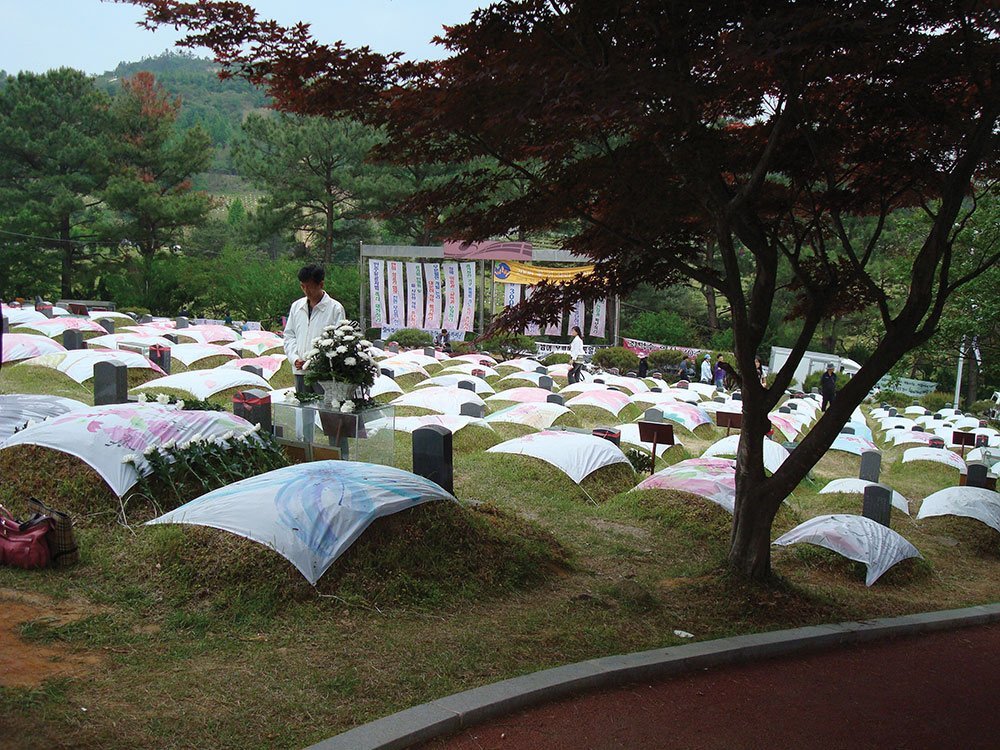
In 1980, students led demonstrations against the dictatorial reign of Chun Doo-hwan, who’d seized power after his predecessor, Park Chung-hee, was assassinated in 1979. In Han’s novel, which opens outside the provincial office, a boy sits on the steps leading to the municipal gymnasium where the dead are being brought from the Red Cross Hospital. The boy, Dong-ho, in search of his friend’s body, becomes a volunteer who keeps a record of each corpse—gender, approximate age, brand of shoes—in his ledger. He also assigns each body a number. Narrated in the second person, the opening chapter is a vivid sketch of the thwarted uprising: mouldering bodies, coffins lifted to the national anthem’s refrain, bereaved families kneeling, Fanta bottles with white flowers and candles presented as a crude and hasty tribute to the dead. Han’s narrative (via Smith’s translation) is unflinching in its description of rotting flesh. She shows, with unsentimental ease, the viscera of what was once a girl in a pleated skirt, her pedicure still visible on her toes: “The right side of her skull has completely caved in, seemingly the work of a club, and the meat of her brain is visible.”
But Han, a Gwangju native herself, isn’t trying to shock or sensationalise the traumatic history of a nation. She documents the sudden crumpling up of human beings into twisted heaps of arms and legs to heighten a longing for normalcy. Amid the carnage, Dong-ho recalls visiting his maternal grandmother and following her into her pantry for an oil-and-honey pastry. The following chapter is narrated in the first person by the soul (or disembodied voice) of his dead friend, Jeong-dae, who observes his own body decompose: “More and more mayflies crowded inside my open wounds. Gadflies crawled slowly over my lips and eyelids, rubbing their dark, slender legs together.” The spectral presence is lonely, frightened and full of loathing for his decomposed body. He recollects a summer, not too long ago, when he was at school with Dong-ho and the chalk dust got into his nostrils. He recalls, with a yearning that leaps off the page and envelopes the reader, his sister’s hand caressing his forehead. His sister, the petite nineteen-year-old Jeong-mi, who works in a textile factory but dreams of going back to school. Also dead, her brother’s soul knows, as he grieves in soundless, bodiless agony.
Women appear swathed in vulnerabilities in Han’s fiction. In both The Vegetarian (2007, published in English in 2015) and Greek Lessons (2011, published in English in 2023) Han’s female protagonists grapple with personal histories convulsed with violence, separations and repressed desire. Greek Lessons, translated by Deborah Smith and Emily Yae Won, is perhaps the more tender novel; it is, quintessentially, a love story. Narrated in alternating chapters by a man and a woman, Greek Lessons explores the relationship that evolves between them. He, a teacher of Ancient Greek on the verge of blindness; she, a woman shrouded in silence, for speech has abandoned her. Both narrators are unnamed; his story is told in the intimate first person, hers in the third person. When the novel opens, she is in a classroom, twitching her lips, unable to read out loud. The grey-haired psychotherapist she has been visiting ascribes her silence to recent emotional upheavals: the death of her mother, a divorce, a prolonged custody battle for her eight-year-old son that has ended in defeat. She has experienced this vanishing of speech once before, at the age of sixteen. Back then, it was a French word—bibliothèque—that prompted her to mumble and break her silence.
Twenty years later, the silence has returned, “Like a shadow bereft of physical form, like the hollow interior of a dead tree, like that dark blank interstitial space between one meteor and another, it is a bitter, thin silence.” Greek Lessons traces this silence and its electric crisscrossing with the nearly blind teacher. From his letters, one learns that he left Korea for Germany when he was fifteen and returned when he was thirty-two. He dwells on language, his mother tongue and his degree in Ancient Greek philosophy, which would be useless in his home country: “After that first autumn that I spent marvelling at, and moved by, my mother tongue, which I had missed unbearably, winter came crashing in from all directions like a landslide, and Seoul began to seem more like a stranger to me, just as the German cities had once seemed.”
Seoul appears in fragmentary blurs to the partially sighted teacher. He notices shoppers on the outskirts of the city: the tracksuit and paunch of a middle-aged man, the sparkly sweater of an elderly woman who’s lighting a cigarette, profanities emanating from the vicinity. He conveys the changes in the city that he returns to: a familiar road, leading up to a temple that was once fringed by potato fields, is now surrounded by residential buildings. His is the nostalgist’s view; he’s attuned to the scents and sounds of a summer’s night—a metaphysical darkness, fragrant with damp grass, sonic with insects and songs from a CD.
Between the nearly blind man and his mute student develops a subtle awareness of each other. Greek Lessons is not a conventional romance, nor is it a long-drawn love story that culminates in a passionate kiss. Han explores gestures and movements; she’s attentive to slight tremors, deep inhalations, a lowering of the head, a tightening of a grip on a pencil. When the narrative finally enfolds them in privacy and conversation, he speaks and she responds through her silence. The prose is preoccupied with physicality: the features of a room, the position of furniture and bookcases, lamp shades and magnifying glasses on a desk. The syntax of movement replaces language: “He sits on the bed, she on the bench, each of them holding a bottle of water. She looks at the veneer-wood flooring, at the shadows the furniture casts on it. When she looks up at the ceiling, she sees their two black shadows on its rice-colour wallpaper, swollen surprisingly huge.”
Han’s novels are strewn with overwrought lives and broken languages; she explores loneliness through the disappearance of words and sentences. In The Vegetarian, a brutal three-part novel about desire and depravity, the female protagonist Yeong-hye’s decision to throw all the meat out of the refrigerator and turn vegetarian leads to a splintering of her being and a complete annihilation of normalcy. “…I had a dream,” is all she says by way of explanation to her husband, whose first-person narrative opens the novel. Her dreams are violent and sordid, their italicised sections indicative of a drastic contrast to her husband’s self-absorbed narrative. She is force-fed meat by her father at her sister In-hye’s apartment; she lets out an animal howl in response to the outrage and slashes her wrist with a fruit knife.
In the second section of the novel, titled ‘Mongolian Mark’, Yeong-hye’s brother-in-law, an artist struggling through an unproductive period, develops an obsession with her. He aches to see the Mongolian mark on her buttocks—details of a blue, thumb-sized birthmark that his wife In-hye lets slip when she’s bathing their son. The narrative, in the calmly descriptive third person, is a provocative account of this obsession. The prose is both erotically charged and deeply lonesome, as though to live out a fantasy is to spiral into an abyss of unfulfilled desire. He paints flowers on her naked body, making her lie in various positions as he films the process. Two years have passed since Yeong-hye has cut her wrist; two years since she was found sitting by the hospital fountain with her hospital gown on her knees, her collarbones and shrivelled breasts exposed to the sun. Now, as her flesh responds to the tip of the paintbrush, she is a study in vulnerability: “Every time the brush swept over her skin he felt her flesh quiver delicately as if being tickled, and he shuddered.”
Yeong-hye, whose unravelling is brought about by a bizarre urge to turn into a tree, is in a psychiatric hospital in the third section of the novel. This part, also in the third person, draws attention to In-hye’s world. She, four years older than Yeong-hye, visits her sister at the hospital with offerings of rice cakes and fried tofu stuffed with vinegared rice. The narrative is dark and rain-splotched; the small hospital she makes her way to is surrounded by mountains. In-hye recalls their childhood and Yeong-hye’s propensity for the muddy outdoors. She watches as Yeong-hye performs a headstand in the hospital’s corridor. “Well, I was in a dream, and I was standing on my head… leaves were growing from my body, and roots were sprouting from my hands… so I dug down into the earth,” Yeong-hye declares in a delirious haze.
At the hospital, where In-hye checks Yeong-hye’s back for bedsores and attempts to feed her a sliced peach, the narrative amplifies the slow and excruciating progress of time. “Time passes”—a phrase that appears repetitively, like section breaks—heightens In-hye’s helplessness and claustrophobia. Through the hospital window, she notices the intensity of the rain, the raindrops that cling to the mosquito netting, the overcast sky and dripping trees. Through an ambulance window, she catches a glimpse of the summer woods. The tranquility of the natural world surrounds her and yet is beyond her reach.
Nature—with its majestic trees, its critters, its play of light and shadow—provides expressive backdrops for Han’s fiction. When language feels inadequate, an insect hums to fill the silence. A soul, bereft of body, remembers the hollyhocks blooming outside his room. Han chronicles human frailty and barbarity but allows the light to seep in through the foliage.

More from Mekong Review
-

Baek Sehee writes: “The world tends to focus too much on the very bright or the very dark.” She steers clear of both extremes in her book. For this alone, it merits attention.
-

Taeyeon Song reflects on what Glasgow taught her about being Korean.
-

A coffee with a stranger opened up uncomfortable truths
- Tags: Free to read, Han Kang, Issue 38, Radhika Oberoi, South Korea
