


The television is on in my friend’s Melbourne home when I arrive from the airport. The US election results are trickling in, district by district, state by state. The analysts tap on their interactive charts, chattering about voter turnout and the margins that either Kamala Harris or Donald Trump need to win. I’ve already been struggling with the notion of a close race between a qualified, competent woman and a narcissistic reality TV star with authoritarian tendencies, but it’s clear that things are going badly for Harris. It’s confirmed by dinnertime that, four years after a chaotic and damaging first outing, Trump will be the President of the United States again.
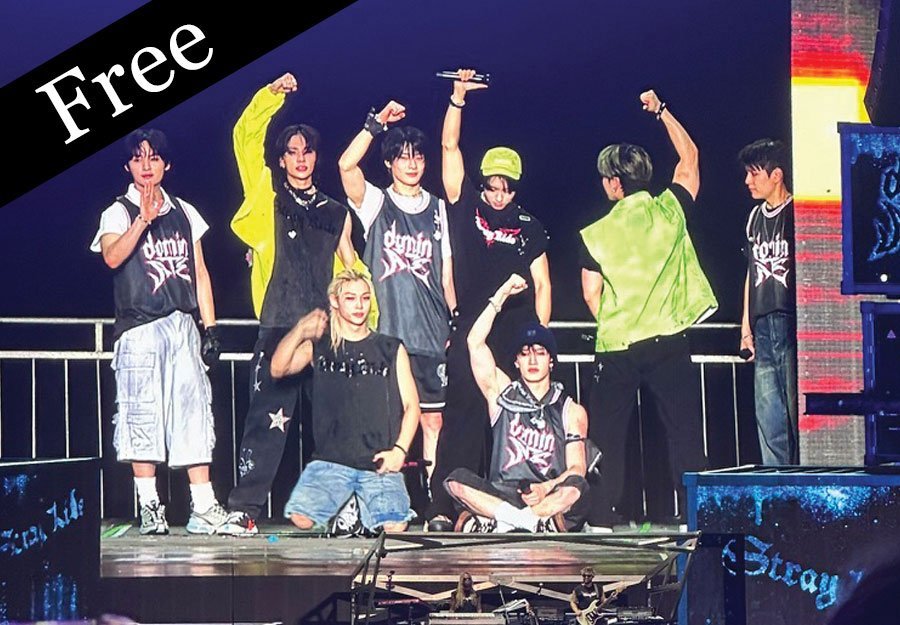
It’s my birthday. I deliberately take the laptop out of my bag. I’m almost never without it because I always worry about emergencies, about some urgent task cropping up. But I leave it behind today; that’s how determined I am to get a proper day off. I stick the AirPods in my ears as I head out the door. There’s no question about the music I’ll be listening to on my day: Stray Kids, the Korean boy idol group I fell in love with a couple of years ago, when I was most in need of something to lift me out of a burnt-out funk.
In the weeks after Trump’s election, people keep asking, “What’s going on with the world?” Everyone I know seems depressed or anxious—usually both. No one knows what the future might bring, especially when the most powerful country in the world is set to again be led by a man without clear policies, only vibes, and highly troubling ones at that. Everywhere we look, freedoms are eroding, stressors are increasing, life is getting more and more difficult for everybody except a tiny minority with obscene wealth. Tens of thousands—women, children, entire families—are being slaughtered in acts of violence that humankind had promised would never happen again, and those in positions to do something about it shrug their shoulders, make excuses or, worst of all, perpetuate the horror. The world is on fire and it’s overwhelming to watch.
There are eight members in Stray Kids and I love them all: Bang Chan, the ever-responsible leader. Changbin, the gym rat who challenges toxic masculinity. Hyunjin, the artist who gives me hair envy every time I look at him. Felix, a ray of sunshine. Seungmin, the hilarious menace. I.N, nicknamed “baby bread” and doted upon as the youngest. I’m especially partial to Lee Know, whose sense of humour and love for cats matches mine, and Han, the multi-talented introvert with the same last name as me (but no relation, of course. If only.) In a life where distance or packed schedules mean I rarely meet my closest friends in person, I live vicariously through their chaotic camaraderie. Don’t you think they’re just putting it on for the cameras? some sceptics ask. I shrug. Maybe their public personas are different from their private ones. I’m not that bothered. Enjoyable though the parasocial relationship between idols and fans might be, I know it’s not real. Perhaps that’s the benefit of being a fan in my thirties rather than in my tweens.

It’s brutal out there for freelance journalists. The number of publications I could write for—and get paid—has dwindled so much that, if I were to stop working for Mekong Review, I doubt I’d be able to survive like I used to. I read about journalists losing their jobs, media outlets slashing budgets or shutting down completely, and feel both despair and panic. Then there’s the deep disappointment and disillusionment, coming from a recognition of the ways in which the media keeps failing the people we’re supposed to serve, chasing clicks or equivocating through rituals of ‘objectivity’ rather than speaking truth to power. I wonder if I can still live as a journalist and pay my bills. I wonder if I want to. I lie awake at night and ponder alternative lives teaching English, working with kindergarteners, stacking shelves in a bookstore.
I’m an early adopter of Threads, Meta’s answer to the rapidly deteriorating Twitter. Meta’s problematic, too, but it’s not easy to quit social media when so much of what I do is online. The journalists, activists and academics I used to chat with on Twitter haven’t made the transition, so my feed is swiftly populated by K-pop fans. It’s glorious. I find a bunch of other people who identify as Stray Kids fans—or Stays, as the fandom is known. Many of them are even around my age, so I don’t feel like a senior citizen crashing a party for preschoolers. We giggle over music videos, share memes, indulge in inside jokes. We have so much fun.
I meet a bunch of human rights defenders within a single week and listen to a political exile describe how they have to look up airlines and flight paths before deciding on where and how they can travel. It sounds exhausting: one has to consider not only the final destination but also the possibility of diversions and emergency landings. Wind up in the wrong country, one with an extradition treaty or a willingness to turn a blind eye to transnational repression, and the consequences could be dire. It angers me that we live in a world where this is the price of caring about justice and human rights. I know so many people, from different countries and cultures and backgrounds, who have chosen to resist authoritarianism and fight for a better world. In one way or another, we all bear the scars of challenging power and being on the receiving end when that power pushes back.
I begin collecting stuffed toys, starting, of course, with the dolls that form part of a never-ending series of Stray Kids merchandise. It’s not the most sensible use of my hard-earned money, but ‘sensible’ seems a highly relative term these days. All I know is that these plushies “spark joy”. I carry one or two with me when I travel. I photograph them in all sorts of places: in a night market in Taipei, at the George Town Literary Festival in Penang, in a parlour paying homage to Robert Burns in Gatehouse of Fleet, Scotland. These photos are better mementoes of my travels than selfies.

I spend November 2024 in Australia, moving from city to city, catching up with old friends and making new ones. The bad news follows: while I’m away, Singapore executes four men. These are men who have each spent more than a decade in prison, and I’ve known most of their families for years. I do what I can from afar—alerting the UN and human rights organisations, posting on social media, giving briefings to raise awareness—but it feels monstrously inadequate. I’m taken back to 2022, that terrible year when Singapore executed eleven men in swift succession. I’ve witnessed the pain delivered by state-sanctioned killing too many times, attended too many funerals over a fourteen-year period of more losses than victories. In the face of such determined violence I feel lost and helpless, too small and weak to hold back my country’s war on drugs.
I turn up the music and lie on my side, mindlessly scrolling on Instagram. I’m tired but I don’t go to sleep. People say that, after a long day slaving away at one’s job, bedtime revenge procrastination is about establishing some control over one’s own time. I suspect my bedtime revenge procrastination comes from apprehension about what tomorrow might bring. Sometimes it brings news of more state oppression, of friends being summoned to police stations. Sometimes it brings execution notices. So I refuse to let it be tomorrow just yet. I swipe up to watch another cute cat video, dance challenge or silly variety show clip.
Two days after my return to Singapore, President Yoon Suk Yeol declares emergency martial law in South Korea, claiming that it’s necessary to protect the country against North Korea and “anti-state elements”. Furious South Koreans, many of whom remember the last time their country was under martial law, take to the streets. On Threads, some international K-pop fans start to worry, of all things, about whether the year-end music festivals and award shows featuring their favourite acts will be affected by a coup. The frivolity of fandom stands in stark contrast to the unfolding political emergency. But then young Korean women take to the streets, brandishing their K-pop lightsticks as protest props, lighting up the freezing nights. It becomes a way to keep spirits up and have some fun even when there’s so much to be angry about.
Shops selling cutesy figurines in blind boxes have popped up all over Singapore. I see Labubu everywhere, the furry elf character grinning at me with her serrated teeth from where she hangs on the bags of other commuters. I realise I’m not the only one who’s adopted a frivolous hobby. We’re all finding ways to relieve the anxieties of living in a world that’s spinning out of control. We’re all swamped with worry and grief about job security, the cost of living, oppression, the climate crisis, crimes against humanity and so much more. We reach for a dopamine hit wherever we can get it.
When I wake up in the morning I am hugging a stuffed toy like I’m still six years old. But I’m not six anymore, so I get out of bed and back to my responsibilities. I do my work for this magazine, for the anti-death penalty movement, for the various other human rights causes I lend my support to. I don’t let my escapist fixations take me completely away from what’s important. But when it all feels too much to bear and an extra boost is required, it helps to have some K-pop boys in my corner.

More from Mekong Review
-
How does one save the world against evil with little more than one’s own imagination? When faced with hopeless nonsense from the political leadership, what can one do with their writing?
-

In Ajoomma, a Singaporean-South Korean co-production directed by He Shuming, an auntie travels to South Korea to visit the shooting locations of her favourite K-dramas… but gets far more than she’d bargained for.
-
Nature provides expressive backdrops for Han Kang’s fiction; while she chronicles human frailty and barbarity, she also allows the light to seep in through the foliage.
- Tags: Free to read, Issue 38, Kirsten Han, Singapore, South Korea
