

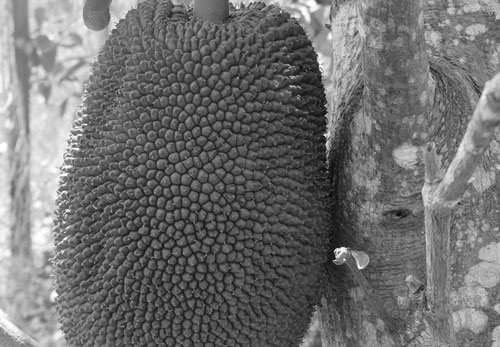
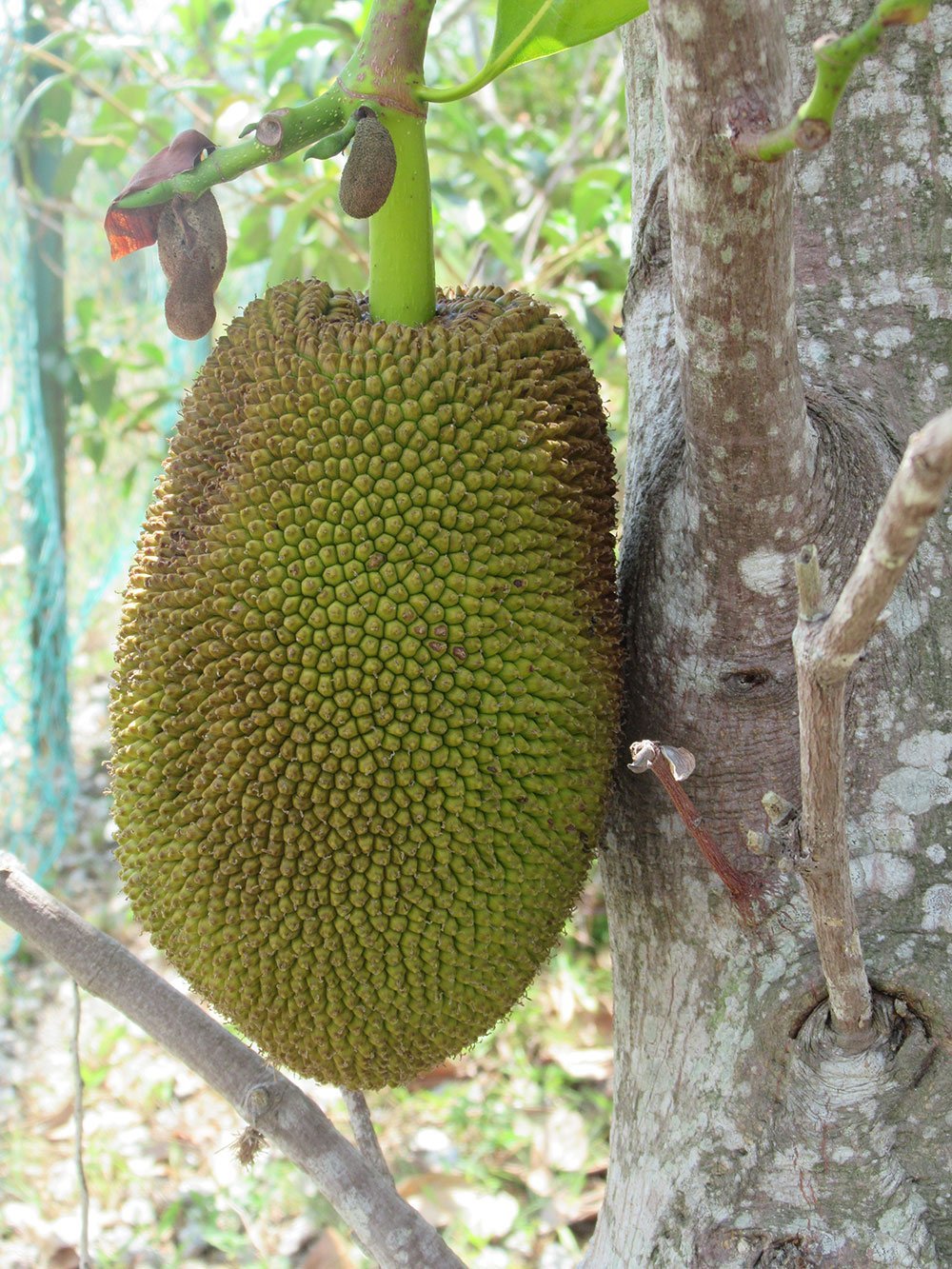
I first encountered jackfruit in a village nestled among the misty hills and rubber plantations of southern India. Its scabrous reptilian hide was discoloured by streaks of congealed latex that leaked like blackened pus from a suppurating wound. There was something unsettling, even grotesque about it — an incongruously large and mottled metastatic growth, more monstrous appendage or malignant tumour than fruit. It looked as if it had just teleported in from another planet. I wasn’t entirely convinced it wasn’t sentient.
It was only when I began living in Malaysia that I tasted jackfruit for the first time. Even then I didn’t immediately make the connection with the huge misshapen fruit I had seen in Kerala. Instead I was more focussed on removing the yellow segments of fruit from their offensive polystyrene and film packaging, which I returned to the mystified vendor after transferring the fruit to a lidded container of the type a young woman of my acquaintance refers to unironically as TaPaoWare, a brand-name worthy of being trademarked. The fruit looked oddly synthetic, as if made of plastic. It was candy-sweet, with an adhesive stickiness that glued my lips and a flavour that reminded me of bubblegum, though not in an entirely good way.
More from Mekong Review
-

My island home
-

Poetry from David Chandler
-

A towel for all times
- Tags: Issue 15, Jackfruit, Malaysia, Marc de Faoite