

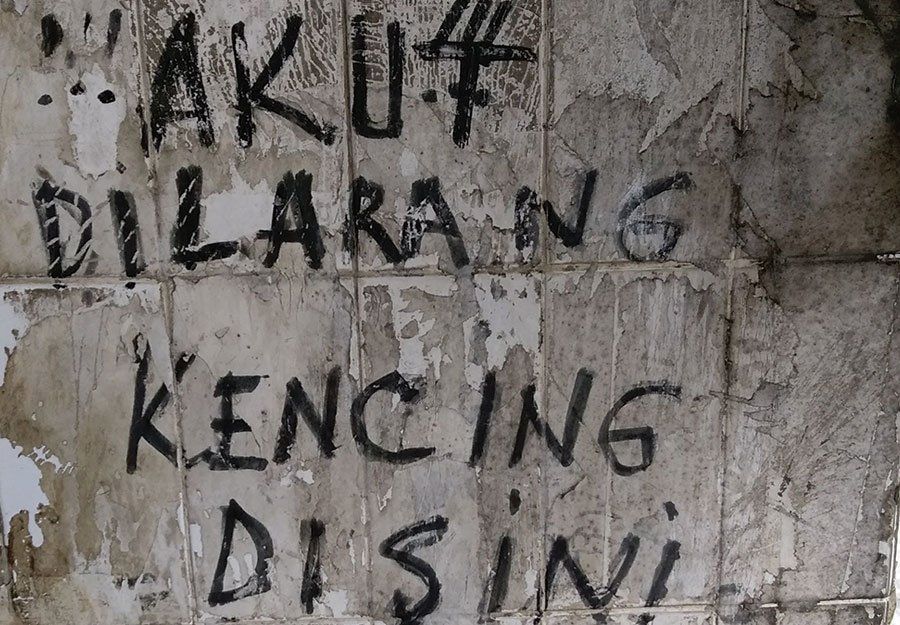

In nearly any neighbourhood in the central Javanese city of Yogyakarta, small structures are set into corners for people to sit inside to rest or even watch television. There’ll be a blackboard on which messages can be written; sometimes there’s what appears to be a time schedule for volunteers to man the space. In some other neighbourhoods, one finds small, fortified structures in which soldiers could ensconce themselves, as if waiting for an imminent attack. These are physical reminders of another time, when phantasmic latent ‘dangers’ stood to threaten the very soul of Indonesia. These days, as the telling of Indonesian history once again becomes the subject of heated debate, it sometimes feels as if those dangers have returned again.
On the night of 30 September and early morning of 1 October 1965, many Indonesians imagined that shadowy agents, saboteurs and infiltrators would somehow surreptitiously creep into their souls and poison them, transforming them into bloodthirsty immoral communists who would commit acts of depravity. In what still remains an opaque part of Indonesian history, six generals were kidnapped by a group of rogue soldiers—suspected of having communist sympathies—who were intent on protecting Sukarno, the republic’s first president, from a possible coup. It has been alleged that these troops and their officers tortured their quarry before murdering them. But they were soon defeated and captured by another cabal of generals, including one General Suharto, the head of the army’s strategic command.
The plot is convoluted, but one must understand that, during that period, the Indonesian armed forces were marked by factionalism and ideological divisions. In the aftermath of the alleged coup and counter-coup, Suharto consolidated power. He first positioned himself as a saviour, then as an avenger who sought to cleanse Indonesia of the Communist Party of Indonesia’s (PKI) influence by jailing, executing and disappearing nearly half a million suspected communists. Many more political prisoners spent years in a detention camp on Buru, the third largest island of the Maluku Islands. Pramoedya Ananta Toer, the writer sometimes described as having been Southeast Asia’s best candidate for a Nobel Prize in Literature, wrote his most famous work, the Buru Quartet, while imprisoned there.
More from Mekong Review
-

Magical realism meets gritty realism
-
Indonesia in the 1960s, through the prism of post-colonialism
-

In a short time wearing face masks became the norm in Ubud
- Tags: Indonesia, Issue 40, Leong Kar Yen