

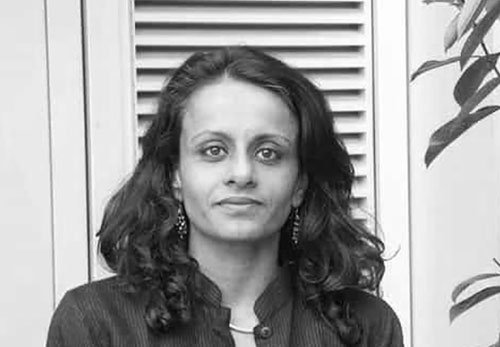
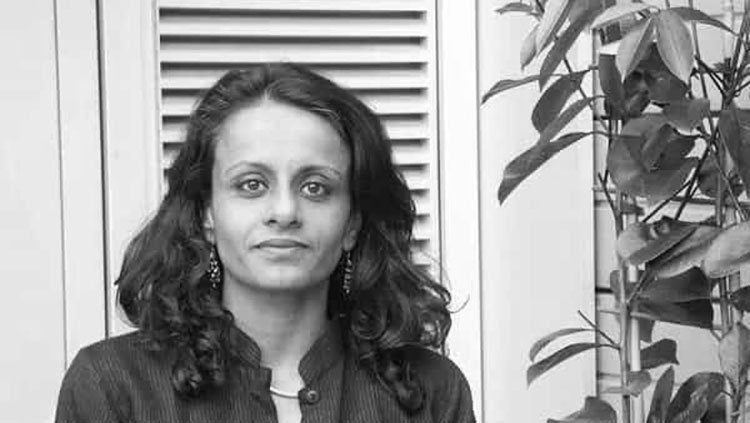
As an academic working in the Faculty of English at the University of Cambridge for the last two decades, Priyamvada Gopal could easily spend her days doing the usual and the expected at a posh university with freshly trimmed lawns and Gothic chapels. Instead, she has been the subject of virulent hatred, positioned at the centre of media controversies, subjected to both serious slander and laughably petty accusations. Even though Gopal has published critical work on the British Empire since the start of her career, the past few years have found her involved in student protests for the decolonisation of universities and, as a result, subjected to disturbing, neoconservative attacks.
Gopal has remained firm against her detractors, resisting what she calls the ‘fake culture wars’ being generated around her, and displaying in the process a sardonic and unsparing wit. Though the dust keeps swirling, Gopal has continued to produce important writing. Insurgent Empire: Anticolonial Resistance and British Dissent, published last year, is a magisterial volume that complicates and expands our understanding of the histories of dissent during the colonial period. Her recent article, ‘On Decolonisation and the University’, published in the journal Textual Practice, also offers clarity on many of the debates raging at American and European universities today.
When we spoke on Zoom, I had expected to meet the intimidating version of Gopal often observed on social media. But instead, I found her relaxed, charming, and easy to talk to.
Insurgent Empire seems to speak directly to a very precarious moment in British history, by which I mean the vigorous defence of empire going on in certain circles these days. I’m not saying this hasn’t happened before, but with Brexit and so on, there’s a real revival of imperial nostalgia, and you’ve been at the front lines of speaking and writing about it. Did these events influence you as you wrote your book?
Yeah, they very much did. What feels to people outside Britain as new and in your face—that is, this energy that goes into renewed defences of the British Empire—has actually been brewing for at least a decade or longer. It’s become very salient because of Brexit, Boris Johnson, and the Trump years. This inability to question or even understand the empire except through an attenuated historical mythology has been around for a very long time. In fact, C.L.R. James, whom I discuss in the book, talks about the mythologies of empire, and he was writing in the early 1960s. He describes this myth of a benevolent and giving empire as being in tatters, and yet that myth is still around. He talks about the ways in which the tatters are taken and stitched up to make the myth new again. And that is exactly right. So, the mythology of the benevolent empire has never gone away and is very salient for me in terms of public discussions in Britain. But I wanted to think about it and define it differently from just saying, ‘Well, here’s the postcolonial version of empire, right, the bad empire versus the good one of the myth’.
Your previous books were focused on Indian colonial and postcolonial literary studies or literary criticism, broadly speaking. What has led to the shift to this more transnational paradigm that seems to be grounded more in history than in literature?
[Y]ou’re quite right, Insurgent Empire is unconstrained by, I think, the need to be literary, and that is a consequence, I suppose, of tenure and seniority. It frees you up. As a young scholar coming into academia, you don’t feel that freedom. I certainly felt much freer … to range outside disciplinary boundaries, to be properly interdisciplinary, to not worry about ticking boxes. And therefore, I was able to tie public concerns and public debates to the actual research.
I think Insurgent Empire shows a commitment to revisionist radical history and dissident history, or the dissident figures left out of history. Do you believe that this is the starting point of ‘decolonising’ in the sense we use the term today? Does decolonising begin with revisionist historical writing?
I interpret revisionism here to mean filling out history and tracking what actually happened. And filling out the gaps in historical understanding. So, yeah, absolutely. I’ve always thought of Jamaica Kincaid’s phrase ‘a demanding relationship to history’ as the essence of decolonisation. That is, wherever you’re situated, you have to develop a more demanding relationship to history in order to decolonise. So, the short answer to your question is yes, but it also means that decolonisation is different depending on the context because contexts are shaped by specific histories. And all those gaps, those revisions, are highly specific. So, it is not a one-size-fits-all model.
What would be your dream programme if you had the power to decolonise the curriculum?
[W]e would have to stop being limited by nation-focused disciplines. I also think we are at a point in history where something like a ‘global humanities’ makes more sense. So, Insurgent Empire, for instance, required me to range across disciplines. I imagine something like a global humanities program—where, if we thought hard about what humanities mean in the present, it might offer more scope for decolonisation.
In debates going on today, there is a kind of division between global North and global South scholarship when it comes to thinking about decolonisation. For example, there is the complaint that decolonial work does not include global South thinkers and that it has become co-opted by moneyed institutions in the global North.
I’ve heard versions of this. If we are in global North institutions, or if you’re in a metropolitan university in Delhi or Kolkata (and I’ve made this point to scholars in India), it does behoove us to think about our situations, our structural positions, which as you say are fairly privileged despite the issues you end up dealing with on a day-to-day basis. Decolonisation is precisely about centring marginalised perspectives, but it’s also about undoing boundaries. And therefore, voices from the global South have to be brought to a position of equality, but equally, one would need to be attentive to hierarchies within the global South. It is not then a simple matter of saying, ‘Well, we will bring in a South African or a Brazilian or an Indian intellectual’. Yes, those voices need to be brought in, but other kinds of hierarchies also need to be thought of.
My experience living and teaching in Kenya is that this type of thing is not a priority, there are many other more immediate battles that people are fighting. I was also thinking about the zero imperative in India toward these agendas. There was some conference on decolonisation in India where it was majority Bengali and upper-caste academics, basically the elite, participating. So, it was imitative of Western conferences and did not connect with any activism or real political concerns.
You are right that decolonisation isn’t picked up in the ways that you and I might be talking about it in global North institutions. But it is actually being picked up by a very dangerous strand in India: the Hindu right-wing. And their argument is that the Hindu nation is the ultimate vehicle of decolonisation. So, actually, I would say that, in India, it is imperative to pick up decolonisation and to think about it not just as something that the global North is doing but actually something that is vital to a country in a state of arrested decolonisation, where decolonisation, as some predicted, did not unfold. And we are living with the consequences of that now, which is rampant neoliberalism, the colonial state apparatus combined with an ideology of racial supremacism. It just happens to be Brahminical and upper-caste supremacism rather than whiteness.
Well, that’s the other thing people will say, that you cannot apply this to caste. Decolonisation paradigms do not apply to caste because caste is much older than European colonialism.
Decolonisation is actually relevant to everybody. The globe is in a state of arrested decolonisation, or rather, non-decolonisation, and you have to bring in caste. The great decolonisers, the great anti-colonialists understood that. I’m thinking of Fanon and Césaire, who told us that colonisation always involved the collaboration of colonial elites and native elites, and that so-called indigenous tyrannies and native tyrannies have to be brought into the frame of decolonisation as much as whiteness or Britishness. So, not thinking about caste in the frame of decolonisation is not an option. You have to, because you can’t understand the British Empire in India without thinking about caste.
This doesn’t mean that caste is reducible to empire, but it is a very fundamental part of how empire operated. It’s quite important to distinguish between what I am saying here and the false claim that caste is a colonial construct. It’s not. It precedes colonialism by millennia, but it works alongside colonial oppression, and that’s something to be thought about. I want to undo these boundaries and keep raising these questions about caste, capitalism, and race because capitalism in India is a caste capitalism, just as it is a racial capitalism elsewhere. It’s not an option not to put all these things in dialogue.
Does it reframe or decentre our understanding of class?
I think so, given that we have caste capitalism in India and given the ways in which caste, while separate from class, does map onto high levels of disenfranchisement in economic terms as well. I think it can bring us back to thinking about gender, race, caste, class, sexuality, and gender assignment in a shared framework because these things work together and not in isolation.
I know that you are constantly being attacked in the media, on social media, in British newspapers. What exactly is going on? There seems to be a small group of public thinkers in the UK who are always under attack, but you more than anyone else.
Well, that’s a relatively easy question to answer. Britain is in the middle of concocted but highly effective culture wars. They’ve been stoked up around empire, nationalism, white supremacism, and Brexit. And just like in the US and other places—in fact, like in India—academics have been targeted and universities have been targeted. Which, in a way, is quite flattering because it does make you think what we do must matter at some level because otherwise why would they bother to attack universities and academics?
I think I function as a very useful abstraction, a bringing-together of a bunch of hate objects. These have nothing to do with me, the person, but all the boxes that I tick. I am an academic: hate object. I’m a woman: hate object. I am not white: hate object. I’m a migrant: hate object. And of course, I’m a lefty, the so-called woke. Someone, a well-known pundit, called me the Torquemada of the Woke Inquisition. So, that’s five for the price of one.
The other thing that really gets up the tabloid noses is that I sit at the heart of an institution they consider their own. Cambridge is meant to be white. It is certainly not meant to be left-wing. It is certainly not meant to host multiple brown women. And this is the source of real upset. So, I tick a lot of boxes and I’m an easy figure in the ongoing and very false culture wars. I mean, I’ve seen cultural wars literally being invented around me. They took a statement I made about the royal family that no one was particularly bothered by until they turned it into a controversy. The headline read something like: ‘Controversial Academic Stokes Fury by Saying Royal Family Has Connections to Slavery’. This is not an especially outrageous claim, but the point is there was no controversy. The headline itself created the controversy. I have a ringside view of how culture wars are complete concoctions. They bear no resemblance to what people are actually talking about or care about.
This is an edited extract of an interview that was originally published at the Los Angeles Review of Books website on 30 August 2021. Read the full version here.

More from Mekong Review
-

Mekong Review amid the chaos
-

Exploring the past, the future and the shape of land made with sand
-
Pakistan's mountainous north
