


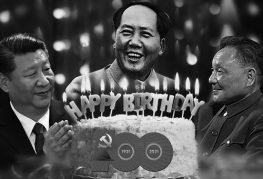
Only one subject has been on people’s minds in the months since we published our last issue. We are not going to ignore one of the biggest crises of our times, but nor are we going to obsess about it. Anthony Tao, a poet and editor, explores the new codes, expressions, even embarrassments of life under lockdown with verses that remind us of that much of this experience is shared. Richard Heydarian—author of a new work on Sino-US relations—explores Democracy in China: The Coming Crisis by Jiwei Ci, argument for a democratic transition in China. Between the crushing of protests in Hong Kong and the lack of openness about Covid-19, democracy seems far off under the neo-Maoist cult of Xi Jinping. Will the virus leave behind a crisis of legitimacy? It has already done untold damage to China’s global reputation.
But we all need other subjects to think about too: history, food, cities, even electronics. Mekong Review includes all them all in the May issue, which is published only on line due to the inevitable disruption of life and business. We hope to be back on paper soon but everything, including our finances, are uncertain.
History comes into its own when it creates noise when governments are trying to enforce silence. Emma Larkin explores the massacre at Thammasat University in her review of Thongchai Winichakul’s Moments of Silence. The Thai academic was a student leader in 1976, when an untold number of people were killed by the police at the prestigious university in Bangkok. The book asks the unaskable in Thailand: to what degree was the king involved. It is a question echoing around the country today, making this book even more important.
The word internment has an ominous tone to it in these times of closed borders and rising walls. Somak Ghoshal explores an account of one of the least known internments of the past century: those ethnic Chinese of Indian citizenship who were rounded up in 1962 after India lost a border war to its northern neighbour. Some three thousand people, from professionals to restaurant workers, were roused from the beds in night-time raids by the army and removed to Deoli, a town in Rajasthan. The trains, scrawled with the words ‘enemy train’, were stoned when they stopped at stations. The history of this tragic and unnecessary violation of the rights of ethnic Chinese is written by Joy Ma, who was born in the internment came and along with Dilip D’Souza, has pulled together an account of this forgotten past. The Deoliwallahs unearth the stories from those who spent anywhere from months to years in the camp. It is a timely reminder of the behaviour of the Indian State as it once again puts up fences for those it sees as foreigners.
Unearthing another dark but more recent event is Thomas A. Bass, whose essay on the nuclear disaster at Fukushima examines how regulatory capture by the power giant TEPCO led to a catastrophe that will shape Japan and the world for decades. Next year will mark the 10th anniversary of the triple disaster: recovery is still a long way off, the monitoring stations are still in place, keeping a watch on the radioactivity that remains.
Peter Yeoh’s profile of the talented Singaporean writer and literary impresario Jeremy Tiang leavens this edition. The novelist, playwright and translator is one of those people who opens up worlds for others. His latest work is a play that follows Arthur Miller to China in 1983, when he went to direct Death of a Salesman in Beijing. A bilingual work with an all-female cast, the play has its subtitle lay out the premise, sort of: The (Almost!) True Story of the 1983 Production of Death of a Salesman at the Beijing People’s Art Theatre Directed By Mr Arthur Miller Himself from a Script Translated By Mr Ying Ruocheng Who Also Played Willy Loman. A translator explores translation with a play about a translator.
With these pops of optimism, we can maintain our hope that all this will end and life will return not to normal but perhaps to a better place, where we will be more conscious of our environment, our history, our enforced silences and more aware of those whose work is not always appreciated.

More from Mekong Review
-

Are we more gullible than we used to be?
-

Mekong Review amid the chaos
-
When will the Party end?
- Tags: Free to read, Robert Templer
