

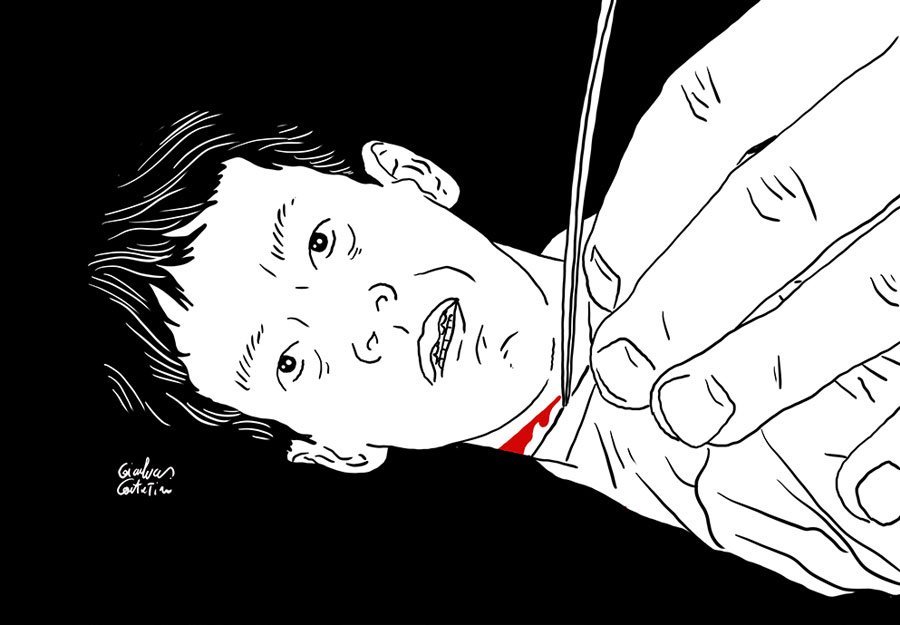
On 5 January 2021, three of Vietnam’s best reporters—stringers for the BBC and other foreign media—were sentenced for up to fifteen years in prison, followed by three years of house arrest. Their crime lay in reporting the news about thugs in the streets and thugs in high office, what in Vietnam is condemned under Article 117 as ‘propaganda against the state’.
Pham Chi Dung, founder and president of Vietnam’s Independent Journalists Association (IJA) received the longest sentence (fifteen years). His two colleagues, Le Huu Minh Tuan and Nguyen Tuong Thuy, received eleven-year sentences. According to the Committee to Protect Journalists, this brings to fifteen the number of Vietnamese journalists currently imprisoned.
I met Dung in Ho Chi Minh City in 2015, when he described himself as living ‘like a fish under the blade’. I wrote about it my book, Censorship in Vietnam, published two years later—from which the following is excerpted.
Dung leads the charge for press freedom in Vietnam—a position he assumed reluctantly, since he was a Party official. On 4 July 2014, a date not chosen by accident (it being Independence Day in the United States), Dung founded the IJA, which now counts eighty-one brave souls as members.
Dung is wearing creased green slacks and a green, long-sleeved shirt rolled up at the sleeves when we meet in 2015 in the courtyard of his neighbour’s house—which in the morning doubles as a café serving coffee and drinks. Along with a crying baby and a yapping dog, the space is filled with neatly dressed people on their way to work. The décor is half chic, half bricolage. Electrical wires sprout from junction boxes, while other surfaces are decorated with flower pots attached to white and grey brick walls.
Dung is lean, with spindle-thin arms and the erect bearing of a former military man. He has a narrow face with a moustache, bowl-cut hair, and bangs on his forehead, which make him look younger than someone who is about to turn forty. As we sit at a table wedged between a statue of Buddha and a parked Honda Dream, Dung lights a Fine cigarette and nurses a glass of iced coffee.
He tells me that the alley leading into the café is usually blocked by plainclothes policemen. ‘Members of the Journalists Association have been beaten, and I am often prevented from meeting with foreigners,’ he says.
A few weeks earlier, as Dung dropped his son at kindergarten, he was rushed by twenty policemen. ‘They handcuffed my hands behind my back, like a common criminal, and took me to the police station to be interrogated. This is the second time I have been arrested on the street, and I am summoned weekly to the police station. They demand that I disband the Independent Journalists Association and stop writing for the BBC.
‘Vietnam’s official journalists’ association is run by the government,’ he continues. ‘Journalists are state employees. Their job is to valorise the Party and spread state propaganda. They receive weekly orders on the stories they are allowed to run and how to cover them. Journalists who disobey will be fired or sent to prison. All publications are state-owned, and no independent media are allowed. In this system, there is no room for something called an “independent” journalists association. Such a thing could only be an association of criminals, traitors, and would-be wreckers of social stability.’
I ask Dung what he and his fellow journalists are trying to accomplish. ‘We are opposed to corruption and social inequality,’ he says. ‘We want a multi-party state, human rights, and civil society.’
Dung was born in 1966 in Hanoi, where his father worked as secretary to Vo Van Kiet, who emerged later as Vietnam’s prime minister. In 1975, at the end of the war, Dung’s family moved south to Saigon, where Dung attended Le Quy Don—’the most expensive school for the rich’. On graduating, he enrolled in the Institute of Military Technology, Vietnam’s West Point.
‘I was mainly taught in Russian,’ he says. ‘It’s different today, when our educational system has given way to what the French call “savage capitalism”, but back then our schooling was rigorous. I was strongest in chemistry and math. I loved reading books, but was terrible in literature. I never imagined I would become a journalist. We have two phases in contemporary Vietnamese literature. From 1975 to 1990, we were dominated by the Russians. After 1990, Western literature began coming into Vietnam, and Vietnamese writers began adopting western styles.’
After five years at the Institute of Military Technology, where many of his professors came from the Soviet Union, Dung graduated in 1989 as a second lieutenant, specialised in logistics and military supply. ‘Altogether, I spent eight years in the military, including my five years at the Institute,’ he says. As a souvenir from that time, I notice that Dung is missing part of the middle finger on his left hand.
‘In 1992 I decided to leave the military and change to civilian life,’ he says. ‘I went to work for the People’s Committee in Ho Chi Minh City, and then in 1994 I began working as assistant to Truong Tan Sang, who is currently the president of Vietnam.’
‘Would he help you if you got in trouble?’ I ask.
‘No, he would do nothing to defend me,’ Dung says, with a wry smile. ‘He would denounce me.
‘For fifteen years, from 1997 to 2012, I worked as a national security analyst for the Communist Party. I also worked as a freelance journalist for a variety of newspapers.’ Dung shows me the press card he was issued by the Cultural Information Department. I ask what benefits the card grants him. ‘You can avoid the traffic police,’ he says. ‘That’s the only benefit.
‘By 2011, I felt that corruption in Vietnam had reached unacceptable levels,’ he says. ‘I wrote articles about it, but no one would publish them. That’s when I began writing for the Voice of America, Radio France, and the BBC. I wrote about Nguyen Tan Dung, the prime minister, and corruption.
‘A year later the Ho Chi Minh City police arrested me. I was held in jail for five months. The party still considered me a “comrade”. They tried to persuade me. I was released at the end of 2012. This is when my point of view changed dramatically. I realised the one-party system was no longer suitable for Vietnam.
‘I decided to follow the democracy movement. I wrote more articles, and then, in 2014, I founded the Independent Journalists Association. To the government, I became a dissident. They no longer consider me a comrade.’
In 2013, Dung resigned from the Communist Party of Vietnam. ‘I published a letter on the internet explaining what I was doing. The government demanded that the letter be withdrawn. The letter is still on the internet.
‘The Party today is nothing more than a protection racket for corrupt interests,’ he says. ‘It is no longer defending the people’s interests.’
In China, someone like Dung would be incarcerated as an enemy of the state. ‘As Vietnam integrates into the bigger world, it can’t act like the Chinese government,’ he says. ‘It can’t block the internet. It can’t suppress links, slow down access and throw up firewalls. This has too big an effect on the economy. It cuts too deeply into profits. Vietnamese officials have shares in internet service providers. Google is blocked in China, but in Vietnam it is easy to access. Here we have power battles among officials, different factions exploiting media for their own ends.’
Dung explains that Vietnam has two competing powers, the Party and the state. Depending on who is in the ascendancy, a journalist can attach himself to one or another and be protected. ‘Generally, the Party wants to block the internet, while the state wants to expand it, so long as it serves their interests.’
Why did Vietnam fail to do what China did—build a parallel internet, replicating Western services, under state control?
‘Chinese officials think more strategically, more long-term,’ Dung says. ‘In 1989 Vietnam opened its doors to foreign investment. It had no plans on how to manage this investment. The focus was local. Each province or region had its own plan. Ten years later Vietnamese officials began to think nationally, but by then the internet had already been developed. This was another example of communist ignorance. They underestimated the power of the internet.
‘In 2005, the internet began a rapid expansion in Vietnam, and it began serving democratic interests. Only then did officials get alarmed, but it was too late. They couldn’t do anything without negatively affecting foreign investment. From 2005 to 2015, the government could only partially block the internet. China had their strategy. They had a domestic network in place from the beginning, but if Vietnam blocked Google and Facebook, the internet would collapse. Foreign investors would sue Vietnam in international court.
‘The Vietnamese people are smart,’ Dung concludes. ‘The government is not.’
I ask him about emails from dissidents, even those under house arrest, who seem to have free access to the internet. ‘This is the luck of the Vietnamese democrats, compared to our colleagues in China,’ he says. ‘Thanks to the internet we have a democracy movement in Vietnam. It’s the most effective means for organising. Telephones are not safe. Emails and Skype are safer,’ he says.
‘We are much better off than our colleagues in China. The current situation in China is like it was in Vietnam in 2005. They are arresting people, and the situation is getting worse under the current prime minister. In China, power focuses on one person, while in Vietnam, we have multiple power centres, or at least two, the Party and the state. We have different interest groups. We have been decentralised throughout our history, even a thousand years ago, and that history is repeating itself in Vietnam.’
Dung publishes two blogs, one called chandungquyenluc (‘Portrait of Power’), which focuses on power struggles among Party officials, and another blog, launched at the beginning of the year, which focuses on political corruption. Needless to say, Dung’s former comrades are not pleased by his portraits.
‘I am not allowed to travel outside the city,’ he says. ‘I can’t go more than twenty kilometres from my house, and I’m always followed by four or five people.’
‘Are you prepared to go to prison?” Dung nods his head. ‘Every one of us is prepared to go to prison,’ he says. ‘We are like fish under the blade, always ready to be arrested.
‘Do you see any signs of progress?’
‘Up until 2012, if you were arrested, you would get ten to fifteen years in prison. Now, thanks to international pressure on human rights, you get two to three years. Of course it’s a waste to sit in prison, but we don’t have a choice.
‘I have two sons, ages three and nine. My children have witnessed me harassed and stopped on the street and threatened by the police. My organisation is the most influential civil organisation in Vietnam. My name is on the top of the government blacklist.’
Dung confirms what I have been told about corruption in Vietnam, which reaches to the top of the government and includes family members and clans. He tells me there is no corporate registry in Vietnam, no transparency regarding financial transactions or ownership.
‘We know the prime minister and his family are involved in various property dealings, where the government has forced peasants off their land. This is a big problem in Vietnam, dispossessed landowners—dan oan—who now number in the millions. But we have no proof of this. They bury the evidence. All we can do is describe the situation based on our observations. We write anti-corruption articles and are criticised…
‘Having evidence in my articles would make my situation worse,’ Dung says. ‘The government would track down the sources of my evidence. In Vietnam we have no sense of Western investigative reporting. Instead we employ the French method of commenting on the news. Sometimes evidence leaks onto social media, but press freedom doesn’t exist here.
‘I went to a seminar in the Philippines on investigative reporting. The journalists from Vietnam had to admit that our press is so weak that we have no evidence,’ he says. ‘After my arrest, all my sources disappeared. We have no rules, no statutes, granting journalists access to information.
‘We can’t ask to see the corporate structure that shows how the prime minister’s daughter owns a big housing project and lots of villas and estates outside Hanoi. The business records are hidden. This is why we want to build the laws of civil society in Vietnam.
‘Censorship is dangerous in Vietnam, but self-censorship of the press is also very dangerous. Each journalist in Vietnam has his own self-censorship machine. I know that if I write another article about the prime minister, I will no longer be allowed to meet foreigners. I will be arrested. I can only criticise his policies, not his corruption.’
All morning, people have been buzzing up the alley on their motorbikes and parking in front of the café. The crowd thins later in the morning, and then at noon a metal grill is rolled across the entrance and padlocked shut. The premises are closed, except to Dung, who is allowed to linger as long as he wants. The gate is unlocked for us when my translator and I slip into the alley and start walking toward the street where we can hail a taxi. I look back to see that Dung has untucked a pen from his shirt pocket and begun jotting notes for one of his daily dispatches.

An edited excerpt from Censorship in Vietnam: Brave New World by Thomas A. Bass
More from Mekong Review
-

Inspired by the portraits of the deceased
-
The monsoon is the most poetic of seasons
-
Sand, once inexhaustible, is disappearing faster than ever
- Tags: Free to read, Notebook, Pham Chi Dung, Thomas A. Bass, Vietnam
