


Japanese Management, Indian Resistance: The Struggles of the Maruti Suzuki Workers
Anjali Deshpande and Nandita Haksar
Speaking Tiger Books: 2023
.
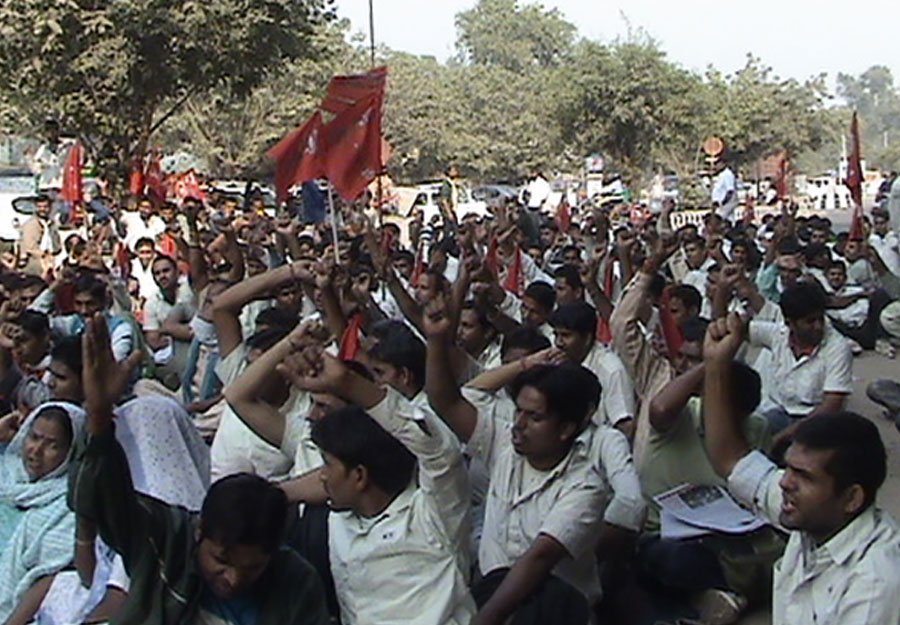
As 2020 was winding down, along with the number of Covid-19 cases in India’s first wave of the pandemic, news emerged about violence at a factory run by Wistron—a Taiwanese supplier for Apple and other electronics corporations—in the southern state of Karnataka. Workers went on a rampage, breaking machinery and other equipment. Disparities in promised wages and the denial of contractual overtime were the triggers of the workers’ ire. While Wistron and Apple stepped in with ad hoc corrective measures to address the grievances, control the damage and safeguard their reputations, workers were subjected to police action. Two years earlier, in Delhi National Capital Region, more than 300 workers at a facility manufacturing devices for Chinese electronics companies broke out in violence on the factory floor over wrongful termination. The workers were penalised for their action, with arrests and detentions by the police.
These cases, and others like it, illustrate how Indian workers in foreign-invested manufacturing facilities or suppliers for global corporations have made themselves heard through violence. A long list of industrial violence raises worrying questions: Why do workers put their bodies on the line? What forces workers’ hands—why are they so often at the end of their tether? Do these incidents indicate deep structural defects, which, unless fixed holistically, will continue to recur? Amid such incidents, the government under Narendra Modi, the prime minister, is seeking to build the country into a manufacturing power, emulating—and with ambitions of overtaking—China.
More from Mekong Review
-
Hafsa Kanjwal contends that Bakshi Ghulam Mohammed’s state-building practices helped strengthen India’s hold over Kashmir while also enabling modernisation, which paradoxically reinforced a sense of alienation rather than reconciliation.
-

Saadat Hasan Manto knew that it was not for him to analyse the multitudes people contain, and that often spill out from us without warning.
-

Snacking in Calcutta