

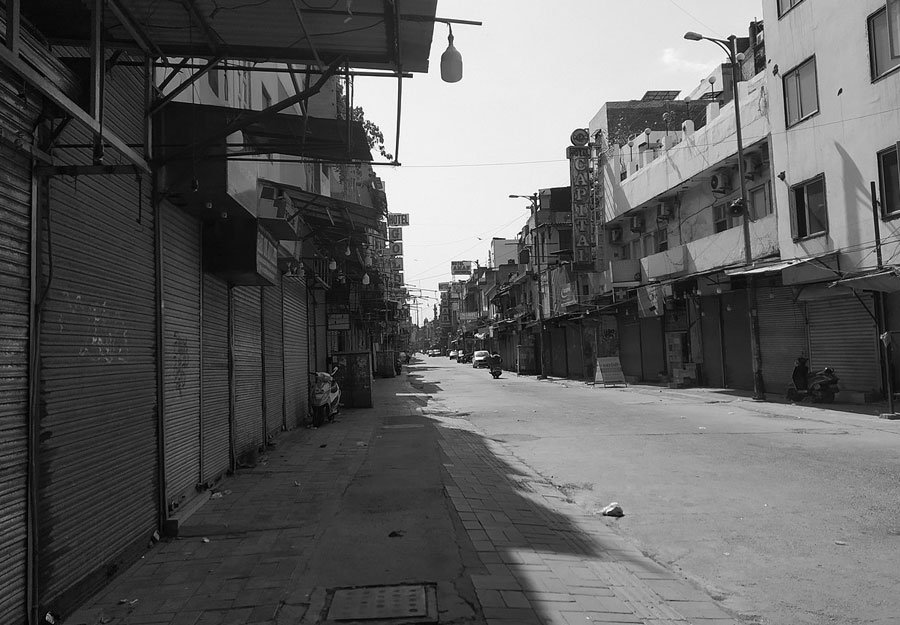
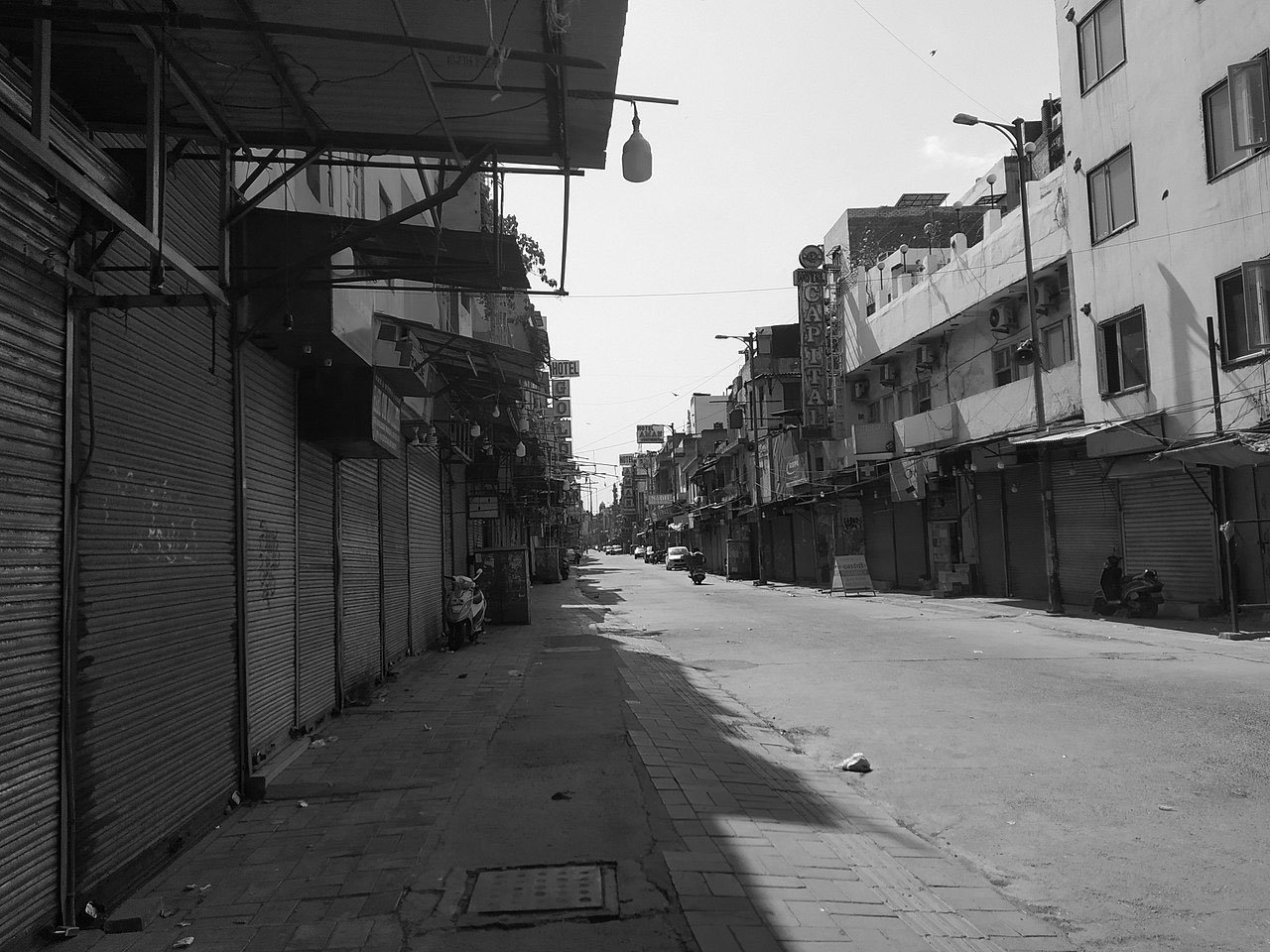
These days it feels surreal to wake up in Delhi. Nothing that was synonymous with a typical Delhi morning exists: no irate car horns sound in the street. No Bollywood film songs play in chai stalls. No two-wheelers or three-wheelers weave in and out of traffic. The streets are empty. The shops and stalls are shuttered. The hawkers’ carts stand abandoned. Even the stray dogs go about with their barks stuck in their throats. The sky stretches clear and blue as far as the eye can see. There is no smog to invade your nose or clutch at your throat or poke in your eyes. Only the birds seem to delight in that. As they fly about squawking, you wonder if they are cackling at the sight of humans locked up in their homes below.
The last time I felt like this in Delhi was way back in 1984 when Prime Minister Indira Gandhi was assassinated by two Sikh bodyguards and vengeful goons took to the streets to teach Delhi’s Sikhs a lesson. Back then, the empty streets spoke of fear and apathy. The Sikhs’s fear of being hunted and the apathy of the rest of the city unwilling to come to their aid. That was when I realised that cities are not meant to be empty or quiet. When they are, it means something is wrong. In the case of Delhi, you can add blue skies to this scenario. A quiet Delhi under clear skies is a sure sign of catastrophe.
Today the catastrophe can be seen in city hospitals that have run out of available beds and oxygen cylinders and in crematoriums that are unable to keep up with the number of dead bodies piling up despite working day and night. It is at the city’s psyche, however, that the second wave of Covid-19 has struck most tellingly.
Delhi is different from other Indian metropolises. You need only look at how the city has evolved since India’s independence from Britain in 1947 to figure out why. In 1947, Delhi had 900,000 inhabitants. By the time the pandemic hit in 2020 it was home to 30.2 million people. The bulk of Delhiites are migrants or the children of migrants. First, there were the political migrants from Pakistan: Hindus and Sikhs fleeing religious persecution after British India was split into Hindu-majority India and Muslim-majority Pakistan at the time of independence. Since then, economic migrants from all over India have flooded the city. Delhi does not possess an ethnic core, which is why it has remained Delhi in an era where ethnic chauvinism has renamed the other Indian cities. What it has had in droves is the migrant’s determination to make good at any cost.
Before the pandemic, that manifested itself in an in-your-face mentality built around getting somewhere and becoming someone fast. If nothing else, the one thing you could take for granted about Delhi was its stomach for a fight. Today even that is in retreat. The city is running scared. Just about every Delhiite either has the virus or knows someone who has it or, worse, someone who has succumbed to it. Those who are safe have no illusions about what can happen if they catch it. Then there is the economic ruin wrought by the second wave of the pandemic. The city was just starting to get back on its feet, but the latest wave promises to knock it down for the count. And there is nowhere to run; the pandemic is raging all over India. The only thing you can do is lock yourself away like a fugitive. You don’t know how long that will save you. Delhi’s homeless, meanwhile, who number in the millions, don’t even have that opportunity.
Will the city ever recover? I certainly hope so. There is a song from an old Bollywood film whose lyrics translate to: ‘Our night may be long/but it is after all only the night.’ Here the lyricist is clearly hearkening to the fact that the night is always followed by dawn. At this moment, however, it is hard to think of the dawn. The night is so dark that it seems to have no end in sight.

More from Mekong Review
-
Pakistan's mountainous north
-

Poetry from Siddharth Dasgupta
-

After 20 years, America is leaving
- Tags: Free to read, India, Notebook, Vikram Kapur
