

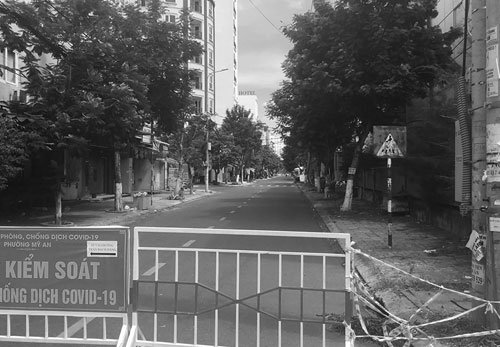

One night, the garbage-pickers disappeared. Over the past year, their numbers had risen exponentially, a reflection of the economic suffering Da Nang, a coastal tourism hub in central Vietnam, has endured since the country first closed its borders last February. You could see them every day, sometimes dozens. Most rode bikes. Many wore conical or flappy hats. Others wore hoodies. They buried themselves under thick layers of oversized clothing, gloves and face masks to hide from the stench of old rice, spoiled milk and mango shavings. Despite their head-to-toe armour, as the lockdown wore on, I was able to recognise a few regulars who’d pedal down my suburban street every day, poking through every styrofoam box and green trash can for the plastic, cardboard and glass that kept them fed.
For much of the first year of the pandemic, Vietnam was held up as an example of what to do right. It had very low case numbers and few deaths compared to other countries. After an initial six-week lockdown with only shops selling essential goods allowed to operate, the country was Covid-free, with the exception of a few quarantine zones—military barracks and luxury hotels—holding passengers of inbound flights for mandatory 21-day entry quarantines. Two negative tests and you were free to go about your business. By and large, life went on, even if it was mostly online. Restaurants, coffee shops and bars were not allowed to seat customers, but they were free to serve diners via delivery and takeout. Grab, the largest ride-sharing and food delivery app in Vietnam, was booming. All we were missing was the international tourists.
By the end of May this year, the were good reasons to believe Da Nang would soon be completely open and the rest of the country would not be far behind. Hotel workers and tour guides and laid-off baristas oozed optimism. On 10 July, Da Nang’s beaches reopened—for five days.
But days later, with news of a new cluster of Covid-19 cases in Cam Le, an urban district of Da Nang, that optimism turned to worry. Beaches closed again. Restrictions on movement became tighter. The last week of my university’s spring semester was completed online. Public schools, which had been opened for in-person teaching since mid-January, closed for the year. Students taking Vietnam’s infamous high school and college entrance exams did so at home.
In mid-June, Ho Chi Minh City experienced the first of what has turned into a rash of serious outbreaks of the Delta strain. A month later, authorities announced that ‘Directive 16’, the official title of a government social distancing decree restricting movement, had become the law in Ho Chi Minh City. This meant closing non-essential businesses and restaurants, curtailing movement of people and banning public gatherings. In Vietnam, cities are often given flexibility in how to interpret government orders. The fear was that Da Nang would follow the southern capital, though the number of cases here was and is much lower. As I write, the seven-day average of new infections in Ho Chi Minh City is around 4,000. Da Nang’s average is 59.
So we waited. And we gossiped. We complained about the apparent lack of a vaccination program in Da Nang. In a country with the lowest inoculation rate in Southeast Asia—less than 0.5 per cent of the country had been fully vaccinated—Da Nang’s numbers were even worse. It seemed as if the Vietnamese government had hoped Covid-19 would burn itself out. Maybe the reluctance of the government to buy vaccines on the open market was a ploy to convince richer countries to donate. Yet another theory speculated we were holding out for Vietnamese virologists to finish developing the home-grown vaccine to prove the country was a true international player, and the waiting was worth the cost. The reason for the speculation? A deficit in government transparency. Nobody knew what was going on.

On 22 July, I took my nightly stroll along the east bank of the Han River. As thousands of bats darted from limestone caverns for their nightly feast, I walked past the garbage dump. Normally, at least two or three people would be rifling through piles of trash left by contractor crews and couples on motorbikes. Often they’d be feeding a fire to burn the unusable trash. Sometimes the smoke was thick. But that night the dump was empty. The following day, I knew something was off. Trash was still taken, but not by members of the informal economy. Instead, it seemed as if garbage collection had become the strict province of city workers in the orange jumpsuits on the three-wheeled golf carts towing the small green dumpsters. No pickers allowed.
The next day, several friends sent me a message. Bao Da Nang, the official newspaper of the Da Nang People’s Committee, had posted a notice online. As of Monday, 26 July, there would be: no more walking, no more food delivery, no more gatherings of more than two people and, most importantly for trash-pickers, no more riding of bikes. Furthermore, people could neither leave nor enter Da Nang without permission. Directive 16 was fully employed.
Perhaps the best way to explain the city’s interpretation of Directive 16 is to describe the current conditions on the ground. Since 1 August, residents of the city have not been allowed to leave their homes for anything other than essential functions. Walking one’s dog, letting one’s children play or stretching one’s legs are not essential functions, though to be fair, patrols don’t really become strict until after 8pm. Driving for any reason other than buying medicine or food or commuting to work is not essential.
Leaving one’s ward—the administrative equivalent of an official neighbourhood association in Vietnam—for any reason other than work is not essential. If a person does work outside their ward, they must have two documents—a letter signed and stamped by their employer and a letter signed and stamped by their ward leader. In order to receive the former, the person’s employer must make a donation to the relief effort, a donation determined by the department stamping the letter.
Residents have been issued shopping tickets by ward leaders or landlords. They are able to use them to leave home—though not the ward—to buy foodstuffs three times a week. And several grocery stores have been granted passes to deliver food throughout a single district, one of six administrative zones, each containing a number of wards. A citywide curfew begins at 8 every night and ends at 6 every morning.
To enforce these rules, there are currently 464 police checkpoints in Da Nang city. The Thuan Phuoc Bridge and the Han River Bridge have been closed to channel traffic south. Checkpoints are staffed 24/7, while uniformed officers patrol the streets by truck and motorbike. Da Nang’s police are exceedingly patient, but sooner or later, everyone hits the brick wall.

Two weeks ago, five wards in Da Nang’s Son Tra district were shut off from the outside world following a cluster of positive tests that appear to have come from one fishing wharf. Wards subjected to ‘local lockdowns’ are sealed at every possible entry or exit point by military and police roadblocks. Strict stay-at-home orders are enforced in at least one of these wards through large fines. Last week, a couple of women were forced to pay a total of VND15 million (US$655) for driving a car without an essential need.
People in at least one of these wards are not allowed out of their homes to shop with tickets like the rest of the city and rely on a system whereby households place orders with ward volunteers and wait. But if we can believe even a small percentage of recent posts on social media, these orders have not always been filled. Both locals and expats plead for food, water and gas for themselves, friends and strangers on Facebook threads. Photos of empty shelves and empty streets are common.
Something new and different is happening, too. Over the past few months, scores of Vietnamese friends and even strangers have ranted to me at length about internal politics. Even a year ago, to speak like this to a foreigner was exceedingly rare. Now neighbours complain loudly for hours about the lack of vaccines and the state news being nothing but propaganda. Things have changed in a very short time. People, it seems, are fed up.
Tonight, a Son Tra-style lockdown is scheduled to take hold in every part of Da Nang. More than 1 million people will be locked in their homes for a week. This weekend, families have crowded outside supermarkets three hours before doors open. With mass vaccinations unlikely anytime soon in Da Nang and social capital running low, what happens next is anyone’s guess.

More from Mekong Review
-

Thanks to the pandemic, Tet in Vietnam won't be quite the same this year
-

A tale of two Covid experiences in Vietnam
-
Readers respond to our review of Ken Burns and Lynn Novick’s The Vietnam War
- Tags: Ben Quick, Free to read, Notebook, Vietnam
