



Twilight in Jakarta
Mochtar Lubis, translated by Clare Holt and John McGlynn
Lontar Foundation: 2014
.
Twilight in Jakarta (‘Senja di Jakarta’), by the Indonesian journalist and writer Mochtar Lubis, was the first Indonesian novel to be published in English. The story is set in Jakarta in a year that could be any time from the mid-1950s into the early 1960s. It explores the lives of characters from vastly different social settings: the poorest garbage collector, newspaper editors and the leader of a fictional political party, all are caught up in the dynamics of city and national politics lacking leadership, direction and a sense of moral compass. Monthly updates on the characters are interspersed with City Beats: journalistic vignettes that capture life on Jakarta’s streets. There is some debate as to how successful the novel is in holding the narrative together. An academic, D.M.E. Roskies, argued in 1986 that while the novel is “not well-made”, the “sum of its parts” brings together the various threads into an “ensemble” that captures Indonesia in the late 1950s. Without doubt Twilight in Jakarta offers an important perspective into the political and social world of Indonesia’s capital at the time.
Written in the late 1950s while Lubis was under house arrest, the novel was smuggled overseas, translated by Clarie Holt, and published by Hutchinson & Co in 1963 under the New Voices in Translation series of the Congress for Cultural Freedom. Translations in Dutch, Spanish, Korean and Italian soon followed. A Malay-language version was published in 1964, but it was only in 1970 that the novel was published in Indonesian in Indonesia. A revised version of the English translation by John McGlynn was published by the Lontar Foundation in 2014. The novel’s publication made Lubis the best-known Indonesian writer beyond Indonesia; around the same time, in 1964, Amnesty International took on his case as a prisoner of conscience.
More from Mekong Review
-

For those curious about Indonesian music, Padang Moonrise: The Birth of the Modern Indonesian Recording Industry (1955-69) is a fascinating portrait of a precarious young country trying to protect its cultural identity while opening itself to the world.
-
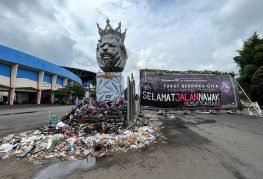
On 1 October 2022, 135 people lost their lives at Kanjuruhan Stadium in Malang, Indonesia, after police officers fired tear gas to disperse football fans. Bayu Dwityo Wicaksono and Faiz Nashrillah speak to a bereaved father and a survivor of the stadium crush.
-

Ducky Tse was an established photographer in Hong Kong when, at the age of fifty, he decided to uproot and relocate to Taiwan. He bought a van and refurbished it, driving it around the country. Through his photographs, he reflects on a new chapter of his life.
- Tags: Ben Murtagh, Indonesia, Issue 30, Mochtar Lubis