

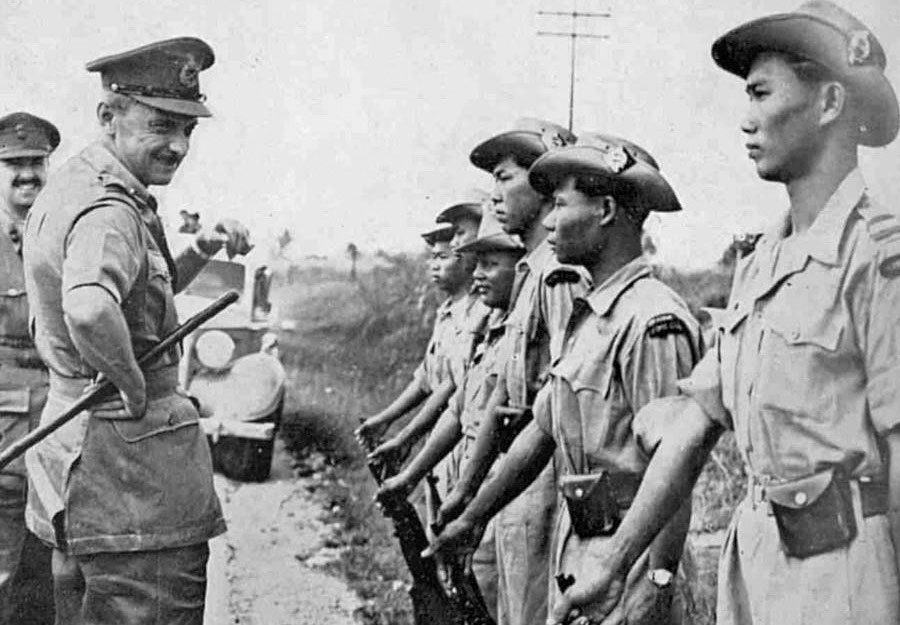

Perak circa 1952
The Long Day Wanes: A Malayan Trilogy
Anthony Burgess
W.W. Norton: 1959
.
When Anthony Burgess first arrived in Malaya, he was not yet a published novelist. Indeed, he was not even Anthony Burgess yet. The year was 1954, and John Wilson, as he was still called, had travelled east to begin work as a colonial education officer. Burgess the literary artist would emerge a couple of years later with the publication of his debut novel, Time for a Tiger. Two more Malaya-set novels followed: The Enemy in the Blanket and Beds in the East. Together these books are known as The Long Day Wanes or, more prosaically, The Malayan Trilogy.
Burgess is, of course, best known as the author of A Clockwork Orange. He resented this fact. Later in his career, he variously derided his most celebrated novel—which he claimed to have dashed off in a few weeks—as “a little linguistic game” and a work “too didactic to be artistic”. It’s an overly harsh assessment, and disingenuous besides, but not altogether wrong. A Clockwork Orange does, after all, revolve around a conspicuous moral thesis (to wit, that the abrogation of free will is far more evil than any single act of evil committed by a free individual), which Kubrick’s film version, to its credit, manages to obscure. It’s as though Burgess took this syllogism from T.S. Eliot and decided to base a novel on it: “So far as we are human, what we do must be either evil or good; so far as we do evil or good, we are human; and it is better, in a paradoxical way, to do evil than to do nothing: at least, we exist.”
There’s no such thesis to be found in The Long Day Wanes. It is not, for instance, a pointed indictment of the British Empire, of which Burgess took a more or less neutral view. Rather, what we get from these three undervalued books is a multidimensional perspective on a climacteric in Malayan history, punctuated by Burgess’s signature humour. The lens through which the reader views the action changes frequently: Malay, English, Chinese, Sikh, Punjabi, Tamil, et cetera. These various points of view, subjective as they are, combine to provide a reasonably objective panorama of post-war, pre-independence Malaya.
The Long Day Wanes placed Burgess firmly within the British colonial literary tradition established by the likes of Kipling, Conrad and Orwell. Thematically, it has much in common with Orwell’s Burmese Days. The approach and style, however, could hardly be more different. Whereas Burmese Days is characterised by a grim earnestness, The Long Day Wanes comes across as defiantly ironic. Ironic, some believed, to a fault. In his memoirs, Burgess recalled Graham Greene, who dealt with Western imperialism in The Quiet American, telling him (not unkindly) that Time for a Tiger was an amusing but essentially frivolous book. Greene’s evaluation hasn’t stood the test of time.
How Burgess wound up in the Federation of Malaya, an association of states and territories administered by the British under a somewhat eccentric colonial set-up, was something of an accident. With middle age looming, he had finally given up on his principal ambition of becoming a professional composer. He was, as he routinely put it, a failed musician. During the war, Burgess had spent time in the Royal Army Medical Corps and the Army Educational Corps, eventually winding up in Gibraltar and ultimately seeing no action. He’d also been married. When his military obligations were fulfilled, he found work as a teacher in a small town in South East England. The pay was lousy, though, and he continued looking for something better. In his spare time he wrote two novels, both of which were rejected (though published years later, after he’d made a name for himself).
It was around this time that Burgess, disappointed, restless and lacking money, accepted an offer from the Colonial Office to teach English at a boys’ school in the Malayan state of Perak. (He claimed to have been drunk when he sent the application and forgot all about it.) In those days, Perak was a flashpoint in the Malayan Emergency, or the war between British-Malayan forces and Chinese communist guerrillas. The latter, Burgess wrote, “would come out of the jungle, steal supplies, terrorise the Chinese and Indian workers, and garotte or shoot the white [rubber] planters”. They were perilous times that, in the eyes of a writer, offered the perfect background for a novel. Burgess made full use of the conflict in The Long Day Wanes, particularly its first volume.
Time for a Tiger got its title from the old slogan for Tiger Beer, still widely drunk in Southeast Asia. Burgess’s attempt to leverage the oblique advertisement was unsuccessful. He wrote to the brewer, Fraser and Neave, asking for a reciprocal gift in the form of a wooden clock bearing the Tiger slogan. He’d seen these in drinking places around Malaya. They declined, prompting Burgess to add a line of dialogue in which a character asserts that Carlsberg is superior to Tiger. “When the novel appeared in 1956,” he later recalled, “I was presented with a two-dozen case of quart bottles of Carlsberg lager. Fraser and Neave did nothing.” When Burgess visited Singapore some years later, Fraser and Neave told him he could drink as much Tiger as he liked, free of charge. It was no use: by then Burgess had, in his own words, “become wholly a gin man”.
He certainly was a gin man, and his wife, Lynne, was a gin woman. To hear Burgess tell it, the two of them were, more often than not, fairly sloshed off gin. It was during their stint in the tropics that Lynne, according to Burgess, became a full-blown alcoholic. She died of liver disease in 1968. Unsurprisingly, the same appetite for gin, and booze generally, is exhibited by the characters in The Long Day Wanes.
The cast of characters is a vast and motley one, wholly convincing in spite of their ridiculousness. There’s Nabby Adams, the nearly seven-foot-tall police lieutenant with a penchant, and boundless capacity, for warm beer. (“I don’t ask much,” he says at one point. “A couple dozen bottles of Tiger every day and I’m quite happy.”) There’s Rupert Hardman, the failed lawyer who takes an imperious Muslim wife and converts to Islam for financial reasons. There’s Rosemary Michael, the mythomaniac Tamil beauty who “hates [her] own race” and is convinced that she’s actually English. These and other characters had real-life counterparts. In some cases, Burgess didn’t bother to change their names. (An unsuccessful libel suit was brought against The Enemy in the Blanket.) Burgess claimed to have done very little inventing in The Long Day Wanes. Nevertheless, he insisted that the book’s everyman hero, Victor Crabbe, was not based on himself. This is rather dubious.
Consider: The school where Crabbe works is a fictional version of the Malay College where Burgess taught. Crabbe has a dissatisfied wife who, like Burgess’s, longs to return to England. Basic similarities like these are to be expected. However, Crabbe also has the same servants that Burgess had, as well as the same mistress, with the same names. He befriends the same people. He has the same passion for language and music. He deplores, as Burgess did, the standard colonial lifestyle and attitudes.
It’s that last trait that alienates Crabbe from his fellow expatriates. It also alienates Nabby Adams, preferring as he does the company of a Punjabi police sergeant. Crabbe and Adams, who become close friends, are “letting the side down” by mixing too much with the native population. As the book’s narrator explains, Crabbe “had broken the unwritten laws of the white man. He had rejected the world of the Club, the weekend golf, the dinner invitations, the tennis parties… He walked round the town, sweating, waving his hand to his Asian friends.”
Themes of race and racial prejudice are central to The Long Day Wanes. “One of the most attractive aspects of Malayan life,” Burgess wrote in a retrospective introduction, “was the profusion of race and culture and language.” He endowed Victor Crabbe with the same broad-minded appreciation. Speaking to his homesick wife, Crabbe acknowledges Malaya’s lack of European cultural amenities: there are no theatres, no concerts, no ballets. “But there are other things,” he says. “The people themselves, the little drinking shops, the incredible mixture of religions and cultures and languages. That’s what we’re here for—to absorb the country.”
The majority of colonial officers did not share this point of view. Burgess was annoyed, though unsurprised, by his English colleagues’ racial and cultural aloofness. But he was taken aback, perhaps naively, by the xenophobia of the native people, which included Malays, Chinese, Indians and Eurasians. Naturally, many of them resented the English, but Burgess was disturbed to learn that they resented each other just as much, if not more. “We had hoped to find among Malayans properties like ancient Oriental wisdom and a lack of racial snobbery which made the orang puteh or white man so detestable,” he wrote elsewhere. They were mistaken. “The Malays called us lintah puteh or white leeches, the Chinese ketam bersepit or pincered crabs (in allusion to their chopsticks), and the Tamil taik Adam or Adam’s shit.”
Many of the natives had, moreover, internalised the pernicious ideas espoused by their colonisers. Burgess and his wife were viewed by some of their Malayan friends as inferior white folk. Once, a Tamil they were drinking with called them despicable. When Burgess asked him why, the Tamil explained that, as he himself was regarded as despicable, anyone who chose to drink with him must also be despicable.
All of this strife—as religious as it was racial—is reflected in the words and actions of Burgess’s characters. Some of them denounce racial prejudice. Others contribute to it. A few manage to do both. In any case, the effect is almost invariably comic. Here, Burgess could not help himself. No matter the theme, he wrote with singular levity. This is true of all of his fiction, including A Clockwork Orange, generally regarded as a dark, dystopian novel. In fact it is a very funny book. So is The Long Day Wanes. Burgess often stated, with mock indignation, that he did not intend his novels to be humorous. That may sound disingenuous, but it’s probably true enough. People with a genuine comic talent don’t have to try to be funny; they just are.
Hence, we can’t help but laugh at Victor Crabbe’s many trials and misfortunes. As the chief protagonist, Crabbe is the one constant thread that runs through the centre of each book, bundling them into a cohesive trilogy. His character is animated, primarily, by an idealistic desire to impart something valuable to Malaya and its people—and to be accepted by them in return. “I love this country,” he ruminates to himself. “I feel protective towards it… I feel that it needs me… I want to live here; I want to be wanted.”
Crabbe is in for a rude awakening. Nothing pans out for him. Everything goes sideways. Certainly, Malaya does not need him. We empathise with Crabbe, but we also laugh at him. That’s Burgess’s trick. As the narrative flows forth, and after his wife leaves him, Crabbe grows less delusional but no less committed to making some kind of lasting contribution to the East. His efforts lead him, inevitably, to a tragic and farcical end. That, on its face, is what The Long Day Wanes is about: an Englishman in Malaya—not to be identified with Burgess, of course—in the late dusk of the British Empire, trying and failing to make his desired mark, or any mark at all.
Zooming out and taking a wider view, however, one recognises in The Long Day Wanes an implicit bildungsroman, with Malaya itself acting as the main character, and its turbulent, undulating path to independence—its spirit contained in the rallying cry “Merdeka!”—as the overarching plot. It’s an ambitious novel of sweeping scope that, quite apart from its aesthetic and comic virtues, functions as an edifying historical document. This was no accident. As Burgess stated in his introduction:
We have to understand the nature of the East, and also of Islam: we can no longer, since Vietnam, regard those far regions as material for mere fairytales… To many, the Far East hardly exists, except as material for televisual diversion. It is hoped that this novel, which has its own elements of diversion, may, through tears and laughter, educate.
Not least of all, The Long Day Wanes ushered in one of the most original and prolific literary careers of the last century.

More from Mekong Review
-

A poem by Anthony Tao
-
A poem from Maung Day
-
Not only did the promise of “Naya Pakistan” never materialise, the country is actually much worse off today.
- Tags: Anthony Burgess, Issue 32, Malaysia, Michael Howard