


Love Marriage in Kabul
Sanaz Fotouhi
Gazebo Books: 2020
.
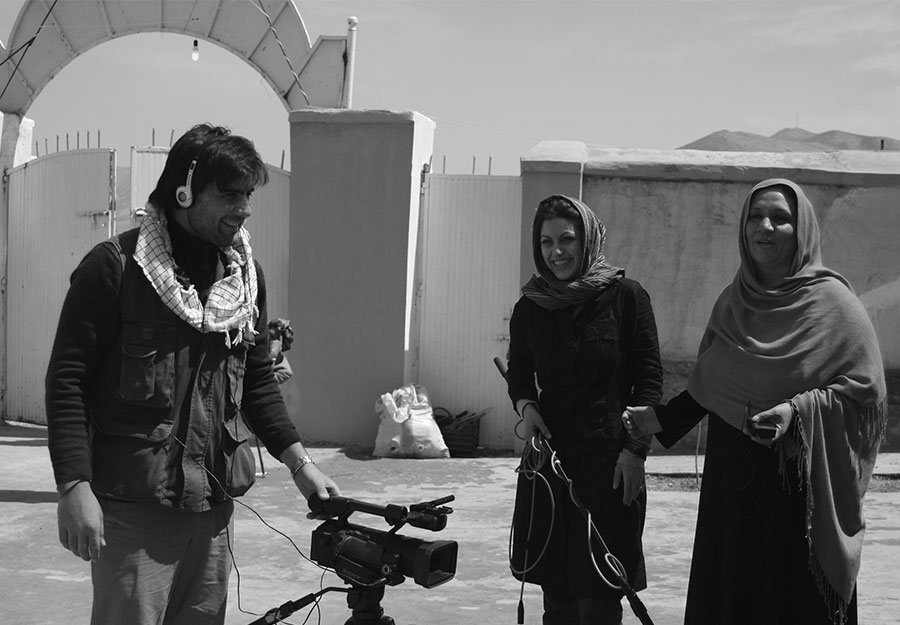
Sanaz Fotouhi, the narrator of Love Marriage in Kabul, is sitting on the ledge of a roof in Kabul. She and her partner Amin have come to film the wedding of seventeen-year-old Abdul and fifteen-year-old Fattemeh, for a documentary they plan to show at an Australian film festival. However, during the making of the documentary Fotouhi has been stricken by the destitution and desperation that marks Afghani life. As an Iranian woman raised in the United States and Hong Kong, now living in Australia, she wonders if she can truly tell the story of women who have lost their lives to the patriarchal traditions of Afghanistan?
The author answers this question by taking the reader several steps back into the past. As Fotouhi describes Kabul, she reflects on a conversation her father had with her grandfather. Fotouhi’s father diligently studied English, a language his own father cannot understand. While the community berates him for what they view as a useless decision, Fotouhi’s father’s commitment changes the future of their family. His upper-level education results in him working in a bank, which in turn results in Fotouhi being raised all over the world.
One of the places her father chooses to reside in happens to be in Afghanistan, and in 2006 Fotouhi makes her first trip to Kabul. She captures that experience in a film. In 2009, Fotouhi and her husband, cameraman and fellow film-maker Amin, decide to return to Afghanistan once more, in order to highlight the work of philanthropist Mahboba Rawi, and to tell the story of Abdul Fattah’s wedding to Fattemah. Rawi runs an orphanage called the Hope House in a suburb of Kabul, which is where young Abdul lives.
Compared to the rest of Fotouhi’s experiences in Kabul, the orphanage is a space of warmth and optimism. The building is much more developed than most in Kabul. The floors are lavishly tiled, there is paint on the plaster walls, there is a shower with hot water (if only for a few hours a day). The children greet Fotouhi and her partner with warm smiles. They look well-cared for and are full of energy. For once, Fotouhi feels happy to be in Kabul. There’s the sense of things changing, or the possibility for a rampaged and ravished country to have something akin to a future.
Nonetheless, tragedy lurks around the corner. The atmosphere appears light, but as Fotouhi encounters three-year-old Mojib for the first time, ‘a lump of sadness’ grows in her throat. This is a premonition of great foreboding. Over the course of the next few hundred pages, Fotouhi enters into the lives of the others who call Hope House home and unravels the less glamorous sides of their lives. Whether it’s Abdul’s earlier life as a penniless orphan, or the earlier marriage which traumatises another, each of the orphans has a lot of anguish to share. No matter how much they try to grin away their pain, life is hard.
What makes Love Marriage in Kabul a particularly joyous read is Fotouhi’s ability to retain a literary flavour in what could have otherwise been a self-indulgent autobiography. The narrative bounces between the stories of the various children and adults in Fotouhi’s circumference with distance, objectivity and integrity. Fotouhi inserts enough narrative voice to entice the reader, but rarely over-speaks. She puts the concerns of these orphans and children first, engaging in her own feelings and thoughts only when it serves to build empathy.
Love Marriage in Kabul does not attempt to be a bigger story than it in fact is. While the book’s premise appears to be that Fotouhi and Amin’s quest to shoot the perfect film will take centre stage, very little of them are in the memoir. The core characters are the Afghan people, and the hardships and happenings that they endure. Sometimes it is a minute moment of focus on the banality of everyday struggle; eating the same bread and beans for another lunch, having to fiddle with the stray antennas of an old television to get a program. Often more harrowing stories are told. Women are beaten for the slightest signs of defiance. Wives lose their lives to suicide, because in their eyes, there is no other path to consider, no other possible future.
Fotouhi is as experienced in her empathies towards human beings as she is in her art. The core plot of the memoir is composed of two events: the marriage of young Abdul Fattah to Fatemeh, alongside Mahboba Rawi’s charity work. Fotouhi truly exalts the latter, and rightfully so, for Mahboba Rawi has done exceptional work in making sure that refugees and orphans from Afghanistan receive further economic and social opportunities both in Afganistan and abroad. As for Abdul and Fatemeh, they are both described with distance, and yet also with warmth. Fotouhi has clearly bonded with these two individuals, but knows the distance between her story and theirs. Chapters alternate between these storylines and memories from Fotouhi’s life and past trips to Afghanistan and Iran. The narrative is often advanced not chronologically but thematically, based on how a particular memory from Fotouhi’s experience awakens mementos of other thoughts and feelings. Fotouhi employs a tight and direct style which keeps her thoughts well balanced with the action and movement of the narration.
Fotouhi’s gift for language is on full display. As she evokes ‘light raindrops’ touching her face like teardrops, she describes alongside them ‘a musky smell’, the sun bleeding out, the dry earth needing life and sustenance. These images not only serve to keep the reader grounded over a misty sunset in Kabul, but also to foreshadow the melancholy that later scenes will elicit. Likewise, when the author makes reference to her grandfather’s decision to sell his orchards of apricot trees to better his children’s education, Fotouhi refers to ‘roots, in the earth, in the dust and the mud’. Though Afghanistan is not her land, the decision to sacrifice for the betterment of one’s lineage reincarnates itself across all heritages. Fotouhi sees it in the decisions of the Afghani people around her, and so she is inspired to take pen to paper, and write, so that the decisions left to the mud can form a place of flourishment.
It requires a certain form of bravery to act on behalf of others, at least when it is selfless. That is, when someone truly wants to transport stories happening in one part of the world to another, there is a certain type of transcendence, of the ego; of the flesh; into something more cosmic and collective. To go to a place as rugged as Afghanistan and to not write misery porn would be a great challenge to any author. What makes Fotouhi’s writing shine are her very down-to-earth observations. When she describes a three-year-old child, she reflects first on his mastery of computer games, or his ability to sing in Hindi, just as she remarks in excitement at the occasional orphan’s mastery of taekwondo. One would have expected Love Marriage in Kabul to carry the feel of cracked mud and torn stones as the landscape it treads on. However, in keeping the tone of the writing light, hopeful and relatable, Sanaz Fotouhi has done more for the narrative of Afghanistan than most other foreign authors. She has taken a place that is misunderstood, maligned, narratively tossed to a corner of vultures, and represented it as a place of hospitality, wonder and warmth.

More from Mekong Review
-

After 20 years, America is leaving
-

Afghan women and the pain of losing of their country
-
Mekong Review amid the chaos
- Tags: Afghanistan, Free to read, Kiran Bhat, Notebook, Sanaz Fotouhi
