

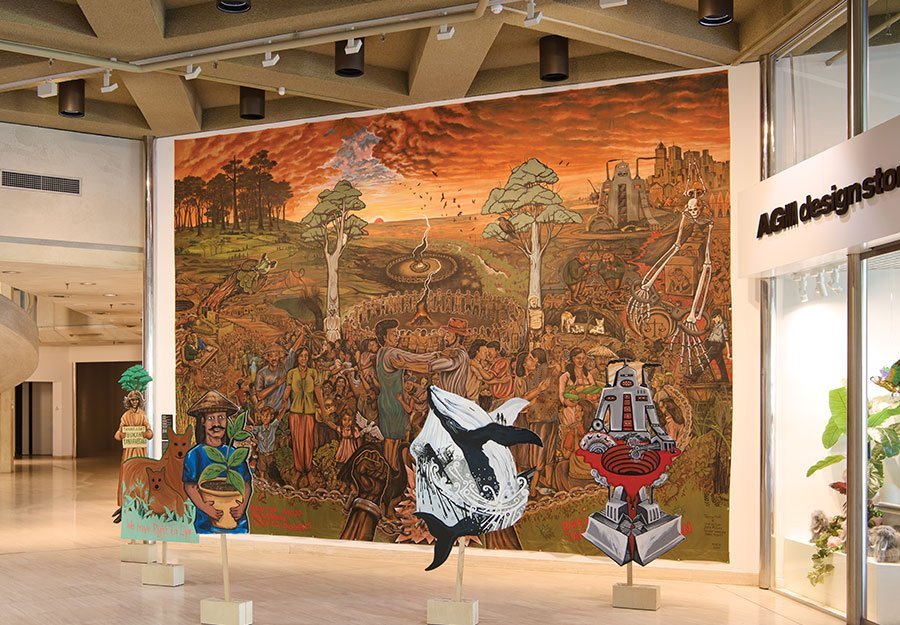

It’s the end of 2024 and the entrance of the Art Gallery of Western Australia in Boorloo (or Perth) is busy with people dropping by to watch the development of a wall-sized painting. It’s being worked on by local Noongar artists—Sharon Egan, Yabini Kickett, Ilona McGuire and Tyrone Waigana—and several painters from Taring Padi, a Yogyakarta-based collective. They’ve titled the artwork in both Noongar and Indonesian: ‘Narbiny nguluk nidja doorntj baarniny, moorditj dooytj-doornt (Care together, strong together)’ and ‘Rakyat Bersatu tak bisa dikalahkan (The People united cannot be defeated)’.
To those familiar with Taring Padi’s work, the painting is one of the collective’s characteristic large banners. While in the style of Indonesian Social Realism, the work has clearly also been influenced by the Carrolup School, a Noongar landscape painting tradition from the mid-twentieth century. In 1940, Carrolup was a technical college that trained Indigenous youth who were part of the “Stolen Generation”—children who’d been taken from their families and placed under the state’s control. As Ian McLean, an art historian, notes: “The Carrolup artists emerged when Carrolup became an institution of assimilation not apartheid.” Art from the Carrolup School is stylistically unique, most often featuring earth-toned landscapes rendered under twilight skies that, although true to life, can seem garish and almost hallucinatory.
More from Mekong Review
-
Magical realism meets gritty realism
-
Indonesia in the 1960s, through the prism of post-colonialism
-

In a short time wearing face masks became the norm in Ubud