


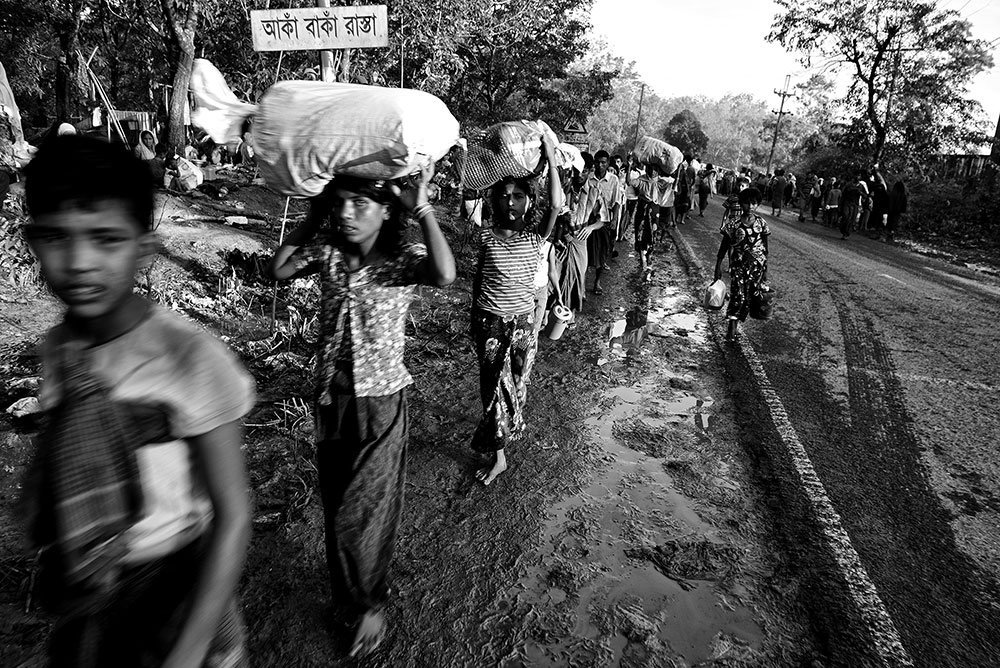
I have travelled down the narrow Cox’s Bazar-Teknaf highway in southern Bangladesh dozens of times over the past eleven years. It is an exhausting three-hour journey, at times slowing to a crawl through the bustling market towns of Ukhia, Kutupalong and Balukhali Bazar. Between Cox’s Bazar and Teknaf, tens of thousands of stateless Rohingya live in limbo, banished from their homeland in Myanmar and, at best, tolerated in Bangladesh. Along this road, they’ve languished for the past thirty years.
Last September I returned to Bangladesh. Almost overnight, the tens of thousands of Rohingya had turned into hundreds of thousands — almost 650,000, it is estimated. On the edges of an eighty-kilometre stretch of this ramshackle highway, a stream of the unwanted and the unwelcome — Rohingya men, women, children, the elderly — slogged through the mud and the rain and the heat, each carrying their own story of violence, trauma, death, torture and loss.
At the southernmost tip of Bangladesh, in the town of Shah Puri Dwip, I stood on a jetty with fourteen-year-old Yasin and three of his friends. They looked across the Naf River into Myanmar. In the distance, smoke pushed up into the clouds from where two Rohingya villages had just been set on fire. Yasin’s village was destroyed four days earlier. Not too far from Yasin, a group of Rohingya, mostly women and children, took shelter in a local mosque. They had arrived the night before. Among the group was twenty-year-old Alcoma. She explained that she had been separated from her husband when the Burmese Border Guard Patrol (BGP), the military and local Rakhine Buddhists attacked her village. Now alone, with nothing more than a bag of belongings, she tenderly held her ten-month-old child, using her white headscarf to shield both of them from the midday sun streaming through the openings in the concrete wall behind her.
More from Mekong Review
-

A poem from Maung Day
-

The Rohingya in limbo in Cox's Bazar
-
While the Myanmar military is responsible for the violence, Kaamil Ahmed points out in I Feel No Peace: Rohingya Fleeing Over Seas and Rivers that more parties are complicit in the exploitation and abuse of Rohingya refugees.
- Tags: Bangladesh, Greg Constantine, Issue 10, Myanmar, Rohingya