

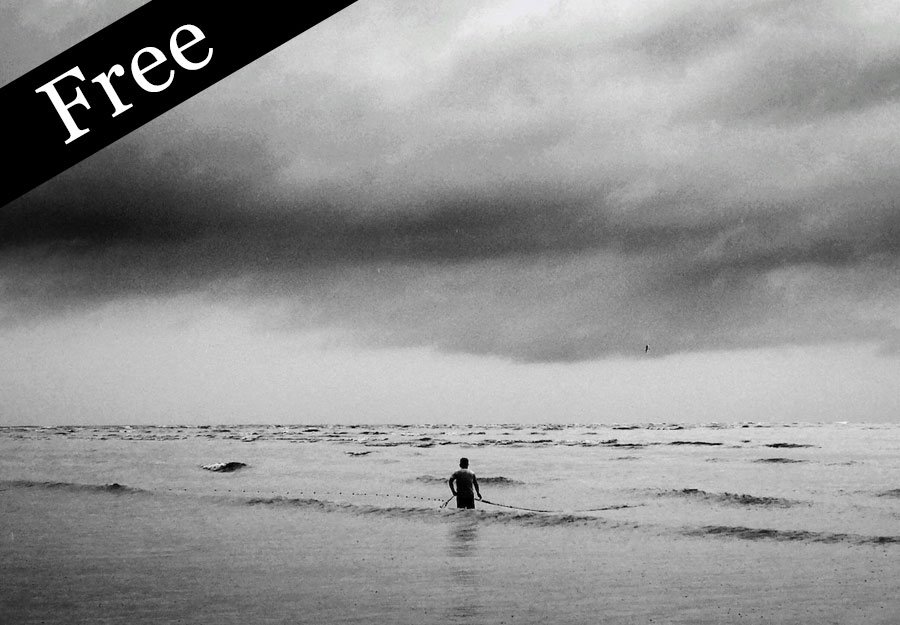
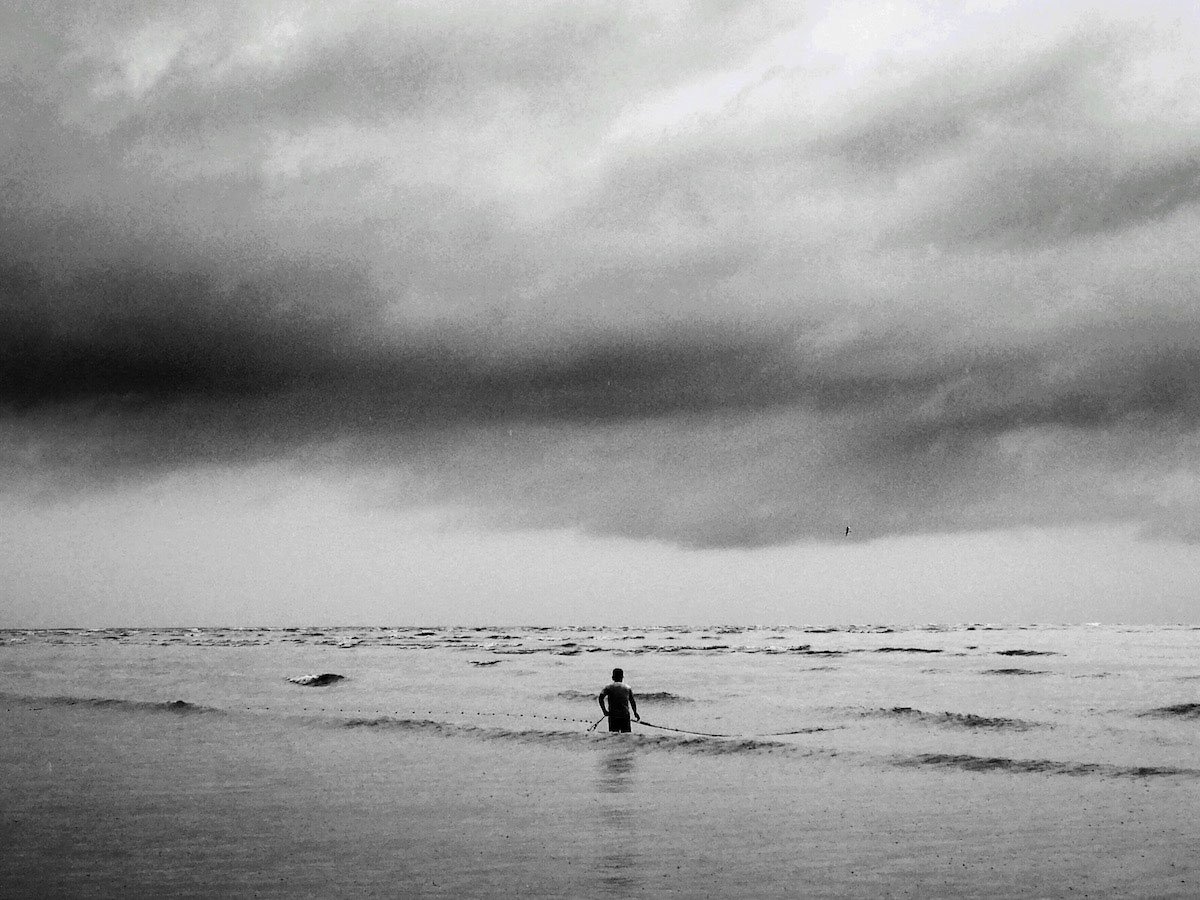
The terminal station was closed two years ago. “Yes, I am sure,” the annoyed young woman behind the digital screen assures Rahman. “The sea has eroded the coast and the station platform is no longer safe.” He settles for a ticket to the station closest to his village. Kampung Pasir Berbisik was named after a local legend, where, during the monsoon, one could hear ghostly voices carried by strong winds from the sea. Tall tales to discourage children from playing by the rough seas. It’s been two hours since the train left the city for the coast but Rahman struggles to fall asleep. A jumble of images dances behind his eyelids. He remembers vividly what the old station looked like: the abandoned lighthouse, the fury of the waves and the taste of fried fish his mother used to make. He remembers everything but his father’s voice. Just one more hour.
The sea has risen twenty-seven centimetres within twenty years; large areas of flat agricultural land have been flooded and turned into deltas. The government established the national Resettlement Agency to relocate millions from coastal cities to newly constructed inland towns and camps. Fishing settlements like his own village have long been abandoned; all that remains of the wooden house he grew up in are three of its eight stilts. Those who have the means have moved to higher ground, while the rest are too poor to have options and squeeze into tiny flats at the edge of the city. Life must go on. A stubborn few have stayed on even as the waves lap against the walls of their homes. When an officer from the Resettlement Agency came to persuade his family to move, Rahman’s father said, “If it is truly God’s will, then we won’t have to wait. The sea can rise instantly.” There was some truth in it. After all, the tide came in and out every day by His will. Beyond performing the Hajj in Mecca, his father had never left the village. Moving to the city was out of the question. Tuan Haji Baha died alone in the same house he was born in and was placed to rest between two coconut trees not ten metres away. As the only son, Rahman was advised by the religious authorities to relocate his father’s grave.
Finally, Rahman recognises the endless stretch of coconut trees that line the road to his ancestral home. A thin, watery mirror covers the land, threatening to swallow the elevated railway line. Home smells of brine, rotting fish and wet soil. Salt from the air seeps into his pores. At the old cemetery he steps around the stones like a visitor inspecting sculptures in an art gallery. Present, but distant. Thinking while trying hard to feel. More than half of the tombstones have already fallen into the sea; a few remain half buried in the sand and are only visible at low tide. Almost all the graves have already been relocated. Except Tuan Haji Baha. This is how people were buried in the old days, before tiered graves and reusable graves became common.
Rahman resents the burden of making a decision; if he relocates the grave, he has to apply to the State Religious Office for permission to exhume and rebury his father’s remains at a new site. He can already hear his father’s disapproval. He places a few flowers from the melur tree nearby on the tombstone and recites a prayer under his breath. He lies on the grass and turns on to his side to face the kiblat, the same direction as his father seven feet underground. He closes his eyes and sinks deep into the layers of sounds.
First the wind.
Then the waves.
His own heartbeat.
Silence.
He’s awoken by a commotion. Several men in hard hats and fluorescent vests are unpacking a truck, strewing equipment and tools along the road just outside the old house. Rahman is momentarily disoriented. Had he called the authorities to relocate the grave already? Had he made his decision?
His thoughts are punctured by a loud voice from the house. A man is gesturing at the workmen and waving his arms, at once hospitably inviting them in and also urging them to stop whatever they are doing. Rahman gets up to investigate, hoping that the decision has somehow been taken out of his hands and he has to neither worry about the logistics, nor—and this weighs much more heavily on him—reconcile the decision with his father’s wish to stay in the only place he knew and loved.
He had, on many occasions, thought about how much this land, this place with all its sounds, smells and history, was a part of his father. Taking him away, even if it’s all going to be subsumed by the waves already lapping on its fringes, seems unthinkable. But time is running out. It had already taken him so long to respond to the letters from the authorities. Had they not issued a final deadline, he’d still be dithering.
When he reaches the house he sees four young men in their work gear huddled together, looking at a piece of paper. He doesn’t recognise the man standing atop the old kampung house veranda. Pieces of wood are missing and the house is precariously lopsided.
He hears the man shout at the workmen to come back later, or tomorrow, or, best of all, never. They’re not needed here, they should go where people need them to build the seawall to protect the shoreline. “Help them, they need it, we are already lost. Go. Go now, this place is lost to the sea, you are all too late.”
The man turns to face Rahman. Rahman freezes mid-step. “Abah?”
His father looks at him blankly, as if Rahman is just another worker disturbing his afternoon rest. “Go, leave me be, there is nothing left for you to do here,” he admonishes Rahman, who is transported back to his youth when his father would scold him for doing all the fun things he wasn’t supposed to do.
“I’m sorry, abah. I know I’m late, but I didn’t know what you wanted me to do,” Rahman pleads.
“Are you still a child? Still cannot decide for yourself what to do? You have your own life to live. Just leave me be and try to remember this place. That’s all we have the end of it. Memories, good and bad.”
His father reaches out his hand and Rahman feels the warmth of his father’s fingers through his hair. A rogue wave startles him awake. High tide has brought the edge of the water to the grave. He looks around. There are no old houses nearby; they have all fallen to the crushing waves, decay and abandonment. Some have even been carted off on trucks. But now he knows what to do.
To remember this place and his father, he needs a place, a material manifestation of that memory. He knows he needs to move his father’s remains inland, to a place where he can memorialise this history, the past that shall not be forgotten.

More from Mekong Review
-

Over a quarter of a century, Malaysiakini grew from a scrappy start-up to a Malaysian media institution. In some ways, to know the history of this news portal is to know the history of modern Malaysia.
-

“Einstein saw space and time as an intrinsically linked existence: how the passing of time is relative to the space we inhabit, which is to say, how we find meaning in our lives depends greatly on where we stand.”
-

Poetry from David Chandler
