

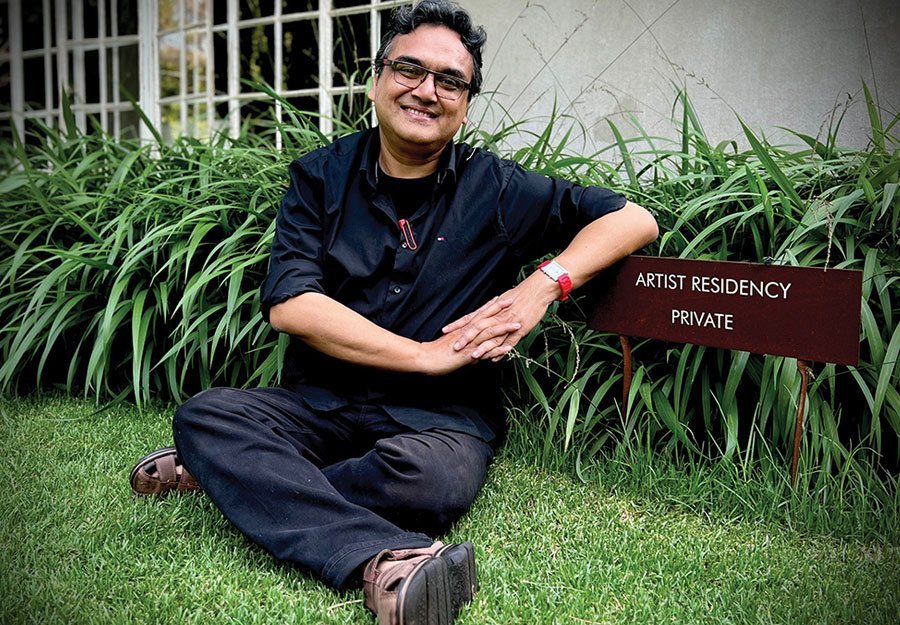

It was early morning, and the air was heavy and humid in Auroville, Pondicherry. In the distance, the gilded Matrimandir radiated an unmatched spiritual aura. The banyan trees were still, the parrots frolicked in the bluest skies and I waited for the poet Sudeep Sen. Over the years I’ve journeyed through Sen’s map of poems—one that has eventually led me to an insulated place of self-discovery, recognition and beauty. The rush of a literary festival was ahead of us—dressed in a typical black kurta and white pyjama, Sudeep Sen cheerfully made himself comfortable on a bench. Two poets, two Bengalis—our conversation started with food, Durga Puja, the Bengali love for an afternoon sleep, and then words, rhythms and poetry began to flow.
I thought it would be rather intimidating to talk to a poet with a thirty-three-year career; one who has edited influential anthologies; was mentored by Nobel Laureates like Derek Walcott and Joseph Brodsky; offered poems to a polarised world in times of crises; and usually writes highly objective, technical, sharp and minimalist poetry. But Sen was cheerfully conversational and inquisitive. He dealt with the intense monsoon heat with a sense of humour. The banyan tree under which we sat reminded him of his childhood home in Bankura, West Bengal. Sen recounted his youth in New Delhi and how the city enhanced his artistic perception. In many of his interviews, Sen describes his commitment to poetry as a “mental disease”—readers would agree that it is rather a mental verve. I requested Sen read the poem ‘Kali in (Double) Ottava Rima’, which to me is an exquisite example of Sen’s devotion to the goddesses without losing attention to the craft of poetry.
More from Mekong Review
-

A poem from Prerna Kalbag
-

Poetry from David Chandler
-
A poem by Aiden Heung
- Tags: India, Issue 34, Jhilam Chattaraj, Poetry, Sudeep Sen