

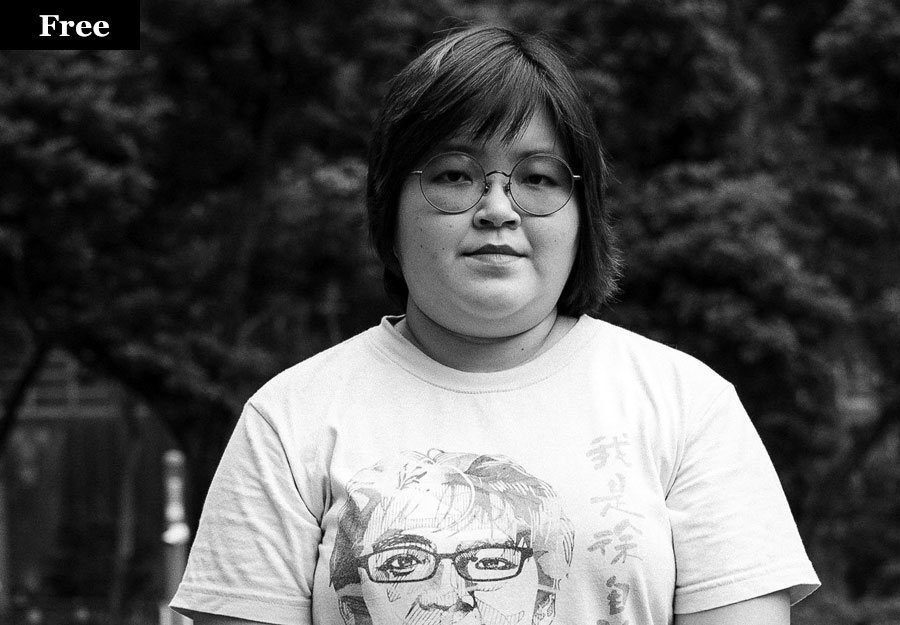
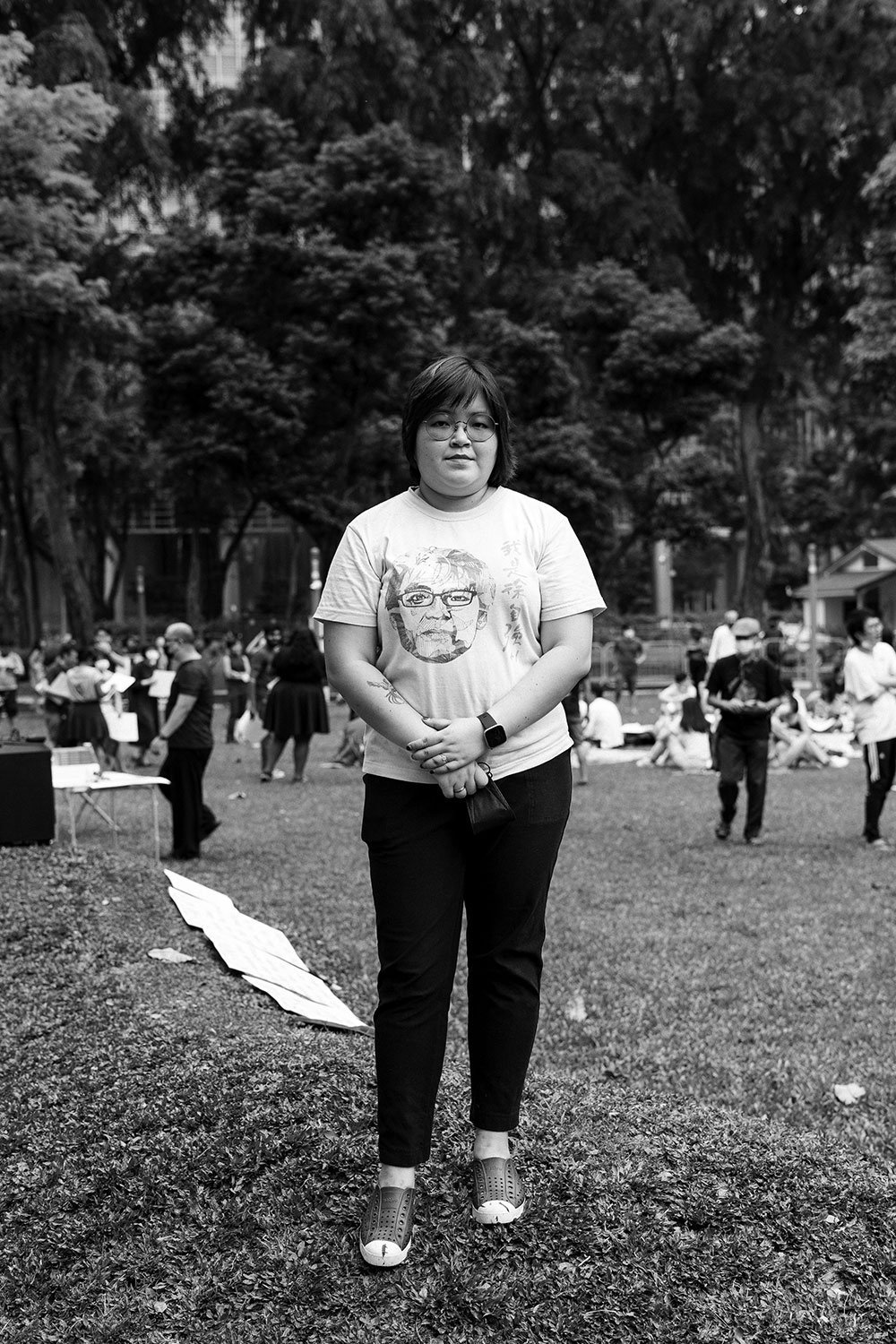
At a Starbucks in Plaza Singapura mall, Kirsten Han and Nazira Lajim Hertslet sit down at a sunlit outdoor table. Despite the buzz of shoppers all around them, their discussion is not a light one. Nazira is the sister of a sixty-two-year-old death row inmate, Nazeri. Han has asked to meet to discuss how much campaigning by the anti-death penalty advocacy group Transformative Justice Collective (TJC) the family is comfortable with, because public calls to abolish executions in Singapore often risk backlash—from online conservatives, but also from relatives concerned about taint-by-association.
Han’s attention to consent is largely a formality. Nazeri has already been part of a publicised effort by twenty-two inmates to pursue legal action against the Attorney-General’s Chambers for obtaining private letters between death row inmates and their lawyers and family members. Furthermore, TJC has already helped Nazira craft a letter to President Halimah Yacob, appealing for her to consider Nazeri’s poverty and addiction problems, and grant him clemency on humanitarian grounds.
Later, as I accompany the women on their twenty-minute walk to the Istana—so Nazira can personally deliver her letter to the president’s office—Han gently tempers her hopes, saying TJC has helped numerous inmates with little success; no president has reversed a hanging since 1998. Nazeri’s chances are slim.
‘I’ve accompanied so many sisters—it’s always the sisters—who often shoulder the bulk of the emotional burden,’ Han says. Her job as an activist is as much about offering solace to those dreading an imminent execution as it is about lobbying for institutional reform. Watching the two women I reflect on the dissonance between their mission and the retail spaceship we’ve just left. As one writer put it, Singapore is ‘Disneyland with the death penalty’.
Han, thirty-four, is a quintessential Singaporean with a quintessentially un-Singaporean upbringing. Her father and mother were musicians with the Singapore Symphony Orchestra—dad was principal french horn player and mum a second violinist. Neither held the typical Asian parent’s wish that their kids should strive for academic excellence and pursue the most pragmatic path towards a stable career.
As young children, Han and her younger brother often stayed at their maternal grandmother’s home because of their parents’ irregular concert schedules. ‘My grandma wanted us to follow in our parents’ footsteps, because she had this idea that classical musicians were guai haizi (good kids). But later my mum told me that’s ’cause Popo had no idea what sorts of things went on in the Singapore Youth Orchestra!’ Han recounts this anecdote with a laugh, but the impression she gives is of parents who were not ‘naughty’, but who espoused independence in an unusually laid-back way. They let their children choose what schools to attend, what subjects to pursue. When Han expressed a desire to veer from the more academic A Levels to study animation and digital arts at Nanyang Polytechnic her parents were unfazed.
‘My mum could see I was struggling and said, “You eventually need to get a degree anyway, right? So why don’t we just cut short this poly business and skip to the degree part.”’
Han knows she’s lucky to have parents who were supportive and could afford to send her to film school at the Waikato Institute of Technology and the University of Wellington in New Zealand. Han was vindicated when she graduated with honours in 2009, earlier than her former peers at Nanyang. She also completed a masters in journalism at Cardiff University in the UK, in 2013.
I asked whether her time in New Zealand had shaped her political consciousness. Her reply is that it did—but only in the minutest of ways. Citing Peter Jackson’s Lord of the Rings movies, Han says many of her university teachers, themselves practising filmmakers, had qualms about the way those movies affected the country’s film output. There were ‘protests that Hollywood money did not translate to fair pay for local actors and production workers. Yet demand for fairer pay also led to sequels being shot outside of New Zealand. All this did not strike me as political at the time. Now, of course, I can see they were labour rights issues, and maybe there was a difference between what the establishment wanted and what people on the ground wanted.’
Han says this ‘not seeing many issues as political’ could be ascribed to the fact that her family rarely talked about politics, and that she grew up in a largely depoliticised country. Since the country’s independence in 1965, Singapore’s People’s Action Party (PAP) has consolidated its rule by emphasising the importance of trade while curbing the messier traits of democracy. Before university, Han never once saw her parents vote in a general election, since the PAP’s two-pronged tactic of suing rival candidates for libel and gerrymandering electoral boundaries led to the suppression of opposition parties and election walkovers. Successive generations of leaders also enacted draconian laws that neutered the media, curtailed civil society and punished vocal critics. Han would later prove to be one of those critics.
Shortly before graduation, Han discovered a website by the filmmaker Martyn See called Singapore Rebel. Some of Singapore’s foundational myths—about meritocracy, equality and justice—began to lift. ‘On Singapore Rebel, I learned about historical events I’d never heard about before, or which had been whitewashed in our school textbooks,’ she says. These events included 1963’s Operation Coldstore and 1988’s Operation Spectrum, when more than a hundred people deemed enemies of the state—politicians, lawyers, unionists, students, artists, even Catholics—were accused of being communists and detained without trial, often for years.
This political awakening coincided with Han’s first two working gigs: first as a freelance reporter covering death penalty cases for Online Citizen; and second as a production assistant for a local company servicing Al Jazeera documentaries, including one about the Malaysian drug mule and death row inmate Yong Vui Kong. The combination of reporting and interaction with Yong’s working-class family coalesced into her first venture as an anti-death penalty activist.
Yong’s case proved seminal both for Singapore’s criminal justice system—his sentence was revised to life imprisonment and caning after a judicial review removed the mandatory death sentence for certain drug offences—and for Han’s personal and professional evolution. As in so many of her subsequent cases, Han never met the inmate, who could be visited only by an approved lawyer and designated relatives. With every case, she has learned more and more about the ‘administrative cruelties’ of the death penalty. With every case, she has bonded with friends and family of the condemned and seen problems that go beyond inmates’ poor decisions: all have been from impoverished or dysfunctional backgrounds.
Han recounts the experience of seeing Yong—abused as a child in rural Sabah and just nineteen when he was arrested for smuggling heroin into Singapore—‘sitting uncomprehendingly in court as lawyers argued over his life in a language he didn’t understand, like it was all an academic puzzle’. For Han, this was to confront the legal quagmire of the death penalty, not to see fully its human cost. The fact that Yong was Han’s age, yet enjoyed none of her privileges, evoked a sense of injustice and empathy that has lasted. Since the campaign for Yong in 2010, Han has written hundreds of articles, advocated for more than twenty death row inmates and liaised with countless relatives. She has also sustained friendships with a few of them, including the sister of Kho Jabing, a migrant worker hanged in 2016 for beating and killing a construction labourer while drunk.
When, more than once, I press her to discuss her thoughts about the victims of killers such as Kho, Han emphasises the distinction she makes between what she feels and what she condones. ‘I sympathise! If my family member were murdered, I would probably also be baying for blood, consumed with anger and grief. But it shouldn’t follow that if I want the murderer to die, the legal system obliges. There must be some sort of limit, to save us from our worst impulses of revenge. To me the administrative implementation of the death penalty isn’t any less depraved than premeditated murder. It is premeditated murder.’
These days, Han’s abolitionist position on the death penalty is girded by a much broader understanding of how the state maintains and expands its power. Her willingness to criticise laws she views as regressive or unjust within a climate of growing authoritarianism has repeatedly placed her in the crosshairs of powerful figures. In 2018, she testified in parliament against the Prevention from Online Falsehoods and Manipulation Act, a law she argued could be exploited to target government critics or, for that matter, silence journalists writing about the death penalty and other sensitive issues. Her articles on the topic provoked the ire of Singapore’s ambassador to the US, who accused her in a letter to the New York Times of falsely painting Singapore as an ‘authoritarian paradise’. In 2019, as part of another push to expand the state’s arsenal with the Foreign Interference (Countermeasures) Act (FICA), K. Shanmugam, the law minister, insinuated that Han had urged external actors to interfere with local politics.
This dog-whistling has occasionally taken a toll on Han’s emotional well-being. She has sometimes ‘succumbed to paranoia’ and confronted the spectre that she might be arrested under FICA or some other broadly defined law. She has also wondered if her work has caused her husband, a freelance foreign correspondent, to be denied an employment pass in Singapore. Since 2014, they’ve had to travel in and out of the country on tourist visas to spend time with each other. ‘Sometimes my husband and I ask ourselves, why do we do this? There must be a less stressful and tiring way of living.’ However, a refusal not to let inmates and their families down has always trumped her own misgivings.
As our interview draws to a close, I note the tattoo on the inside of Han’s right wrist, a pictogram of the Chinese phrase jia you, which literally means ‘fuel up’. It serves as a permanent reminder for her to recharge, gather herself and keep fighting the good fight.

More from Mekong Review
-

Ducky Tse was an established photographer in Hong Kong when, at the age of fifty, he decided to uproot and relocate to Taiwan. He bought a van and refurbished it, driving it around the country. Through his photographs, he reflects on a new chapter of his life.
-
The taste of home
-
There is only one place to eat this
- Tags: Issue 27, Ken Kwek, Kirsten Han, Singapore