


In the six months since Ho Chi Minh City slid into a stringent 12-week lockdown, the city’s vaccination programme has gone from a standing start to 99 per cent of adults having received at least one dose, according to the National Centre for Covid-19 Prevention and Control. This is a remarkable achievement and one from which many in the city are benefiting. Life here now resembles something like a ‘new normal’ (bình thường mới). Many inner-city dwellers have already received a booster jab or have registered with their ward official for the top-up shot and expect to be called forward imminently. With two and increasingly three jabs in their arms, residents have returned to coffee shops, markets and dine-in eateries in droves. Back in July, the central pedestrian thoroughfare of Nguyễn Huệ, normally crowded with locals parading pet dogs, enjoying street snacks and watching amateur performers, grew deserted and eerie as lockdown approached. Apart from a roving health authority vehicle reminding small groups not to congregate and to wear their masks properly, the traffic was gone. Sellers of bánh tráng nướng (grilled rice paper) had abandoned their usual spots on the boulevard’s side streets. Everything was quiet.
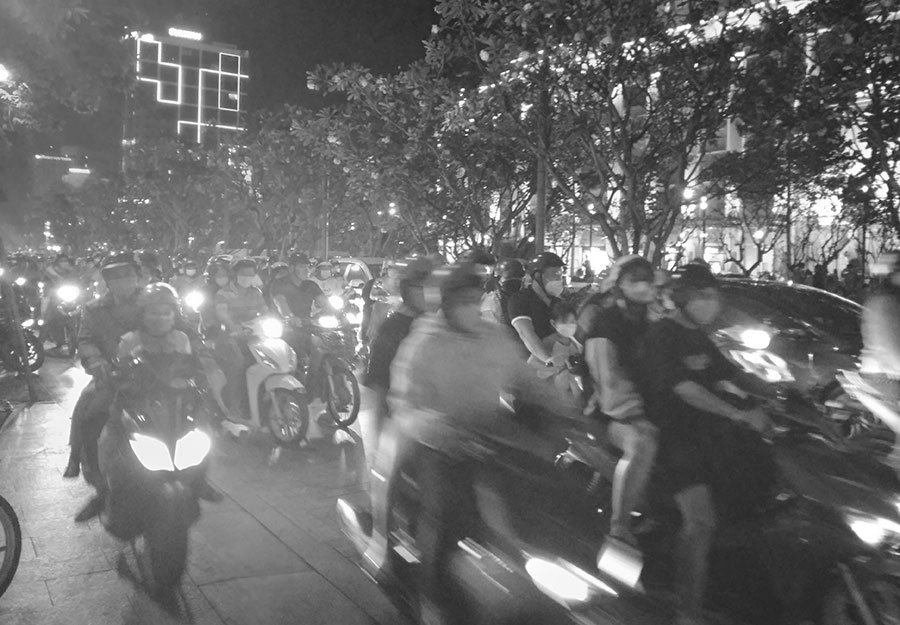
On Christmas Eve, however, Nguyễn Huệ was once again packed with families, couples and friends on motorcycles out to see and be seen. Revellers chattered excitedly and dance music boomed out from a busy rooftop bar. After so long stuck indoors, everyone wanted to have the same noisy, chaotic fun they would enjoy in any normal year. The public address system explaining how to download the official Covid-19 app was drowned out by this din and the revving of engines as hundreds of scooters inched forwards in the scrum. Notably absent were the European and US tourists who would usually have stepped out of nearby hotels to join the festivities. Vietnam aims to welcome such travellers back in 2022, but uncertainty remains around when international visitors will be able to enter the country in anything like the numbers typical before the pandemic.
Nowhere are the effects of the moratorium on foreign visitors more visible than in the backpacker enclave of Phạm Ngũ Lão. Every other commercial unit is for rent or for sale. Utility companies’ final demands for payment are stapled to the door handles of premises that have clearly been shuttered for many months. And the once ubiquitous backpackers are, of course, nowhere to be seen. Alongside the signs of economic decline, however, are several new businesses catering to the immediate needs of Saigon’s post-lockdown population. A vast former sports bar occupying a prominent position on the junction of Đề Thám and Bùi Viện Streets has taken on a new function as a fruit and vegetable market. An ex-nightclub further up Bùi Viện Street now sells bags of rice, cleaning products and other household supplies from green plastic crates. Some Vietnamese friends say they sometimes come to the remaining bars and cafes to socialise though, now that prices are lower, and fresh Christmas and new year decorations suggest several venues expected locals over the festive period.
Tiếp tục sống thôi (‘life goes on’) is a popular saying among friends catching up in post-lockdown Ho Chi Minh City. This phrase reflects the pragmatic mood in the city as restrictions ease and people begin to resume their usual activities. It also acknowledges a shift in official rhetoric that has taken place since Vietnam dropped its Covid zero policy in the wake of rocketing cases during the fourth wave. Banners advocating ‘living safely with the virus’ (sống chung an toàn với dịch) can be seen on public buildings, in parks and on digital ad boards. Vietnam recently took on Thailand in the recent semi-finals of the Asian football cup. There were relaxed scenes in cafes and bars citywide. When I asked my fellow viewers whether they were still scared of Covid-19, all of them said no. Several had neighbours or family members who had been infected, isolated themselves and lived to tell the tale. By using masks and disinfectant and getting inoculated when invited, these fans felt they would be able to protect themselves from the virus while going about their daily business.
The Ministry of Health’s long-running 5K campaign, which encourages citizens to adopt behaviours that limit viral spread, remains core to official messaging around the virus. However, the recently launched 5T drive updates the messages for the ‘new normal’ era. The campaign urges citizens to follow strictly the original 5Ks guidance around wearing a face mask, using disinfectant, making health declarations, not gathering in groups and keeping a safe distance from others and furthermore to keep only as much food as necessary at home, to call on the doctor for a home visit and to get vaccinated in the local ward/commune, and it advises that everyone should test for Covid-19. The second of these commands aims to combat the hoarding seen earlier in the pandemic, while the third seeks to prevent regular hospitals and temporary Covid-19 field hospitals from being overloaded.
So what does ‘living safely with the virus’ look like day to day? For one thing, Ho Chi Minh City’s streets have become much busier over December. This could be because migrant workers who were double jabbed in their home provinces have now returned to the city. Many fell on hard times during the long lockdown and fled Saigon en masse several months ago: in October, city leaders estimated that fully 40 per cent of the city’s workforce was absent and urged migrant labourers to come back. While some may be waiting until after early February’s lunar new year celebrations, the roads already feel busier here than a month ago. As more traffic is about, larger crowds now build up at red traffic lights. Take a glance at the scooters either side of you, and you will notice disinfectant sprays clipped to the knee panels where you would usually see cups of sugar-cane juice or coffee hanging. That almost everyone is wearing a mask is nothing new: many commuters already wore them before the pandemic due to the city’s high levels of air pollution. These days other forms of personal protective equipment such as shields that attach to the wearer’s face via a pair of plastic glasses can also be picked up at roadside stalls. The city’s ever-enterprising street sellers have diversified their offerings to match the ‘new normal’ consumption patterns of city dwellers.

Shopping in conventional neighbourhood stores has also changed as proprietors have adjusted their premises and their sales processes to protect staff and customers from Covid-19. On Nguyễn Thái Bình Street in District 1, many hardware stores now have makeshift barricades to keep distance between patrons and servers. The photograph below shows one shop’s transaction system. After requesting their desired goods, customers put money in the red tray given to them by a sales representative. Staff then spray the cash with antibacterial agent and return the purchased goods and disinfected change in the green tray. It is unclear how long these measures will last but shoppers seem to understand and accept them.
Coffee shops are everywhere in Ho Chi Minh City. At my local cafe, a friend and I grabbed the last two spare seats on a midweek lunchtime. As well as Grab and Gojek delivery drivers, retired people and municipal workers enjoying some shade and refreshments following their shift’s end, some families with small children were gathered around tables inside or occupying multicoloured fold-out chairs on the pavement outside. Ho Chi Minh City schools closed in May as the fourth wave of Covid-19 swept the city. Grades 9 and 12 resumed face-to-face lessons a couple of weeks ago and grades 7, 8, 10 and 11 will return imminently. A return to the classroom is not yet planned for grades 1-6. My friend asked the mother of a young girl about their schooling, and she explained that her six-year-old daughter has online lessons with her grade 1 peers only in the afternoons, leaving the mornings free for mother and daughter to run errands in the neighbourhood together and sometimes drink iced chocolate alongside other members of their closely knit community in this busy coffee shop. She is not keen to send her daughter back to school for face-to-face learning while the virus is still circulating. Online classes are the best solution for now, she says, echoing the concerns of other worried parents I have encountered. Due to the excellent level of vaccination coverage, however, it is surely only a matter of time until all schools in Ho Chi Minh City fully reopen.
Vietnam has rolled out first, second and third vaccines with increasing speed; 1.6 million jabs were delivered across the country on just one day recently (30 December), according to data from the National Centre for Covid-19 Prevention and Control. But the fact that there is no discernible anti-vaccine movement in Vietnam doesn’t mean there has been no vaccine hesitancy. The blue banner below reads ‘The first available vaccine is the best vaccine’. These appeared around Ho Chi Minh City at the start of the city’s vaccination effort when some residents were reportedly debating the desirability of the various vaccines and considering waiting until they knew their chosen brand was available before attending a vaccination appointment.

Vietnam’s complicated relationship with China and the southern capital’s close people-to-people links with the US might have been behind citizens’ differing levels of enthusiasm for the Sinopharm and Pfizer vaccines. However, this period of deliberation seems to have passed. The aforementioned brands as well as AstraZeneca, Moderna, Johnson & Johnson and Cuba’s three shot Abdala course have been accepted by city residents who say có còn hơn không (‘anything is better than nothing’) when it comes to the different levels of protection that the various vaccine types offer. As the booster programme rolls out citywide, these debates aren’t being re-run. Much as they have adapted rapidly to the ‘new normal’ ways of living in a crowded megacity, the city’s residents have proven pragmatic when it comes to protecting themselves from the virus. As in European and North American countries, various vaccines have been used in combination with each other depending on supply.
At this point, just a handful of cases of the omicron mutant, all apparently imported, have been detected in Vietnam—in Hanoi and Quảng Nam province. Five infections were suspected in Ho Chi Minh City, but genome sequencing by the Pasteur Institute later ruled out the omicron strain. Cases are almost certainly already more widespread than this though and are likely to be under-reported due to the apparently relatively mild symptoms that an omicron infection brings. Vietnam’s health authorities can learn lessons by observing omicron’s behaviour in nations like the UK and France, which accounts for the bulk of new Covid-19 cases in these countries, whereas delta is still the pervasive strain in Vietnam. While another citywide lockdown in Ho Chi Minh City seems unlikely, the metal barricades used to seal alleys, squares and highways for several months last year have not completely vanished from public view. Rather they have been partially absorbed into the ephemera that clutters any city footpath. In my working-class neighbourhood, two of these barricades have been rearranged to demarcate a grimy bit of pavement piled high with garbage from the local market from the area close to two ladies selling street food. Some function as al fresco clothes drying racks and others have ads for fresh seafood purchasable via Zalo instant messenger slapped on them and even live chickens tied to them. These defunct pieces of street furniture could be restored as bona fide blockades at short notice if coronavirus cases escalate in Saigon once again. But for now, everyone seems to be enjoying the ‘new normal’ and the calm before any omicron storm.

More from Mekong Review
-

Inspired by the portraits of the deceased
-
Vietnam as seen from above and below
-
Readers respond to our review of Ken Burns and Lynn Novick’s The Vietnam War
- Tags: COVID-19, Free to read, Note, Rachel Tough, Vietnam
