


Balancing on the stairs of her stilt house at the edge of the Can Gio forest, Sang Thi Phung pulled on rubber boots. It was a rare moment when the 39-year-old wasn’t barefoot.
‘Here it’s a few steps back and forth and that’s the end of the land. I only put on slippers when coming back to the mainland,’ Sang said.
Sang’s home is a forest guard station on the bank of a river that runs through Can Gio, a large mangrove forest and Unesco biosphere located some 40 kilometre southeast of Ho Chi Minh City.
Her feet were darkened by dried clay (clean water is scarce at the guard station and visits from outsiders rare). The rainwater she and her husband collect in plastic barrels is barely enough for their daily needs.
Sang headed out to the sampan tethered in front of the house, waiting for a phone call. An old-model Nokia dangled from the sampan roof, which is the only spot that gets a signal. In front of the boat lies a vastness of rivers that cut through the seemingly endless 30,000 hectares of mangroves. On this windless morning, nature had become very quiet.
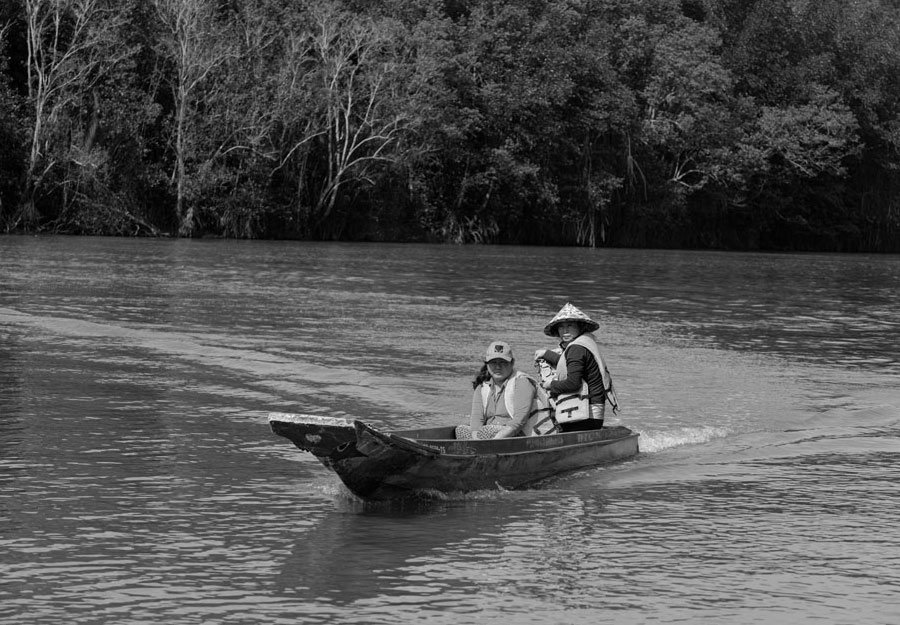
Eight a.m., no one had called, which meant everything went as planned. As the familiar sound of a long-tail boat grew louder, Sang spotted the garish pink nón lá (Vietnamese hat) of her fellow guard, 42-year-old Lan Thi Truong, across the silver stream. Lan, who leads the self-governing group of forest protectors in Can Gio, and Sang were meeting to welcome a new co-worker, a third woman who would join them in their work as forest guards.
Though all three grew up near the river, none know how to swim, and so they carefully put on life jackets. The water had risen above the mangrove roots, making it a suitable time for the women to start their patrol. They manoeuvred the long-tail boat along the forest edge, snaking their way through each small canal, as the day slipped away. Once the boat was tethered and headlamps were strapped to their heads, the three women started wading into the forest’s core.
‘It’s quite scary to patrol in the forest alone, so we ask each other to go together,’ said Sang. ‘Men are stronger so they could go faster. We women go slower so if we can’t finish in a day, we’ll continue the next day, making sure that no plot is skipped.’
Spreading across 2,000 square kilometres, Ho Chi Minh City is known for its relentless construction and lack of green space. Under the circumstances, the Can Gio mangrove—one of the last green spaces—plays a role in the vitality and survival of the city.
The forest is sometimes referred to as the green lungs of the city, but it does more than provide fresh air. The mangroves form a shield that protects nearly 9 million residents from typhoons that roll over the South China Sea. They also serve as a kidney, filtering waste water from the industrial complexes in the city and neighbouring areas.
With Ho Chi Minh City sinking by the year due to rising sea levels, the Can Gio forest has never more vital than today.
But a $9 billion development, backed by Vietnam’s largest conglomerate Vingroup, approved by the government last year has scientists and environmentalists concerned. The 2,870-hectare Can Gio ‘sea encroachment tourist urban area’ project would reportedly be built on reclaimed land. A petition sent to the government by two dozen environmentalists, scientists and organisations warned of a potential ecological collapse in the area caused by the project. The city government has defended the project, noting that it will help the district’s development and bring about job opportunities for the locals.

After applying red lipstick and foundation to her face, Lan set a floral nón lá on her head. She was ready to begin her forest patrol.
‘Even if all I see the whole day are just trees and trees, I still have to look beautiful. Living in this vast forest, what else but doing make-up could bring us amusement?’ she said, tightening her grip on the steering pole as the boat sped up.
The mangrove forest has a long history written by mothers, wives and daughters. Lan, like other second-generation guards, began following her parents into the forest when she was a child. The families brought their children with them, teaching them a life that was isolated from the city. While her brothers after growing up found their way back to the mainland and a new type of city life, Lan stayed in the forest.
Today, Lan lives with her husband and some of their children. Her older children couldn’t stand the difficulties of forest life and moved to the city to become workers. She said her children didn’t want to stay amid the many challenges. To use clean water, the family must count every single drop. On cloudy days, there is no way to charge batteries as the electricity comes only from solar panel. At night, it is hard to ignore the twinkling of the millions of lights in the city, while they depend solely on the flame of an oil lamp flame that flickers in the surrounding darkness.
She understands her children’s desire to leave. In her 20s, Lan frequently thought about quitting her job. She wondered ‘Why are those living in the mainland who are my age happier than I am? They have friends to have coffee with and electricity for watching movies; while here I am, my whole day passing with no one else but my own self and this forest.’
But these days Lan has little doubt that she will continue guarding the forest as long as she can.
‘It’s like getting married to someone. Years of living with the forest have deepened my love and compassion for it. If something bad happens to it, I’d feel hurt, too,’ Lan said.
As Lan spoke, she expertly rowed the sampan to the mainland, then put on her slippers. She strolled around the market, on cement roads filled with honking motorbikes and chaotic traffic, heading toward her parents’ home. In the distance were the sounds of laughter and someone singing a cải lương [Vietnamese opera] song. Just a few hours later, she was ready to return home.
‘I’m too used to being in the forest. Travelling even just a bit further out of it feels strange,’ Lan explained, as she headed back to her sampan. She said she hopes to stay on as a forest guard until retirement.
‘First, it’s my parents, then it’s my husband and I, we have buried all of our younger years here to take care of and to protect it. Our life has been to nowhere else, but only here, in it.’

One day in the rainy season of 1978, in a swamp so barren that it was hard to spot even a single mangrove, Lan’s mother, Nguyen Thi Don, planted an avicennia seedling that had been carried over from Vietnam’s southern tip.
Like other forests in Vietnam, nearly 40,000 hectares of flora in Can Gio had been wiped out by defoliants sprayed by the US between 1961 and 1971. The forest died. Without the protective mangroves, salinity crept in from the sea, reaching the south of the city. In other areas, the forest loss led to landslides, according to reports by the non-governmental Ho Chi Minh City Union of Science and Technology Associations. In 1978, three years after taking over the southern capital, the Ho Chi Minh City People’s Committee passed a decree to restore the biosystem of the Can Gio mangrove forest.
A labour force mobilisation for replanting the forest followed, employing locals, youth and re-education prisoners. Five hundred residents of Can Gio, mostly women and children, registered to join the replanting. Both Sang’s and Lan’s parents belong to this pioneering generation.
As perceived by the city governors at the time, replanting the Can Gio forest was an urgent action for the nation’s post-war revival. To the women of Can Gio, replanting the forest was an opportunity to earn some extra money to buy rice to feed their children.
At that time, recounted Don, ‘Everyone was destitute and no one had enough rice to eat’.
‘In the past, men here went to the sea and fished, women mainly stayed at home to take care of children. When the city called for reforestation, we were excited because we could earn money and bring our children with us.’
Decades later, the 30-hectare forest represents a miracle. In the early 1970s, US biologists estimated that it would take ‘100 years to restore the biosystem of Can Gio mangrove forest’, said Cuong Dinh Nguyen, the former head of the Ho Chi Minh City Forest Service.
‘This would be impossible without the women of Can Gio. Three or four men working in a day could not reach the productivity gained by a single woman,’ he said.
Hai Minh Nguyen, the former director of Duyen Hai Forestry and a member of the Can Gio board of management, still remembers images of women in nón lá, bent over, pressing mangrove seedlings into the mud.
‘After a few days, the management board soon realised that it’s their petite physique that helped women wade through mud faster than men. That’s why they had higher productivity. The forest was replanted mainly by women,’ he said.
Those who planted the forest had to do so around the phases of the tide, working day and night, rain or shine. They ate rice mixed with sorghum, waded through mud that reached their thighs, cut their legs on thorns. Even when the trees matured, many of the planters decided to stay to protect the trees against illegal logging. In 2000, the Can Gio forest was inscribed as a World Biosphere Reserve by Unesco.

More from Mekong Review
-

Inspired by the portraits of the deceased
-

The monsoon is the most poetic of seasons
-
Sand, once inexhaustible, is disappearing faster than ever
- Tags: Free to read, Notebook, Vietnam, Vo Kieu Bao Uyen
