

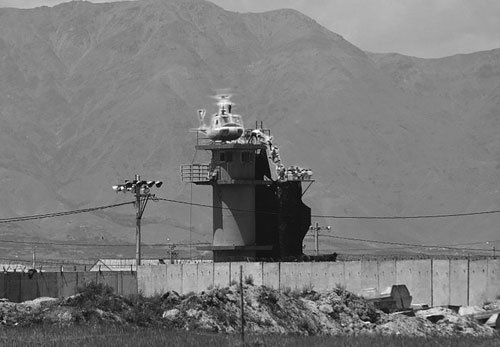

On Friday, 2 July, the last US aircraft departed Bagram Airfield, the largest US military base in Afghanistan.
The Americans departed with little notice or ceremony, perhaps concerned that what many perceive as abandonment of their Afghan allies might attract the kind of insider attack that plagued international forces during the height of the war around 2010. At the time of writing, only US, British and Turkish troops remained in the country. The final 80 Australian troops, the majority of whom had been providing military officer training at a base on the outskirts of Kabul, departed before the end of June.
Outside the fortified compounds of Kabul and Bagram, Afghan security forces have been routed in recent weeks by an ascendant Taliban.
In April, US President Biden announced the country’s final military withdrawal would begin 1 May. Since then, more than 100 of Afghanistan’s approximately 400 district centres have fallen under the control of the insurgents. The figures are especially concerning for the Afghan government because of the way that control has at times been ceded. There have been numerous reported instances of Afghan government forces—often besieged and out of ammunition, food and water—surrendering. With the surrenders come weapons, ammunition and fleets of armoured vehicles.
While government special forces have wrested back a handful of the districts, military momentum is undoubtedly in the Taliban’s favour. The majority of territory overrun by the insurgents has not been in the country’s south, where the movement began in the 1990s, however, but in the north, where the strongest resistance came during their reign between 1996 and 2001 and from where the US departments of State and Defense sourced the majority of their anti-Taliban allies after the 2001 invasion.
Peace talks between the Afghan government and the Taliban, the beginning of which, the US claimed, was required in order to ensure the withdrawal of international forces, have gone nowhere. Moreover, Kabul, now almost entirely bereft of US military support, has little leverage with which to pressure the Taliban at the increasingly irrelevant negotiating table.
And so, once again, Afghanistan is left in a state of deep distress amid the actions of a foreign power. Fifty kilometres north of Kabul, Bagram Airfield speaks to this tragic history repeating itself.
BAF, as it is known to service men and women, was the nerve centre of US special forces-led counter-terrorism operations in Afghanistan and across the border in Pakisan’s Federally Administered Tribal Areas. The prison housed within became synonymous with the abuse and torture of Taliban detainees and those from transnational terror groups by US military and intelligence agencies.
Razed during the Afghan civil war of the 1990s, the base was rebuilt by the US military following the attacks of 11 September 2001. But the base is far older: it was originally established by the Soviet Army in the 1950s.

More from Mekong Review
-
Pakistan's mountainous north
-

Afghan women and the pain of losing of their country
-

Disillusioned with the jihad, Asad started a bookshop
- Tags: Afghanistan, Andrew Quilty, Free to read, Notebook
