


In April last year, having successfully warded off the coronavirus threat, Taiwan launched #TaiwanCanHelp. The campaign donated face masks, protective clothing and other medical equipment to countries where the pandemic was swiftly spreading.
A little over a year later, Taiwan was unexpectedly confronted with an outbreak of its own. Paradoxically, its previous success (under 1,200 confirmed cases out of a population of 23 million) had become a liability, with people making the calculation that the risks of infection were lower than those of side effects from vaccination. As such, when the crisis exploded in May of this year, the majority of Taiwanese were left unprotected, and the island found itself facing a vaccine shortage. To make matters worse, the government’s attempts to purchase vaccines produced by Germany-based BioNTech was repeatedly frustrated because PRC-based drug company Fosun Pharma claimed to have exclusive rights to distribute the vaccine in Greater China, including Taiwan. At the same time, pro-China politicians in Taiwan took advantage of the crisis to agitate for the authorised use of the Chinese Sinovac and Sinopharm vaccines, sowing further public vaccine scepticism and distrust.
Taiwan’s sudden vaccine crisis triggered a round of international relief efforts. On June 4, the Japanese government donated 1.2 million doses to Taiwan, the largest ready-to-use stockpile in the international market. Two days later, a United States Air Force carrier transported three US senators and 750,000 doses of vaccine to Taipei airport, the first batch of vaccines that the Biden administration had delivered anywhere outside the US. On June 21, another US apply arrived, increasing the size of their donation to 2.5 million doses. Two days later, Taiwan received further unanticipated help from the Baltic nation Lithuania, which announced a donation of 20,000 doses.
That Taiwan suddenly found itself a beneficiary of global charity was certainly a humbling lesson after having basked in its previous success. Yet, the experience also showed that international aid-giving still follows the logic of mutual aid. Taiwan was the largest source of international donations to the 2011 Tohoku earthquake and the Fukushima nuclear disaster, which resulted in overwhelming support among the Japanese public for its government aid to Taiwan. A Lithuanian minister also acknowledged that their donation was reciprocating Taiwan’s gift of face masks last year.
While Taiwan is basking in the timely international benevolence, with predictable umbrage from China, whether the democratic island deserved such largesse remains a valid question. Taiwan, the seventh largest economy in Asia, is obviously not impoverished and could afford to buy vaccines on the international market. This was an issue not of cost, but of access. In addition, even at the height of the current wave, Taiwan recorded only around 500 cases and two dozen deaths per day, low by international standards.
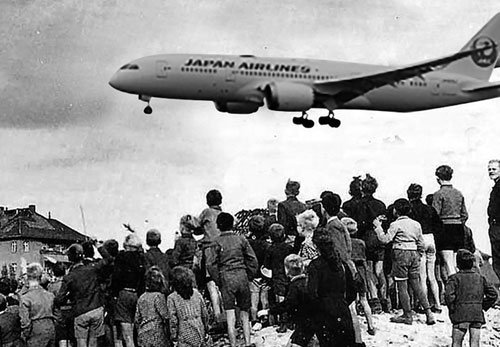
Taiwan was able to receive such disproportionate global attention precisely because the island sits at the frontline of a new cold war. The international vaccine airlift was reminiscent of the Berlin Blockade of 1948-1949, in which the Soviet Union imposed a blockade on roads into West Berlin, which sat behind the Iron Curtain, triggering a yearlong effort to airlift supplies from the West. In hindsight, the Soviet Union made a consequential mistake by deciding to hold West Berlin hostage. West Germany and its allies were not intimidated by the threat, and the country subsequently emerged as the economic powerhouse of continental Europe.
The stakes with Taiwan are disproportionately higher than its size and population. Similarly, the Hong Kong pro-democracy protest movement of 2019, which received global attention eclipsing that of the so-called Arab Spring 2.0 protests of 2018-2020 or the Chilean protest movement in the same period.
Both Taiwan and Hong Kong are emerging as flashpoints of what many are calling a new cold war precisely because the cities lie in the ‘engagement zone’ of rival geopolitical powers. As a result, vaccine-starved Taiwan becomes the prime recipient of international aid not because of the severity of its health crisis, but rather due to its geopolitical value. Time will tell whether this democratic island will be able to get back on its feet and be prepared to face the challenges ahead.

More from Mekong Review
-
Pakistan's mountainous north
-
Photographer Yvan Cohen in Bangkok's disappearing Chinatown
-

After 20 years, America is leaving
- Tags: Free to read, Ming-sho Ho, Notebook, Taiwan
